
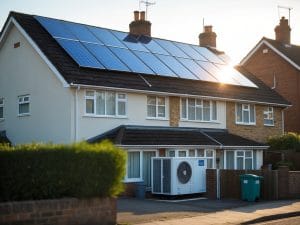
Multi-million pound Social Housing Decarbonisation Fund project delivers insulation, solar panels and heat pumps to cut tenant bills and carbon emissions across the district.
Folkestone & Hythe District Council has completed a major energy efficiency programme that upgraded 463 council homes with insulation, solar panels, air source heat pumps and new glazing. The figures show this represents one of the largest social housing retrofit projects in Kent, funded through a combination of central government grants and council match funding totalling £4 million.
The data reveals the project delivered improvements in two distinct phases. Wave 1 targeted 125 properties and achieved annual carbon dioxide reductions of nearly 295 tonnes – equivalent to taking around 64 average cars off the road for a year. Phase two expanded the programme with contractor Aran Group upgrading over 200 additional homes to bring the total to 463 properties.
The council’s announcement follows completion of Wave 2.1 of the Social Housing Decarbonisation Fund (SHDF), a national programme launched by the Department for Levelling Up, Housing and Communities to improve energy efficiency in social housing. Folkestone & Hythe secured its allocation in 2023-2024, with delivery extending through 2025.
Project Delivers Measurable Results
According to council figures, the first phase alone prevented 295 tonnes of CO2 emissions annually from just 125 homes. Scaling this across all 463 upgraded properties suggests potential annual savings of over 1,000 tonnes of carbon dioxide – though the council hasn’t yet published full data for the full programme.
All work was completed to PAS2030:2019 standards and verified by independent Retrofit Coordinators, ensuring quality and compliance with national retrofit guidelines. The Aran Group case study confirms 100% of their installations met these technical requirements.
The project focused particularly on older housing stock in areas with higher levels of deprivation, including properties in Folkestone East, Hythe, and Sandgate & West Folkestone wards where fuel poverty affects many households.
Council Highlights Tenant Benefits
The authority argues the upgrades will deliver significant benefits for residents through reduced energy bills and improved comfort. Homes fitted with air source heat pumps and enhanced insulation should stay warmer in winter and cooler in summer, whilst solar panels will cut electricity costs.
The project aligns with the council’s net zero ambitions and contributes to national targets under the Social Housing Decarbonisation Strategy. Officials point to the measurable emission reductions already achieved and the programme’s role in supporting local employment through contractors like Aran Group.
But the scale of bill savings for individual tenants remains unclear. The council hasn’t published specific figures on expected annual savings per household, making it difficult for residents to gauge the financial impact.
Limited Opposition to Retrofit Programme
Unlike many council initiatives, the energy efficiency programme appears to have generated minimal public objection. Council records show no significant opposition during the planning or delivery phases, with disruption during installation described as manageable.
The lack of controversy likely reflects the programme’s focus on improving existing homes rather than new development, and the absence of costs for tenants. All work was funded through the government grant and council contributions, with no charges passed to residents.
However, some residents may have experienced temporary inconvenience during installation of heat pumps and insulation work, though the council reports these issues were resolved through coordination with contractors.
National Context and Future Funding
The Folkestone & Hythe project forms part of a £179 million national SHDF Wave 2 programme targeting up to 20,000 homes across England. The fund represents a key element of government efforts to decarbonise social housing and tackle fuel poverty.
Yet future funding rounds remain uncertain, with no guarantee of additional SHDF allocations. This could limit the council’s ability to upgrade its remaining housing stock to similar standards.
The completion of Wave 2.1 ahead of schedule positions Folkestone & Hythe well for any future funding opportunities, with established contractor relationships and proven delivery capability.
Key Takeaways
- 463 council homes received energy efficiency upgrades including insulation, solar panels and heat pumps through £4 million government-funded programme
- Wave 1 results show 295 tonnes annual CO2 reduction from 125 homes, suggesting significant environmental benefits across full project
- All work completed to national PAS2030 standards with minimal resident disruption or public opposition
What This Means for Folkestone & Hythe Residents
Tenants in the 463 upgraded homes should start seeing lower energy bills immediately, particularly as winter heating costs typically represent the largest household energy expense. The council advises residents to monitor their bills over the coming months and contact the housing team if they don’t see expected savings or experience any maintenance issues with new equipment. For the wider district, the project demonstrates the council’s commitment to tackling climate change whilst supporting residents with cost of living pressures, though future retrofit programmes will depend on additional government funding becoming available.
Folkestone & Hythe Council Completes £4 Million Energy Upgrade Programme for 463 Council Homes Quiz
5 questions