
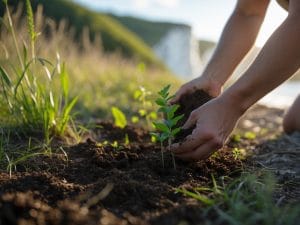
Folkestone & Hythe District Council is offering grants for projects that reduce emissions, improve climate resilience and support community cohesion.
Folkestone & Hythe District Council has announced up to £250,000 of funding for community groups, charities and small businesses looking to cut carbon emissions and strengthen local climate resilience.
The green grant programme, which runs until 31 March 2027 or until funds are exhausted, forms part of the council’s broader push to achieve zero emissions by 2030. According to council documents, the scheme aims to support projects that deliver measurable environmental benefits whilst bringing communities together.
What Projects Could Benefit
The funding covers a diverse range of environmental initiatives. Community workshops, school eco-clubs, energy-efficiency improvements and composting projects all qualify for support, according to the council’s proposals.
Nature-based projects also feature prominently. Tree planting schemes, wildflower meadow creation and micro-rewilding initiatives could receive backing under the programme.
But there’s a catch. Grants cover up to 80% of total project costs, leaving applicants to find the remaining 20% through other funding sources or their own resources.
The Council’s Climate Agenda
The grant scheme sits within Folkestone & Hythe’s wider environmental strategy. The council has published a District-Wide Carbon Plan targeting emissions from road transport, residential and commercial buildings, waste management and water usage.
Climate Change Specialist James Wilderspin’s team has identified 33 specific actions to eliminate the council’s own emissions by 2030. The new grants extend this approach to community-level projects.
The council argues the programme will democratise environmental funding. Traditional grant recipients often struggle with complex application processes; this scheme aims to widen access beyond established organisations to grassroots groups and small enterprises.
Potential Challenges
Yet the 20% match-funding requirement could prove problematic. Smaller community groups often lack substantial reserves or sophisticated fundraising capabilities, potentially excluding those most in need of support.
The council hasn’t published details about application criteria, assessment timelines or appeals processes. With £250,000 available across a two-year period, oversubscription seems likely given the breadth of eligible projects.
No published opposition to the scheme has emerged, though questions remain about delivery practicalities. Will rural communities have equal access to urban areas? How will the council measure carbon reduction claims? What happens if projects fail to deliver promised outcomes?
Assessment and Delivery
Council documents suggest a practical, results-focused approach rather than symbolic gesture politics. Projects will be assessed on measurable impact, cost-effectiveness and delivery readiness.
The Economic Development team will oversee administration, working alongside climate specialists to evaluate applications. This cross-departmental approach reflects the council’s recognition that environmental and economic development goals increasingly overlap.
Cabinet members for Environment, Local Economy and Housing Assets will likely have oversight roles, though specific governance arrangements haven’t been detailed publicly.
Broader Context
as local authorities nationwide grapple with competing demands on stretched budgets. Environmental initiatives must compete with housing, social care and transport priorities.
Folkestone & Hythe’s decision to ring-fence £250,000 for community climate projects signals significant political commitment. But it also raises questions about opportunity costs – what other services might receive reduced funding to accommodate this programme?
The two-year timeframe suggests urgency. Climate scientists consistently warn that emission reductions must accelerate sharply this decade to avoid catastrophic warming.
Next Steps
Application details remain unpublished. The council promises further information about eligibility criteria, assessment processes and deadlines in coming weeks.
Community groups and small businesses interested in applying should monitor the council’s website and social media channels for updates. Early preparation could prove advantageous given likely competition for funds.
The scheme’s success will ultimately depend on uptake, delivery quality and measurable environmental outcomes. Whether £250,000 can generate meaningful carbon reductions across a district the size of Folkestone & Hythe remains to be seen.
Key Takeaways
- Up to £250,000 available for carbon-cutting community projects until March 2027
- Grants cover 80% of costs, with applicants finding remaining 20% match funding
- Wide range of projects eligible, from energy efficiency to biodiversity schemes
What This Means for Folkestone & Hythe Residents
Local community groups, charities and small businesses should start preparing project proposals now, as application details will be published soon. Those with existing environmental initiatives may find this funding helps scale up their work, whilst new groups could use grants to launch carbon-cutting projects. However, the 20% match-funding requirement means organisations should secure additional funding sources before applying, and rural communities should ensure they have equal access to information about the scheme as urban areas.
Folkestone & Hythe launches £250,000 green grant scheme for carbon-cutting community projects Quiz
5 questions