
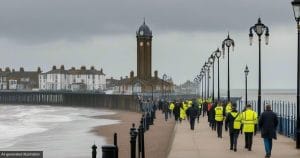
A nationalist march and a counter-protest on Herne Bay seafront on Saturday passed off peacefully: Kent Police reported no disorder and no arrests among the 180 or so people who took part. In France on the same day, nearly 1,000 people were arrested, a week after riots that the French President blamed on ultra-left groups.
Kent Police said there were “no reports of disorder and no arrests were made in Herne Bay” on Saturday 24 October, when the Kent Nationalist Movement marched along the town’s seafront and a counter-protest gathered to oppose it. The force said around 180 people attended the two events in total. It has not said how many were on each side.
The contrast could hardly be sharper. In Herne Bay, a nationalist march that its opponents call far-right passed off peacefully, with no disorder, no arrests and no injuries. In France, violence that the country’s President and Interior Minister have blamed on the ultra-left and the radical far left has left 997 police officers and gendarmes injured, a town hall burned out and more than 3,000 people arrested in two weekends.
On the same afternoon, France held its second weekend of nationwide protests in eight days. By the evening, its Interior Minister, Laurent Nuñez, was reporting nearly 1,000 arrests. The weekend before, the French Interior Ministry recorded 2,397 arrests and 997 police officers and gendarmes injured. President Emmanuel Macron blamed what he called “des factieux issus de groupuscules d’ultra-gauche, rejoints par de nombreux délinquants”: seditious elements from ultra-left groups, joined by many criminals.
What happened in Herne Bay
The march, advertised as the “End the Invasion March”, was listed for 1pm to 3pm. Marchers walked along the seafront in stormy weather carrying flags and banners, including one reading “White Lives Matter”, according to the BBC. Counter-protesters met them with chanting and drumming. A large police presence kept the two groups apart.
A Kent Police spokesperson said: “No reports of disorder and no arrests were made in Herne Bay today during a demonstration and counter-protest. A total of around 180 people attended both events, which saw a large number of specialist officers in the town.”
The group used loudhailers throughout the day to tell its marchers not to speak to journalists, the BBC reported. One marcher told the BBC he was there in solidarity “over the identity of the UK”. The organiser, Harry Hilden, declined to be interviewed. On the other side, one counter-protester told the BBC she “didn’t want Herne Bay to be associated with” anti-immigration sentiment “because it doesn’t represent the town”.
Why the organisers say they marched
The Kent Nationalist Movement describes itself on its website as “a grassroots activist pressure group”. It says it campaigns for “the closing of Asylum-Seeker Hotels, and the prevention of more HMO’s being established throughout Kent, housing illegal asylum-seeking migrants”, and against “future construction of mass housing estates”, which it calls “the Trojan Horse of the demographic change of our ethnic population”. Its strapline is: “Kent is the Garden of England, and not the home of the Third World.”
The event listing for Saturday’s march gives one line of explanation: “Join us in our fight against the Kent County Council.”
In a post earlier in the week, the group said it had put up more than 100 England flags on the High Street and seafront and handed out more than 1,500 leaflets. It explained the choice of town: Herne Bay was “one of the few that remains overwhelmingly English” in Kent. It did not point to any asylum site or incident in the town.
Mr Hilden had said before the event that the march was in opposition to mass migration, which he said “risks turning white Britons into a minority”, the BBC reported.
The MP for Herne Bay and Sandwich, Sir Roger Gale, had criticised the planned march last month, calling on residents to stay away and “treat it with the contempt it deserves”.
What the official figures show
Home Office statistics published on 27 August give the number of asylum seekers on Home Office support in each council area. In the Canterbury district, which includes Herne Bay and Whitstable, there were 205 at the end of June 2026. All but one were in dispersal accommodation: ordinary rented houses and flats, many of them shared, arranged by Home Office contractors. The other received financial support only. None were in hotels.
The figure has more than tripled in three years, from 63 in June 2023. It peaked at 227 at the end of December 2025 and has fallen in each of the two quarters since.
Across Kent and Medway, 1,060 asylum seekers were on Home Office support at the end of June. Medway had 346 and Canterbury 205, the highest of the Kent districts. Hotel use has fallen sharply. A year earlier, about 283 people were in hotels in Ashford, Thanet and Gravesham. By June 2026 the figure was 47, all of them in Thanet.
Asylum hotels and dispersal housing are arranged by the Home Office and its contractors, and planning decisions on HMOs are made by the district councils. Kent County Council, the target named in the event listing, has been run by Reform UK since May 2025, when it won a majority of the 81 seats. Kent Local News has asked the group what it wants the county council to do.
Across the Channel: the October riots
France’s protests began on Saturday 17 October as a nationwide day of action against the cost of living. The Interior Ministry put the turnout at about 550,000. It turned violent in several cities. By the next day the ministry’s figures stood at 2,397 arrests and 997 police officers and gendarmes injured, seven of them seriously.
Mr Nuñez said groups of rioters had acted “à l’instigation très claire de l’ultragauche”, at the very clear instigation of the ultra-left. On 19 October he condemned “des militants d’ultragauche qui ont voulu tuer des policiers”, ultra-left militants who wanted to kill police officers. He acknowledged a loss of control in some large cities and offered his resignation. President Macron refused it.
In Limoges, the historic part of the town hall, opened in 1883, was gutted by fire during the protests of 17 October. Its roof and belfry collapsed. The Limoges prosecutor’s office confirmed to AFP that a 34-year-old man was arrested on 20 October. A police source told AFP that he is on a security watchlist for membership of the ultra-left. AFP’s report did not say whether he has been charged, and the police source’s description has not been tested in court.
On Saturday 24 October, some 70,000 police officers and gendarmes were deployed. The Interior Ministry put the number of marchers at 410,000. By early evening Mr Nuñez reported nearly 1,000 arrests, against 385 at the same point a week earlier. He said the main processions had gone well, and blamed the violence on “militants de l’extrême gauche radicale, de l’ultragauche”. Two people were seriously injured, in Clermont-Ferrand and Toulouse.
In Belgium, protests against education cuts in Brussels and Liège on 17 October also turned violent. Police detained or arrested 195 people, 27 of them minors. Five officers were lightly injured. Barricades went up in central Brussels and fires were lit in Liège, and police used tear gas and water cannon in both cities.
What protesters told reporters
In street interviews filmed in Paris on 24 October by two American reporters, Matthew Miller and Alex Miller, and broadcast by GB News, protesters described their aims in their own words. “Everybody needs to fight against the government, against Macron, and against capitalism,” one said. “It’s the whole system that is being contested.” Another said: “I’m a socialist, I’m a communist, I’m anti-capitalist revolutionary.” A third said: “We fight for every oppressed people, for Palestine, Sudan, Congo, Tibet, Myanmar, Uyghur.” Asked to name his favourite communist, one marcher replied: “Karl Marx.”
Several of those interviewed wore Palestinian keffiyehs or clothing in the Palestinian colours. Speaking on GB News, Matthew Miller said one man with a Palestinian flag on his head had told him he was a communist who “stands for Palestine, Algeria”, and that the students’ grievances were a starting point for wider far-left goals.
GB News also broadcast footage circulating online which, it said, appears to show a French member of parliament from the far-left La France Insoumise party posing for photographs alongside demonstrators carrying Palestinian flags. GB News did not name the politician. “Carrying a Palestinian flag isn’t a crime, and neither is wearing a mask in itself evidence of rioting,” its presenter Ben Leo said, but he asked whether politicians supporting the demonstrations were “drawing a clear enough line between peaceful protest and the people causing utter chaos”.
Two protests, one weekend
On the record, Saturday’s protest in Kent, a nationalist march and the counter-protest against it, ended without an arrest or a reported injury. On the same day in France, protests that the country’s President and Interior Minister have blamed on the ultra-left ended in nearly 1,000 arrests. That came a week after 2,397 arrests, 997 injured officers and a burned-out town hall.
Right of reply
Kent Local News has asked the Kent Nationalist Movement, Kent Police, Kent County Council and Canterbury City Council for comment on the points in this report. Kent Local News could not find any published contact details for the organisers of the Herne Bay Together – United Against Hate counter-protest, so was unable to ask them for comment. Any response will be added to this report as a dated update.
Key information
- Herne Bay, Saturday 24 October 2026: Kent Nationalist Movement march and counter-protest, around 180 people in total (Kent Police); no disorder, no arrests
- Organisers’ stated aims: close asylum hotels, stop HMOs housing asylum seekers, oppose mass housing estates; event described as a “fight against the Kent County Council”
- Asylum seekers on Home Office support in the Canterbury district, 30 June 2026: 205, none in hotels (63 in June 2023; peak 227 in December 2025)
- Kent and Medway asylum hotel use, 30 June 2026: 47 people, all in Thanet (about 283 a year earlier)
- France, after 17 October: 2,397 arrests, 997 police and gendarmes injured; blamed by President Macron on ultra-left groups and criminals
- France, 24 October: nearly 1,000 arrests (provisional), 410,000 marchers, 70,000 police and gendarmes deployed
- Belgium, 17 October: 195 arrests in Brussels and Liège, five officers lightly injured
Herne Bay march and the October riots in France - Quiz
5 questions
Sources
- Kent Nationalist Movement — homepage, “Our Mission” (read 25 October 2026)
- Kent Nationalist Movement — “End the Invasion March”, Herne Bay, 24 October 2026 (event listing)
- Kent Nationalist Movement — “A day of activism in Herne Bay”
- BBC News — “Pro and anti-immigration protesters march in Herne Bay”, Helen Catt and Nathan Bevan, 24 October 2026
- Home Office — Immigration System Statistics, Asy_D11: asylum seekers in receipt of support by local authority, year ending June 2026 (published 27 August 2026)
- AFP — Violences en France : Macron promet fermeté et “transparence” sur le dispositif sécuritaire (18 October 2026)
- Belga — Manifestations en France : environ 550 000 manifestants, 400 interpellations (17 October 2026)
- LCP — Mobilisations du 17 octobre : le ministre de l’Intérieur reconnaît un manque (19 October 2026)
- AFP — Mairie de Limoges incendiée : un suspect lié à l’ultragauche interpellé (20 October 2026)
- France 24 / AFP — “Les cortèges se sont bien passés”, déclare Nuñez, qui comptabilise près de 1 000 interpellations (24 October 2026)
- Anadolu Agency — 195 arrested as education protests turn violent in Belgium (18 October 2026)
- GB News — “Europe is FALLING”, Ben Leo, with street interviews from Paris by Matthew Miller and Alex Miller (25 October 2026)
- Kent Local News correspondence: questions to the Kent Nationalist Movement, Kent Police, Kent County Council and Canterbury City Council, 25 October 2026