
A draft objection published with Maidstone Borough Council’s cabinet papers says Kent County Council has leaned on a 13-year-old planning decision, taken when ancient woodland had weaker protection, to justify allocating new quarrying land near Aylesford. Cabinet considered it on 8 September. Kent’s consultation closes on 17 September.
A draft objection to Kent County Council’s plan to allocate new quarrying land south and west of Hermitage Quarry, near Aylesford, argues that the county council has misapplied the national test protecting ancient woodland.
The response was published with Maidstone Borough Council’s cabinet papers for 8 September. Officers recommended that cabinet agree it and submit it before Kent’s consultation closes on 17 September. Whether cabinet did so is not yet known: no decision record had been published at the time of writing, and the minutes of that meeting are not due before the next cabinet.
It is not the first time the borough has objected. It wrote to Kent County Council in August 2023 during an earlier consultation and updated that response in July 2024, asking on both occasions for significant reassurance that the national test could be met.
What Kent is proposing
The Kent Mineral Sites Plan, adopted in 2020, sets out where mineral extraction is acceptable in principle and forms part of the development plan against which planning applications and appeals for minerals and waste are decided. The pre-submission draft updates it.
Two sites within Maidstone borough are allocated. Chapel Farm at Lenham was already in the 2020 plan and is unchanged, with the borough asking only for a minor amendment on ancient woodland. The land south and west of Hermitage Quarry is the only new site. The wards affected are Barming Heath and Teston, and Harrietsham, Lenham and North Downs.
The ancient woodland test
National planning policy says development causing the loss or deterioration of irreplaceable habitats, ancient woodland among them, should be refused unless there are wholly exceptional reasons and a suitable compensation strategy exists. The wording appears at paragraph 193(c) of the 2024 National Planning Policy Framework. The same test is repeated in the 2026 framework, but because the Kent plan is being examined under the older system, the 2024 version still applies.
The woodland in question is Oaken Wood. Maidstone’s response describes it as a particularly significant local landscape, pointing to its size, which has so far limited disturbance and fragmentation, its long history of rotational coppice management, its underlying geology and hydrology, and what the response calls its somewhat idiosyncratic flora.
Kent County Council justifies the allocation through an evidence document, the Hermitage Quarry Suitability for Allocation Assessment Report of June 2026. Maidstone’s response says that report does not provide the reassurance the borough asked for.
Its sharpest criticism concerns a decision letter issued by the Secretary of State in July 2013, when the planning framework of the time set a lower bar for protecting ancient woodland. Maidstone says the assessment report acknowledges that the 2013 decision was taken under out-of-date policy, yet still relies on it to conclude that the benefits of the extension amount to wholly exceptional circumstances. The borough’s response argues the county council is treating the older decision as a precedent rather than applying the current, stricter test to current conditions, and states in terms that the test has been misapplied.
What the borough is asking for
The response concludes that the plan is unsound on two of the four tests a planning inspector applies. It says the allocation is not justified, because the supporting evidence is not adequate, and that the allocation and its justification are not consistent with national policy.
Rather than simply opposing the site, the response asks for modifications to the June 2026 assessment report, and says some of those modifications would then require the land to be reassessed. If the evidence is not updated, it states, Maidstone considers the Mineral Sites Plan unsound.
The cabinet report is candid about what that means. It says the response is in effect making the case that Kent County Council has not applied the tests properly and that its evidence base is inadequate. It also acknowledges the other side of the argument: that the consequences of the representations are significant for the supply of Kentish ragstone, with knock-on effects on commercial activity and local jobs.
What happens next
Kent County Council’s consultation closes on 17 September. The county council will then submit the revised plan, with all responses received, to the Secretary of State for independent examination. A planning inspector will decide whether the plan is legally compliant and sound, taking the representations into account.
The borough’s Planning and Healthier Stronger Communities Policy Advisory Committee considered the report on 2 September, ahead of the cabinet meeting.
Sources
- Maidstone Borough Council, Cabinet, 8 September 2026 (agenda and papers)
- KCC Minerals Sites Plan Consultation Response — report to Cabinet, Maidstone Borough Council, 8 September 2026
- Pre-Submission Draft Kent Mineral Sites Plan Regulation 19 — Public Consultation Response by Maidstone Borough Council, September 2026
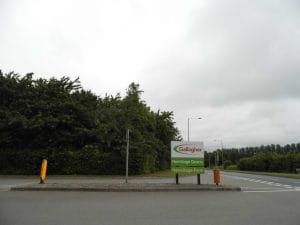
Top image: the entrance to Hermitage Quarry, Barming, pictured in 2016. Photograph by David Howard, licensed under CC BY-SA 2.0 via Geograph and Wikimedia Commons.