
Part 4 of 5 · Kent Water Investigation
This is the fourth of a five-part Kent Local News investigation into the capacity of the county’s water supply, wastewater treatment, and chalk-stream environments to support the level of growth currently planned for the region. Part 1 set out the picture — 97 per cent of monitored water bodies in the Medway basin and 100 per cent in the Stour failing the Water Framework Directive’s “Good” test, the 53 per cent real-terms Southern Water bill increase across 2025–2030, and the eleven at-risk works named in Southern Water’s own wastewater plan. Part 2 documented the housing-capacity gap — South East Water’s written confirmation that it can supply potable water for 6,318 of the 19,620 homes Tonbridge & Malling is mandated to deliver by 2040. Part 3 examined the demographic engine the targets are built on. This part examines what building to those targets does to Kent — across water, land, climate, wildlife and food. Part 5, the multi-party survey, follows on Monday 8 June.
Why “cumulative” is the right word
Planning law assesses development site by site. An application is judged against the capacity of the road, the school place, the local sewer and the nearest protected site — each in its own column, each with its own threshold. The framework is built to answer one question: can this particular scheme be accommodated? It is not built to answer the question residents across Kent are actually asking, which is whether the sum of every planned scheme, in every district, can be accommodated by the same finite county at the same time.
That is what a cumulative assessment means: not the impact of one development, but the impact of all of them landing on systems that overlap. The water a new estate drinks is abstracted from the same chalk aquifer that feeds the stream that the same estate’s drainage discharges into. The field it is built on was farmland and was also flood storage and was also habitat. The pressures do not queue politely in separate columns. They arrive together, and they interact.
Pillar one: water — abstraction and the aquifer
Kent sits on chalk. The county’s drinking water is drawn in large part from the chalk aquifer beneath it, and that same chalk feeds its rivers. This is the structural reason the two cannot be separated: every additional litre abstracted for supply is a litre not flowing through a chalk stream.
The South East is officially classified as “seriously water-stressed”. The designation is not rhetorical — it is triggered when the proportion of available freshwater already abstracted crosses a defined threshold. The scale of that stress is visible in the regional figures the designation rests on: in the Thames Water area, 52 per cent of available freshwater is abstracted against a severe-stress threshold of 40 per cent. That particular ratio describes the Thames basin to Kent’s west, not the Medway, Stour and chalk-aquifer sources that South East Water and Southern Water actually draw from; it is offered here as the regional context behind the “seriously water-stressed” designation that covers the whole of the South East, Kent included. On the official measure, the region is taking close to, or more than, what the environment can sustainably give.
Against that backdrop the direction of travel for abstraction in Kent has not been upward. As South East Water set out in the capacity correspondence documented in Part 2, it cannot simply draw more from the aquifer to serve more homes, because the aquifer is at or near its sustainable limit and chalk-stream protections constrain, rather than loosen, the licensing position. That is the upstream constraint behind the company’s capacity letter.
Pillar one, continued: the chalk streams
Kent contains a substantial share of the world’s chalk-stream habitat — part of a globally rare ecosystem of fewer than 220 such streams worldwide, the overwhelming majority of them in southern England and almost nowhere else. The Darent, the Cray, the Nailbourne, the Petteridge Brook and the Eden are Kent’s, as Part 1 of this investigation recorded.
These are the first systems where abstraction pressure becomes visible, because a chalk stream’s flow depends directly on the level of the aquifer beside it. A stream that loses its flow does not simply pause; the habitat it supports degrades, and a failing chalk stream is, as Part 1 set out, harder to remediate than a conventional river of comparable size. Chalk-stream classifications carry weight under the Habitats Regulations and the Water Framework Directive jointly, so consents tied to their catchments are correspondingly more constrained. The resource is finite and slow to rebuild: what is lost from a globally rare habitat is not readily restored.
Pillar one, completed: where the sewage goes
The other end of the water cycle is wastewater, and here the cumulative pressure is just as direct. Every home connected adds load to a treatment works, and Southern Water’s own 2024 Drainage and Wastewater Management Plan names eleven Kent works at risk of breaching their dry-weather-flow consents under planned growth — Motney Hill, Aylesford, Tonbridge and both Royal Tunbridge Wells works among them.
The system is already spilling heavily when it rains. Southern Water’s storm overflows, on Environment Agency monitoring, discharged for 317,000 hours in 2023 — 8.8 per cent of the entire national spill volume, on a network serving 4.7 million people. Nationally, the Environment Agency’s 2024 monitoring returns, published in March 2025, recorded spill duration reaching what the regulator itself characterised as an “all-time high”. The Environment Agency attributes these spills to water-company operation and underinvestment, not to housing, and that attribution stands. The point this investigation draws is narrower and different: it concerns the marginal load that tens of thousands of additional connections place on a network that is already, on the regulator’s own monitoring, spilling at record levels — not a claim that growth is the primary cause of the existing spills.
Pillar two: land — the ground itself
Water is the pressure this series began with, but it is not the only finite resource a housing target consumes. The most obvious, and the least reversible, is land.
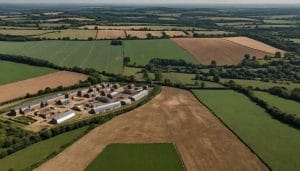
The locked, documented figures in this investigation describe homes, not hectares — Kent Local News does not hold a verified county-wide tally of greenfield loss, and this part will not invent one. But the direction is not in dispute. A target of 19,620 homes in Tonbridge & Malling alone, replicated in scaled form across Maidstone, Swale, Canterbury, Ashford and Folkestone & Hythe, is delivered overwhelmingly on land that is currently open: farmland, field margins, the urban edge.
Building on that land does something specific and durable. It seals the soil — replaces a permeable surface that absorbs rainfall with roofs, roads and hardstanding that shed it. Sealed ground cannot store water or grow food while it remains built, and reversing that change is effectively permanent on any planning timescale: developed land is not, in practice, returned to field or floodplain within the lifetime of the plans that authorise it. Every other pressure in this part flows partly from that single, physical fact: the conversion of soft, absorbent, productive ground into hard, impervious surface.
Pillar three: climate — heat, drought and flood
The climate dimension of growth in Kent is best understood not as a separate emissions ledger but as an amplifier of the water and land pressures already described. Kent Local News holds no verified county emissions total for this development pipeline, and states the point qualitatively rather than attach a figure the record does not support.
The interaction works in two directions, both adverse. In drought, a warming climate raises water demand at exactly the moment the chalk aquifer is least able to supply it — a system already abstracted close to its sustainable limit faces its highest demand precisely when it has least to give. In flood, the same sealed ground that cannot store water in a drought sheds it all at once in a downpour, into the same drainage network whose storm overflows already spilled for 317,000 hours in a single year. Heavier, more concentrated rainfall meeting more impervious surface, draining into a system at record spill levels, is the cumulative climate risk in a sentence. On this investigation’s reading of the documented record, growth compounds that risk rather than sitting alongside it.
Pillar four: biodiversity — the wildlife the system carries
The Water Framework Directive grades a river not merely on its chemistry but on the life it supports — the fish, invertebrates and plants that constitute its ecological status. That 97 per cent of monitored Medway water bodies and 100 per cent of the Stour’s fail the “Good” test is, read correctly, a biodiversity statistic as much as a water-quality one. The ecology these rivers should carry is, by the regulator’s own classification, not there.
The Stodmarsh National Nature Reserve north-east of Canterbury is the clearest case of wildlife setting a hard limit on growth. Because nutrient loading reaching the reserve was found incompatible with its protected status, 7,145 homes across the Kent and Medway planning authorities were blocked under a nutrient-neutrality requirement by March 2025, according to Natural England and Kent County Council planning monitoring. That a single protected site can halt thousands of homes is the measure of how tightly the two systems are bound. The Stodmarsh Stream Enhancement Scheme approved on 24 April 2026 eases — but does not erase — that constraint, releasing credits for an estimated 3,000 to 5,000 homes in its first phase, against a national backlog that Greenshank Environmental estimates at more than 160,000 homes. Stodmarsh, even fully resolved, is roughly five per cent of the national total.
The coast tells the same story at the other end of the catchment. Dymchurch was classified Poor under the Environment Agency 2024 bathing-water designations — the lowest band, triggering advice against bathing — with both wastewater treatment and agricultural runoff identified among the contributing pressures. A bathing water at Poor is a place where the cumulative load on the system has exceeded what the receiving environment can absorb.
Pillar five: food and farmland security
The fifth pillar closes the loop, because it is where land, water and wildlife meet. The farmland being converted to housing is the same farmland that grows food, and in Kent — the historic Garden of England — that is not an incidental loss.
The clearest illustration sits inside the Stodmarsh solution itself. According to Greenshank scheme documentation, the Greenshank scheme works by restoring 2.5 kilometres of heavily managed agricultural ditches into more natural streams that filter nitrogen and phosphorus before the water reaches the Stour. In other words, easing the growth constraint required taking agricultural land out of intensive production and giving it back to the water system — an explicit acknowledgement that farmland, water quality and habitat are competing claims on the same ground. Agricultural runoff is simultaneously named as a pressure degrading Kent’s bathing waters and rivers, which means the farmland is under pressure from both directions at once: shrinking in extent as it is built on, and constrained in its remaining use by the nutrient limits the water environment can bear.
Food-producing capacity, once sealed under housing, does not in practice come back within the lifetime of the plans that authorise the building. That is the security dimension — not an abstraction, but the simple arithmetic of a finite county asked to grow more homes, store more floodwater, protect more habitat and produce food on the same diminishing stock of land.
The compounding thesis, stated plainly
Set the five pillars beside one another and the cumulative logic is, on this investigation’s reading, unmistakable. The aquifer that supplies the homes feeds the chalk streams; abstracting more for one leaves less for the other. The sewage network that serves the homes already spills at record levels into the rivers that already fail their ecological test. The land the homes sit on was farmland and flood storage and habitat, and sealing it forfeits all three. A warming climate raises demand in the drought and runoff in the flood, against infrastructure with little slack in either direction. And the food-producing ground that might absorb some of this is itself the resource being consumed.
No single one of these is, on its own, a reason to stop building. Taken together, on the documented record assembled across this investigation, they are the reason this publication argues the conventional planning question — can this site be accommodated? — is the wrong question. The right one is whether the county as a whole can carry the sum, and that question has not been asked at county scale because the system is not built to ask it.
Key Takeaways
- The pressures of growth on Kent are, on this investigation’s analysis, cumulative, not separate: water, land, climate, wildlife and food are bound to the same finite county and the same overlapping systems, so impacts that planning law assesses site by site in fact compound.
- Water: the South East is officially “seriously water-stressed”; the regional benchmark behind that designation is the Thames Water area, where 52 per cent of available freshwater is abstracted against a 40 per cent severe-stress threshold. South East Water reports it cannot expand abstraction as chalk-stream protections tighten, and Kent’s chalk streams — part of a globally rare habitat of fewer than 220 worldwide — are degrading.
- Land: targets of the scale of Tonbridge & Malling’s 19,620 homes are delivered largely on open land, sealing soil that can then neither store water nor grow food — an effectively permanent change on any planning timescale.
- Climate: growth amplifies water risk in both directions — raising demand on a stressed aquifer in drought, and shedding runoff from sealed ground into a network whose storm overflows already spilled for 317,000 hours in 2023.
- Wildlife: 97 per cent of monitored Medway water bodies and 100 per cent of the Stour’s fail the WFD’s ecological test; the Stodmarsh nutrient constraint blocked 7,145 homes by March 2025; Dymchurch was classified Poor for bathing water in 2024.
- Food: the Stodmarsh easing itself required restoring agricultural ditches into filtering streams, illustrating that farmland, water quality and habitat are competing claims on the same shrinking stock of ground.
What This Means for Kent Residents
For residents, the cumulative picture reframes the choice their Local Plan presents. The instinct in a planning consultation is to weigh a single development against a single local concern — the traffic, the view, the nearest school. The evidence assembled across this investigation suggests that instinct, while reasonable, misses the structure of the problem. The constraint is not any one site. It is the sum.
That has a practical consequence. Because the systems overlap, a measure that eases one pillar can tighten another. Restoring farmland ditches at Stodmarsh unlocked homes by protecting a river — but did so by taking land out of food production. Adding treatment capacity to absorb more sewage requires energy and capital that the funding settlement documented in Parts 1 and 2 has already largely committed elsewhere. There is no costless lever, because every lever pulls on a system connected to the others.
None of this is an argument that Kent should not grow, and Kent Local News does not make that argument. It is an argument that the growth has to be planned against the real, cumulative carrying capacity of the county — the water, the land, the climate exposure, the protected wildlife and the food-producing ground, assessed together rather than one column at a time. That is the question the final part of this investigation puts to the parties seeking to govern Kent.
Part 5 of this investigation, publishing Monday 8 June, sets out the practical path to capacity: a survey of what each of the political parties active in Kent proposes to do about the gap this series has documented, assessed on its merits. Every party contacted on 2 May 2026 was given until 17:00 on 12 May to respond; their answers, and the silences, are recorded there.
Kent's water and the bigger picture: how growth compounds across five systems Quiz
8 questions
Sources
- Environment Agency, Water Framework Directive classification data, Medway and Stour catchments (current cycle): 97 per cent and 100 per cent failure of “Good” ecological status.
- Environment Agency / Defra “seriously water-stressed” designation for the South East; Thames Water area abstraction at 52 per cent of available freshwater against the 40 per cent severe-stress threshold, cited as regional context for the designation.
- Environment Agency Catchment Data Explorer, Kent chalk-stream classifications (current Water Framework Directive cycle); chalk streams carry heightened protection under the Habitats Regulations and the WFD jointly (see Kent Local News Water Investigation Part 1).
- Southern Water Drainage and Wastewater Management Plan, 2024 (eleven named at-risk Kent treatment works).
- Environment Agency storm-overflow Event Duration Monitoring data: Southern Water 317,000 hours in 2023 (8.8 per cent of national spill volume, 4.7-million-person network); 2024 returns published March 2025 (national “all-time high”). The Environment Agency attributes spill performance to water-company operation and underinvestment.
- Environment Agency Bathing Water Classifications, 2024 (Dymchurch classified Poor).
- Natural England / Kent County Council planning monitoring (7,145 homes blocked under Stodmarsh nutrient neutrality, March 2025).
- Natural England approval and Greenshank Environmental scheme documentation, 24 April 2026 (Stodmarsh Stream Enhancement Scheme: restoration of 2.5km of agricultural ditches; 3,000–5,000 homes first phase; national nutrient-neutrality backlog estimated by Greenshank at more than 160,000 homes).
- Tonbridge & Malling Borough Council adopted Local Plan (19,620 homes to 2040); South East Water capacity correspondence, 2026 (6,318-home potable-supply figure).
- Kent Local News Water Investigation Parts 1, 2 and 3 (May 2026).