
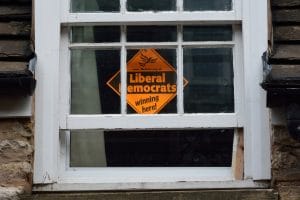
Liberal Democrats retained outright control of Tunbridge Wells Borough Council on Friday, sweeping eleven of the fifteen seats up for election in the borough’s 7 May 2026 thirds-cycle vote and taking 38 per cent of the borough-wide vote share.
Cllr Ben Chapelard’s administration is back in the chamber with a comfortable working majority and, on the night’s count, a clear electoral mandate from across the borough’s urban centre and most of its suburban wards. Liberal Democrat candidates won single-seat holds in six wards, gained Rusthall & Speldhurst from Labour, and took both Sherwood seats — including the unseating of sitting Conservative Cllr Christian Atwood — plus both Southborough & Bidborough vacancies. The result entrenches the position the party first secured in the 2024 all-out election and gives the leader the negotiating mandate the borough will carry into the Government’s Local Government Reorganisation decisions in the months ahead.
The result also delivers the harder national-resonance side-story of the night: Reform UK contested all fifteen seats and won none of them, despite finishing third in vote share, on 21 per cent — just two points behind the Conservatives. Twelve months after the party took outright control of Kent County Council in May 2025, Reform’s first borough-wide standing slate in Tunbridge Wells came back empty-handed.
With all fifteen seats now declared, the borough’s Returning Officer’s official tally is:
- Liberal Democrats: 11 seats / 38% of votes
- Conservatives: 2 seats / 23%
- Reform UK: 0 seats / 21%
- Green Party: 0 seats / 9%
- Tunbridge Wells Alliance: 1 seat / 4%
- Independents for Tunbridge Wells: 1 seat / 2%
- Labour: 0 seats / 2%
- English Democrats / Independent: 0 seats each, less than 1 per cent each
The Reform UK question — one in five voters, no representation
If a fairer test of Reform UK’s national momentum than the headline KCC result of May 2025 was always going to be a competitive borough-level vote in a setting where the party had no incumbent advantage, Tunbridge Wells offered exactly that. Reform contested all fifteen seats. The party currently holds none on the borough. By share of the vote, Reform finished third — behind the Liberal Democrats and the Conservatives, but ahead of every other party that contested the borough — a measure of voter intent that, on any proportional metric, would have produced a meaningful Reform group on the council. Under first-past-the-post in fifteen single- and twin-seat wards, it produced none.
The party’s nearest result was Dennis Deane in Rural Tunbridge Wells, where he polled 987 votes against Cllr David Knight’s 1,474 — a respectable third place on 25 per cent of a 49.8 per cent turnout, but a long way short of unseating a sitting Conservative. The party’s second-best showing came in Cranbrook, Sissinghurst & Frittenden, where Matthew Beattie polled 674 votes (25 per cent share) against Cllr Alexander Ellison’s 1,227 (46 per cent share). On the verified breakdown for that ward published by the Council, Reform polled ahead of both the Liberal Democrat and Green candidates — outpolling them by margins large enough that, in a proportional system, the seat would not have been a Conservative hold.
Cllr Hugo Pound, speaking for Labour during the count, said the Liberal Democrat ground operation was “very impressive” and observed that Reform had run a comparable campaign infrastructure across Kent without producing the same return. The contrast tracks a wider pattern visible in the borough-wide tally: Reform’s vote share is unambiguously material, but its return on that vote share, under the borough’s electoral mechanics, is zero.
That gap matters because the next twelve months in Kent — with the unitary reorganisation programme moving through the Government’s preferred-option decision in the summer and the shadow-unitary elections beginning in May 2027 — will be exactly the period in which a Reform councillor base across borough and district authorities would convert national poll standing into the negotiating leverage the party would need at the Kent Mayor stage. As of Friday in Tunbridge Wells, the conversion has not happened.
The Liberal Democrat sweep — eleven of fifteen, including a take from the Conservatives
Of the eleven seats the Liberal Democrats won, six were holds in single-seat wards: Pantiles (Cllr Pamela Wilkinson, 1,246 votes), St James’ (Cllr Gavin Barrass, 1,478 — the night’s largest single-ward margin), Culverden (Cllr David Osborne, 1,402), Paddock Wood (Cllr Christopher Digby, 1,195), St John’s (Cllr Ukonu Obasi, 1,047) and Park (Cllr Richard Brown).
The party’s most concrete substantive gain was Rusthall & Speldhurst, where Liberal Democrat Ian Standing took the seat with 1,192 votes to the Conservative David Sumner’s 717 — a Liberal Democrat gain from Labour. On a 48.4 per cent turnout, the result alone shifts the cabinet partnership maths in Cllr Chapelard’s favour.
The night’s most consequential single result, however, was Sherwood, where both seats — one a regular thirds-cycle election, the other a vacancy fill — went to the Liberal Democrats. Cllr Christian Atwood, the sitting Conservative who was the party’s only urban-Tunbridge-Wells incumbent on the ballot, lost his seat. With both Sherwood seats and the two Southborough & Bidborough vacancies (Kimberley Johnson and Ash Shukla, both Liberal Democrat) returned for Cllr Chapelard’s party, the Liberal Democrats added four seats from the four “double” returns alone.
The Conservative loss in Sherwood — held but did not gain, and lost ground
The Conservatives were the official opposition before the vote with seven sitting seats. On Friday’s count they held two: Cllr David Knight in Rural Tunbridge Wells (1,474 votes against the Liberal Democrats’ 1,131) and Cllr Alexander Ellison in Cranbrook, Sissinghurst & Frittenden (1,227 votes on a 46 per cent share). Both are rural wards where the Conservative footprint has historically held against the urban Liberal Democrat trend.
The party’s loss was Sherwood. Cllr Christian Atwood’s defeat there, on a 23 per cent borough-wide vote share that was just two points ahead of Reform UK’s, is a meaningful blow to the parliamentary-style opposition the Conservatives have been trying to anchor on the council since they lost outright control in 2022. The party’s pitch on this campaign — pushback against the Labour government’s revised housing targets, opposition to top-down planning and council-tax pressure — held its rural footprint but did not, on the seats counted, hold the urban one.
The longer arc against which to read that result is the borough’s political memory of the 2019 cross-party vote that killed the £108 million Calverley Square theatre and civic-complex scheme championed by the then-Conservative cabinet, and the 2022 election that ended a Conservative majority of more than two decades. The Tunbridge Wells Alliance was founded predominantly to fight Calverley Square; its co-founder David Hayward later left to form Independents for Tunbridge Wells in August 2023 after disputes over the post-2022 Borough Partnership. Six years after the project was scrapped, the Conservatives are still working back towards the position from which they fell — and on Friday, in Sherwood, they moved further away from it.
Two close calls — the local-first parties survive on margins
Two results were genuinely on a knife-edge. In Pembury & Capel, Cllr David Hayward of Independents for Tunbridge Wells — the breakaway party he founded in August 2023 after leaving the Tunbridge Wells Alliance over its participation in the Borough Partnership cabinet — held his seat by 18 votes: 934 to the Liberal Democrat candidate Nick Slessor-Pavely’s 916. In Hawkhurst, Sandhurst & Benenden, Cllr Ellen Neville held the seat for the Tunbridge Wells Alliance by 49 votes: 943 to the Conservative candidate Rosanna Taylor-Smith’s 894.
Both wards are reminders that the borough’s two local-first parties continue to function as a meaningful political quantity, even on a night when the major-party machinery dominated the broader picture. Together, with their existing cabinet roles under the Borough Partnership, the Tunbridge Wells Alliance and Independents for Tunbridge Wells go into the next year with five councillors between them — not enough to change majority arithmetic, but enough to keep their distinctive governance posture in the chamber. On Friday’s vote-share figures — 4 per cent for the Alliance, 2 per cent for IfTW — both groups are running on small but loyal cores. If the next five years of Kent politics produce a Reform-versus-establishment polarisation, the local-first groups may find their distinctive voter base is the one being asked to choose first.
Labour’s zero-of-eight
Labour fielded eight candidates across the borough and elected none of them. The party retained its four sitting councillors who were not up for election in this thirds cycle — the Borough Partnership cabinet roles continue under that arithmetic for now — but the night represented a clear failure to grow. On 2 per cent of the borough-wide vote share, Labour finished joint last among the parties standing serious slates, on a level with Independents for Tunbridge Wells which fielded only two candidates.
Tunbridge Wells’s Labour group goes into the next year having voted with the Liberal Democrat administration on the substantive borough decisions of this term — the Local Plan, the procedural choice to grandfather the lower 678-homes-a-year housing target rather than restart under the new methodology, the Option 3a unitary preference — without a corresponding electoral return on that partnership stability. The 2027 shadow-unitary picture, when it comes, will be the first opportunity to test whether that posture has cost the party local credibility or cemented it.
What this means for Tunbridge Wells — and the LGR overhang
The councillors elected on Friday will sit on a borough authority that the Government has already announced will be abolished and replaced by a new unitary council under the Local Government Reorganisation programme. Tunbridge Wells Borough Council’s own preferred option, agreed on 17 November 2025, is “Option 3a” — a merger with Sevenoaks, Tonbridge & Malling and Maidstone into one of three new Kent unitaries. A final Government decision is expected in summer 2026, with the new unitary system due to come into force in April 2028. In practical terms, most of the councillors elected on Friday are starting what may be a two-year term, not the standard four.
That overhang gives the night’s results an unusual character. Cllr Chapelard’s administration is now the political body that will negotiate Tunbridge Wells’s entry into the new unitary on behalf of borough residents — and, on its own current preference, dissolve itself in the process. The Liberal Democrat majority confirmed on Friday is therefore the borough’s negotiating mandate as much as it is its administrative one. Tunbridge Wells residents will get a fresh ballot at the shadow-unitary stage in May 2027; Friday’s vote was, on the current trajectory, the second-to-last full-borough election Tunbridge Wells will ever hold.
The wider Kent picture, briefly
Tunbridge Wells was the only borough in Kent holding a borough-level election this year. Kent County Council, which sits one tier above the borough, was elected outright by Reform UK in May 2025 and is twelve months into that administration; Medway holds its own elections separately as a unitary authority and is not in the borough cycle. The result in Tunbridge Wells is therefore the only direct 2026 voter test in Kent of how the post-2024 political landscape is settling — and on that test, the borough’s verdict was: Liberal Democrat continuity at the top; local-first survival on knife-edge margins; Conservative recovery still incomplete and a defended urban seat lost; and Reform UK’s national insurgency producing one in five votes but no councillors.
Liberal Democrats hold Tunbridge Wells with 11-seat sweep — Reform UK's first borough slate yields no councillors Quiz
8 questions
Sources
- Tunbridge Wells Borough Council — official Returning Officer’s tally, Borough Elections, Thursday 7 May 2026 (election results by party):
democracy.tunbridgewells.gov.uk/mgElectionResults.aspx?ID=31 - Tunbridge Wells Borough Council — official ward result, Cranbrook Sissinghurst & Frittenden, 7 May 2026:
democracy.tunbridgewells.gov.uk/mgElectionAreaResults.aspx?ID=237 - Tunbridge Wells Borough Council — official ward result, Rural Tunbridge Wells, 7 May 2026:
democracy.tunbridgewells.gov.uk/mgElectionAreaResults.aspx?ID=244 - Tunbridge Wells Borough Council — “About the elections” briefing for Thursday 7 May 2026, including ward-by-ward seat allocation:
tunbridgewells.gov.uk/council/voting-and-elections/elections/thursday-7-may-2026/about-the-elections - Kent Local News pre-election guide, “Tunbridge Wells Borough Council elections: your complete voter’s guide” (published 6 May 2026)
Full ward-by-ward candidate biographies, party material and pre-election framing are in our pre-election guide: Tunbridge Wells Borough Council elections: your complete voter’s guide.
Vote-share and seat-count figures from Tunbridge Wells Borough Council’s official Returning Officer’s tally as published on the Council’s democracy portal. Kent Local News is regulated by IMPRESS. Image: a Liberal Democrat “Winning Here” campaign placard photographed at a UK general election (stock image, iStock / Ian Redding); not photographed in Tunbridge Wells.