
Councillors were asked to approve a Government-funded pilot letting voters in Maidstone’s ten contested town council wards vote at a town-centre hub five days early, as well as on polling day. Tunbridge Wells ran a similar pilot in May 2026.
Residents in Maidstone’s town council wards could have the option of voting at a central hub in the town centre on Saturday 1 May 2027 — five days before polling day — under a flexible voting pilot that was put before Maidstone Borough Council’s Democracy and General Purposes Committee on 26 October 2026.
The proposal, submitted conditionally to the Ministry of Housing, Communities and Local Government (MHCLG) ahead of the committee meeting, would also operate the same hub on polling day, Thursday 6 May 2027. The hub would allow any in-person elector from across the Town Council area — covering ten contested wards — to vote there, regardless of their designated polling station, and to hand in a postal vote.
What the pilot would involve
The pilot combines two elements that MHCLG is seeking to test nationally: early voting and a central voting hub on polling day. Officers said that running both at the same election would allow comparative data to be gathered — for example, how many voters choose to vote early on a Saturday compared with the traditional Thursday.
Maidstone town centre was described in the proposal as an ideal location given its accessibility, high footfall and transport connections. The submission noted that the town centre attracts more than 25 million visits annually.
The Maidstone Town Council area has approximately 89,350 residents. Officers noted that the area has a younger age structure than the wider borough, higher deprivation levels, higher unemployment and lower car ownership, with more than one in five households having no access to a car or van — factors cited as making improved voting accessibility particularly relevant.
Cost and government backing
Any additional costs of running the voting hub and the early voting weekend would be met by Government, creating no additional cost for Maidstone Town Council, according to the report.
MHCLG gave conditional approval for the pilot subject to formal agreement by the committee and by the Minister. The proposal cannot be altered at the conditional submission stage, though officers noted that committee members’ views on implementation were welcome.
The first round of flexible voting pilots was conducted in May 2026 at Cambridge, Milton Keynes, North Hertfordshire and Tunbridge Wells. Officers said those pilots were evaluated as successful by the Electoral Commission, prompting MHCLG to invite bids for a second round at May 2027 elections.
Maidstone was unable to bid in 2026 because it held no elections that year, and initially could not bid for 2027 because it had been expected to hold Shadow Authority elections for the then-proposed West Kent Council. Following the postponement of local government reorganisation, the planned Town Council election became eligible, and MHCLG agreed to extend the submission deadline to allow Maidstone to submit a conditional proposal by 21 September 2026.
Committee’s decision
The report asked the committee to approve the pilot set out in its submission to MHCLG. The council had not published the minutes of the meeting at the time of writing, so the committee’s decision is not yet on the public record.
Sources
- Maidstone Borough Council — Democracy and General Purposes Committee, 2026-10-26 (agenda and papers)
- Committee paper (Maidstone Borough Council)
- Committee paper (Maidstone Borough Council)
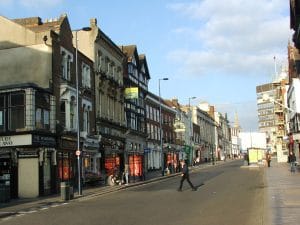
High Street, Maidstone. Picture: Chris Whippet / geograph.org.uk, CC BY-SA 2.0