
Medway Council’s Cabinet was asked on 22 September 2026 to confirm additional and selective licensing schemes for private rented homes across seven wards in Chatham, Gillingham, Luton and Strood, after a statutory consultation in which residents broadly supported the plans and landlords largely opposed them.
Medway Council’s Cabinet was asked on 22 September 2026 to confirm the council’s first additional and selective licensing schemes for private rented properties, covering seven of Medway’s 24 wards. If confirmed, the schemes were expected to start in November 2026.
Which areas and schemes are proposed
The additional licensing scheme covers Houses in Multiple Occupation (HMOs) beyond those already subject to mandatory licensing. It was proposed for six wards: Chatham Central & Brompton, Fort Pitt, Gillingham North, Gillingham South, Luton, and Watling.
The selective licensing scheme would require private landlords of rented homes in the designated areas to hold a licence. It was proposed for seven wards: the same six, plus the Strood North & Frindsbury ward.
Both schemes are intended to run for five years. Officers said the fee structure had been calculated so that the schemes would be cost-neutral to the council, with licence fees covering the cost of running them, and that the fees had been benchmarked against other councils’ schemes.
Consultation results
A statutory consultation was carried out between 23 March and 4 June 2026 by independent consultants Transform UK. It had been due to close on 31 May 2026 but was extended after an ICT fault closed the online survey early. There were 209 responses.
On additional licensing, 56% of respondents agreed with the proposals and 28% disagreed. The Cabinet report puts support among residents and local businesses at 72% and among other stakeholders at 67%. Among landlords, letting agents and managing agents, 41% disagreed and 28% agreed.
On selective licensing, 50% of respondents agreed and 41% disagreed. Residents and local businesses were broadly in favour, with 74% supporting the proposals according to the Cabinet report. Landlords, letting agents and managing agents were the main group opposed: the Cabinet report says 82% of them disagreed, while the table in the consultation report gives the figure as 81%.
Why the report came back to Cabinet
Cabinet had already approved the proposals on 4 August 2026. The report was brought back to the 22 September meeting, officers said, “to remove the risk of potential challenge”.
Cabinet was also asked to agree that the decisions be treated as urgent and not subject to the normal call-in process. The chair of the Regeneration, Culture and Environment Overview and Scrutiny Committee agreed that the decisions were reasonable and that call-in should be waived, on the grounds that the council is required by law to publish public notices within seven days of a Cabinet decision confirming the designations.
The council had not published the minutes of the meeting or a record of the decision at the time of writing, so Cabinet’s decision is not yet on the public record.
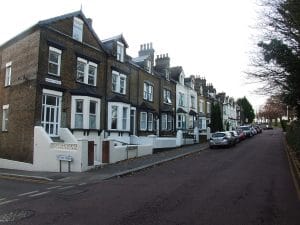
Image: Albany Terrace, Chatham, in the Fort Pitt ward. Illustrative only; it does not show any property referred to in the council’s report. Photo by Chris Whippet, via Geograph, CC BY-SA 2.0.