
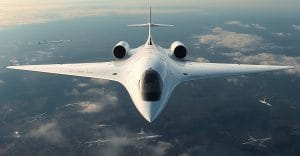
The experimental X-59 aircraft has relocated from Birmingham, Alabama, to Daytona Beach, Florida, as NASA presses ahead with research into quieter-than-conventional supersonic flight.
NASA has announced that its experimental X-59 aircraft has travelled from Birmingham, Alabama, to Daytona Beach, Florida, marking a fresh step in the agency’s Quesst mission — a programme designed to gather the scientific and acoustic data that could one day persuade regulators to permit supersonic passenger flights over land.
The aircraft, developed in partnership with Lockheed Martin Skunk Works, is built around a single proposition: that supersonic travel does not have to be deafeningly loud. According to NASA, the X-59 is designed to produce a quiet thump rather than the sharp, disruptive sonic boom associated with conventional faster-than-sound flight.
NASA posted about the relocation on social media, describing the aircraft’s movement between the two American cities. The exact date of the flight has not been independently confirmed from the available official NASA material. What is confirmed is where the X-59 now sits — and what it is there to do.
What the X-59 Actually Is
It’s worth being clear about what this aircraft is not. The X-59 is a research aircraft. It carries no passengers, operates no scheduled routes, and has no commercial approval. Its entire purpose is to generate data — acoustic measurements, engineering performance figures, and public reaction records — that NASA intends to hand to aviation regulators in the United States and internationally.
The aircraft is the centrepiece of NASA’s Quesst mission, which stands for Quiet SuperSonic Technology. The mission’s aim, according to NASA, is to collect evidence that could support the development of new rules allowing supersonic flight over populated land areas — something currently prohibited under existing regulations.
The Science Behind the Thump
Traditional supersonic aircraft create a pressure wave that reaches the ground as a loud, startling boom. The Concorde, which retired in 2003, produced noise measured at over 100 perceived loudness decibels — enough to rattle windows and prompt public complaints on a wide scale. That noise problem was a central reason Concorde was barred from supersonic flight over land, confining its faster-than-sound performance to transatlantic routes.
The X-59 takes a different approach. Its elongated, narrow fuselage and carefully shaped nose are designed to break up those pressure waves before they coalesce into a single loud boom. Larry Cliatt, Quesst acoustic validation sub-project manager at NASA, said: “We expect the X-59 sonic thump to be as low as about 75 perceived loudness decibels.”
That’s a hefty reduction from Concorde’s levels, though the comparison isn’t entirely straightforward — the two aircraft operate in different eras, under different engineering constraints, and for entirely different purposes.
NASA says the X-59 is designed to cruise at around Mach 1.4, or around 925 mph. During its first supersonic test flight, the aircraft reached Mach 1.1 — about 713 mph — during an 81-minute flight that peaked at 43,400 feet. That flight was described by NASA as a milestone for the programme, though the agency has been careful to frame it as a research result rather than a commercial breakthrough.
What Comes Next for the Quesst Mission
The relocation to Daytona Beach is part of the programme’s ongoing development. NASA plans to use the X-59 for community overflight tests across selected locations in the United States, during which it will measure the sound experienced by people on the ground and gather public reaction data. That information is intended to feed directly into regulatory discussions about whether, and under what conditions, supersonic passenger travel over land could be permitted.
None of that is imminent. The X-59 programme is still in an active research phase, and no commercial supersonic service has been announced, approved, or scheduled anywhere in the world as a result of this work. Any future service involving UK airspace would require separate assessment and approval by relevant UK aviation authorities, covering noise, emissions, safety, and environmental impact.
And the engineering questions aren’t all answered yet. Whether the 75-decibel thump remains acceptable to communities living beneath potential supersonic routes — rather than in controlled test conditions — is precisely what the overflight programme is designed to find out.
What This Means for Kent Residents
There is no direct impact on Kent from this aircraft movement, which took place entirely within the United States. But the Quesst programme’s longer-term ambitions are relevant to anyone who flies internationally: if NASA’s data eventually convinces regulators to permit supersonic passenger routes over land, journey times on transatlantic and European routes could shorten considerably. Any future supersonic service operating into or out of UK airports — including those serving Kent — would require approval from UK aviation authorities and would be subject to noise and environmental assessment under British and international rules.
Source: @NASA
NASA's X-59 Quiet Supersonic Aircraft Moves to Florida as Quesst Mission Advances Quiz
5 questions