
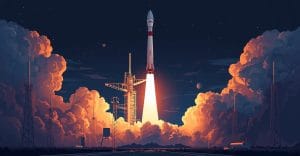
A Falcon 9 rocket lifted off from Vandenberg Space Force Base on 22 August 2026, delivering 27 Starlink satellites to orbit and marking SpaceX’s 100th Falcon family mission of the calendar year.
One hundred launches in a single year. That’s the milestone SpaceX announced after a Falcon 9 rocket lifted off from Space Launch Complex 4E at Vandenberg Space Force Base, California, at around 12:25 a.m. Local time (07:25 UTC) on 22 August 2026, carrying 27 Starlink satellites to low Earth orbit.
SpaceX confirmed the achievement across its official social media accounts, describing the mission as completing its “100th Falcon launch of the year.” Launch-tracking services and specialist spaceflight reporting clarify the precise breakdown: this flight was the 99th Falcon 9 launch of 2026, with the overall tally reaching 100 when counting at least one Falcon Heavy mission earlier in the year. So the headline figure refers to the Falcon family as a whole, not Falcon 9 alone — a distinction worth keeping in mind.
A Booster That Keeps Coming Back
The first-stage booster performed a return landing on SpaceX’s autonomous droneship *Of Course I Still Love You*, stationed in the Pacific Ocean — a now-routine outcome that still represents an engineering feat when you step back and think about it. Reusable boosters are central to SpaceX’s ability to sustain this kind of launch rate, allowing the same hardware to fly multiple missions rather than being discarded in the ocean after each flight.
That pace is genuinely striking. Reaching 100 Falcon family launches before the end of August means SpaceX has been averaging well over one launch every three days across 2026. For comparison, the entire global launch industry managed around 200 orbital launches in the whole of 2022. SpaceX alone is now approaching half that total in under eight months.
The Constellation Keeps Growing
The 27 satellites delivered by this mission join what independent tracking organisations describe as a Starlink constellation of more than 11,000 spacecraft in low Earth orbit — though that figure comes from satellite trackers rather than a single verified official count, and the precise number shifts as older satellites deorbit and new ones arrive. SpaceX hasn’t published a definitive live total.
Elon Musk, SpaceX’s chief executive, has repeatedly framed Starlink’s scale as essential to its commercial viability, arguing that a large constellation is needed to provide consistent global coverage. The service is now authorised by Ofcom to operate as a broadband provider in the United Kingdom, competing with fixed-line and mobile internet options.
Not Everyone Is Celebrating
The 100-launch milestone has drawn measured responses from parts of the scientific and policy community. The Royal Astronomical Society and other bodies have raised concerns about large satellite constellations contributing to light pollution that interferes with ground-based telescopes, as well as radio-frequency interference and the long-term risk of orbital debris. At a constellation size exceeding 11,000 satellites, the questions around space traffic management and collision-avoidance protocols are no longer theoretical.
Space-safety organisations stress that very high launch rates increase the need for effective tracking and deorbiting compliance to keep low Earth orbit usable for everyone — including future scientific missions and other commercial operators.
Ofcom’s own position reflects a mixed-technology view of broadband delivery. The regulator supports satellite services as part of a broader connectivity picture, but UK digital policy continues to prioritise rolling out gigabit-capable fixed networks and 5G as the primary solution, with satellite filling gaps rather than replacing terrestrial infrastructure.
What the Numbers Show
At 99 Falcon 9 launches year-to-date, SpaceX’s 2026 cadence already exceeds its full-year totals from several previous years. Industry analysts frame this as evidence that high-cadence reusable launch operations are commercially viable at scale — a model that competitors including Rocket Lab, United Launch Alliance, and Europe’s Arianespace are watching closely as they develop their own reusable systems.
The cost per launch has not been publicly itemised for this specific mission, and SpaceX does not routinely disclose per-flight economics. But the broader commercial-space analysis suggests that reusability, combined with volume, is driving launch costs downward compared with the expendable-rocket era.
Chris Hadfield, the retired Canadian astronaut and space commentator, said of SpaceX’s launch cadence earlier this year: “The rate of access to space has changed permanently. What we’re watching is the industrialisation of low Earth orbit.” That framing captures the scale of what the data shows, even if the long-term consequences — for orbital safety, for competition, for astronomy — remain genuinely open questions.
What This Means for Kent Residents
Starlink is already available to households and businesses across Kent, including rural and semi-rural areas where full-fibre or superfast fixed-line broadband hasn’t yet reached — and where Ofcom data confirms coverage gaps remain. Residents can order a Starlink terminal directly, with an upfront equipment cost and a monthly subscription fee charged in GBP and subject to UK VAT, though those costs are higher than a standard fixed-line package. For anyone in a Kent village still relying on slow ADSL or part-fibre connections, each Starlink expansion mission like this one adds capacity to the constellation they depend on — meaning more satellites in orbit can, in principle, support more consistent speeds and reliability for UK users.
Source: @SpaceX
SpaceX Falcon 9 Completes 100th Falcon Family Launch of 2026 with 27 Starlink Satellites from California Quiz
5 questions