
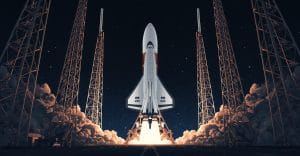
SpaceX has assembled the full Starship rocket at its Starbase facility in Texas, with a planned orbital launch attempt targeted for no earlier than 28 September 2026, pending Federal Aviation Administration approval.
There’s something almost hard to believe about a rocket that stands 124 metres tall — taller than the Shard’s roof and roughly equivalent to a 40-storey building. Yet that’s exactly what SpaceX now has sitting on Pad 2 at its Starbase site in south Texas, as the company pushes towards what would be Starship’s first ever orbital flight.
SpaceX posted on 23 September 2026 that the Flight 14 vehicle had been stacked and was ready for the next stage of pre-launch preparations. The announcement confirmed what space-watchers had been tracking for days: Ship 41, the upper-stage spacecraft, was transported to Pad 2 on 22 September and lifted overnight onto Super Heavy booster B21, completing the full assembly.
What “Stacking” Actually Means
For anyone not deep into spaceflight, “stacking” simply means placing the upper part of the rocket — the Starship spacecraft itself — on top of the booster stage below it. Think of it like putting the top tier on a wedding cake, except the cake is taller than most buildings and filled with liquid methane.
Ship 41 stands around 52 metres on its own. Mounted on B21, the combined vehicle reaches around 124 metres, according to reporting by Spaceflight Now. That makes it the tallest rocket ever built.
What Flight 14 Is Actually Trying to Do
This is where things get genuinely ambitious. Earlier Starship flights tested increasingly complex objectives — surviving re-entry, catching the booster with mechanical arms at the launch tower, controlled splashdowns. Flight 14 is a step further again.
According to reporting based on SpaceX’s mission plan, the flight is intended to achieve orbital insertion for the first time. On top of that, it plans to deploy 26 Starlink V3 satellites during the mission, perform an in-space de-orbit burn, and then bring the spacecraft back through a controlled re-entry. The planned mission duration is around ten hours, with a 75-minute launch window.
That’s a lot to ask of a single test flight. But SpaceX has been building towards exactly this profile across the previous 13 flights.
The Regulatory Picture
Here’s the part that matters for whether any of this actually happens on 28 September: the Federal Aviation Administration still needs to issue a launch licence.
The FAA completed an environmental review of Starbase launch operations, resulting in what’s called a Finding of No Significant Impact and a Record of Decision. That’s a meaningful step. But environmental clearance is separate from the actual launch licence — the agency must still determine that SpaceX has met its launch-safety, financial-responsibility and other licensing requirements before any rocket leaves the ground.
Earlier reported targets, including a date of 22 September 2026, were superseded as preparations continued. The 28 September date remains a no-earlier-than target, not a confirmed slot. As of 24 September 2026, the FAA had not publicly confirmed that a licence had been issued.
A wet dress rehearsal — where the fully assembled rocket is fuelled without actually launching — was expected to take place after stacking, as part of final verification before any launch attempt.
The Bigger Picture for Commercial Spaceflight
Starship is designed to be fully reusable, with both the Super Heavy booster and the Starship upper stage intended to land and fly again. If Flight 14 achieves its orbital objectives, it would mark a genuine shift from testing to operational capability — at least in principle.
The Starlink V3 satellites planned for deployment are part of SpaceX’s ongoing effort to expand its broadband satellite constellation. Starlink already serves customers across the UK, including in rural areas where fixed broadband options are limited.
Elon Musk, SpaceX’s chief executive, has spoken repeatedly about Starship as the vehicle intended to carry humans to the Moon and eventually Mars. But the nearer-term commercial case is satellite deployment at scale — and Flight 14 would be the first real test of whether Starship can do that job.
What This Means for Kent Residents
The launch is taking place in Texas and has no direct impact on Kent. But Starlink’s satellite broadband service is already used by residents across rural parts of the county where fibre or cable connections remain out of reach, and a successful orbital flight would support SpaceX’s ability to expand and upgrade that network over time. More broadly, UK interest in commercial spaceflight is growing, and developments like this shape the wider industry that the UK Space Agency is working to attract investment into.
Source: @SpaceX
SpaceX Stacks Starship Flight 14 Vehicle Ahead of First Orbital Launch Attempt Quiz
5 questions