
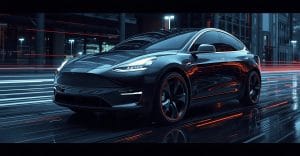
Tesla’s first production Cybercab has entered on-road engineering tests in Austin, Texas, though a human safety monitor remains on board during the validation runs.
A car with no steering wheel and no pedals is now being driven — or rather, driving itself — on public roads in Austin, Texas. Tesla posted this week that “engineering tests of the first production Cybercab have begun in Austin”, marking a concrete step forward from factory floor to real-world road validation for its purpose-built robotaxi.
The announcement came via Tesla’s own social channels, and it’s a meaningful milestone. Production of the Cybercab is understood to have started at Gigafactory Texas earlier in 2026, making these Austin road tests the first time a production-spec vehicle has moved beyond the factory and into live traffic conditions.
What the Cybercab Actually Is
This isn’t a modified saloon with the steering column removed. The Cybercab is a ground-up, purpose-built autonomous vehicle — two seats, no driver controls at all, designed from the outset to carry passengers without any human at the wheel. That’s a fundamentally different engineering proposition from, say, a Tesla Model Y with Full Self-Driving software bolted on.
According to an EPA filing cited in recent reporting, the Cybercab carries a 48 kWh battery and a single front-mounted motor rated at 163 kW — that’s around 219 horsepower. The combined unadjusted range figure from the same filing comes in at 418 miles, which, if it survives the usual EPA-to-real-world adjustment, would still represent a respectable figure for a compact two-seater. The car weighs in at 3,113 lb, or roughly 1,412 kg for anyone thinking in metric.
It’s a lean, stripped-back machine built for one job.
Engineering Tests vs. A Robotaxi Service
It’s worth being clear about what “engineering tests” actually means here, because the language matters. This is not a commercial robotaxi service. Nobody in Austin is currently opening an app and hailing a Cybercab to take them across town. These are validation runs — the kind of real-world testing that sits between factory sign-off and any kind of public deployment.
And there’s another detail that puts the current stage in context. Reports covering the video Tesla posted confirm that a human safety monitor was present inside the vehicle during the tests. So while the car has no steering wheel or pedals, a person is still on board to observe and, if needed, intervene. That’s standard practice in supervised autonomous vehicle testing, but it does mean the Cybercab is not yet operating fully unattended on public roads.
Tesla’s own documentation classifies the Cybercab as an SAE Level 4 system within a defined operating area. Level 4 means the car can handle all driving tasks without human input — but only within specific conditions and geographic zones. It’s not the same as Level 5, which would mean full autonomy anywhere, in any conditions.
Where Tesla Goes From Here
Tesla has been developing its robotaxi operations in Austin using both the purpose-built Cybercab and modified Model Y vehicles. The engineering tests of the production Cybercab appear to be part of system validation ahead of any wider rollout, though the company hasn’t announced a specific timeline for moving to unsupervised commercial service.
The absence of conventional driver controls raises questions that go well beyond engineering. Who is legally responsible if a Cybercab is involved in a collision? How do regulators approve a vehicle that, by design, cannot be manually driven? How do emergency services interact with it? Tesla’s First Responder Interaction Plan, referenced in recent reporting, addresses some of that last question, but the broader regulatory and legal frameworks are still catching up with the technology.
These aren’t hypothetical concerns. They’re the kinds of questions that regulators in the United States, the United Kingdom, and across Europe are actively working through right now.
Dan O’Dowd, founder of The Dawn Project and a persistent critic of Tesla’s autonomous driving systems, has previously said: “Tesla is using public roads as its test track.” Tesla disputes that framing, pointing to its safety record and the structured nature of its testing programmes. Both positions reflect a genuine tension in how autonomous vehicle development gets done — and who carries the risk while it’s happening.
What This Means for Kent Residents
For most people in Kent, a robotaxi rolling around Austin, Texas feels a long way off. But the regulatory decisions being shaped by tests like these — on liability, safety standards, and approval pathways for vehicles without driver controls — will directly influence when and how autonomous vehicles might eventually appear on UK roads. Anyone in Kent who drives, insures a car, or uses public transport has a stake in how those rules get written, even if the Cybercab itself won’t be pulling up outside Maidstone town centre any time soon.
Source: @Tesla
Tesla Begins Engineering Tests of First Production Cybercab on Austin Roads Quiz
5 questions