
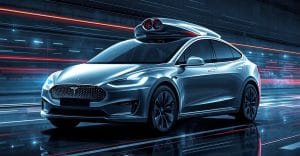
Tesla has posted a projection that its planned autonomous Cybercab vehicle could nearly halve emissions per mile compared to its existing Model 3 and Model Y, citing higher use through ride-hailing as the key driver.
If you’ve ever watched your car sit on the driveway all day while you’re at work, Tesla’s latest claim might make you think twice. The company posted on X that its planned Cybercab autonomous vehicle is “projected to nearly halve emissions per mile compared to Model 3 + Model Y” — and the argument behind it is straightforward enough: a car that never stops working produces far fewer emissions per journey than one that spends most of its life parked.
Tesla’s post states that typical personal cars sit parked around 95% of the time, whereas the Cybercab “keeps driving, doing the work of several cars.” The implication is that a single autonomous vehicle operating continuously in a ride-hailing fleet could replace several privately owned cars, spreading the emissions cost of manufacturing and charging across far more journeys.
It’s a compelling idea. But there’s a lot to examine before it becomes reality — especially here in the UK.
What Is the Cybercab, Exactly?
The Cybercab is Tesla’s purpose-built autonomous ride-hailing vehicle. It is not a modified Model 3 or Model Y. Tesla has described it as designed from the ground up for driverless, high-use operation — no steering wheel, no pedals, no human driver required.
As of mid-2026, it has not entered mass production. It does not have UK type approval, which means it cannot legally be sold or operated on British roads. And the emissions figure in the tweet is a manufacturer projection — not a figure verified by any independent body, academic study, or UK regulator.
That last point matters. The claim that Cybercab could “nearly halve emissions per mile” compared to the Model 3 and Model Y is Tesla’s own modelling. No peer-reviewed lifecycle analysis has confirmed it. The Model 3 and Model Y are both fully electric, already on sale in the UK, and carry official WLTP efficiency ratings used for regulatory and tax purposes. The Cybercab has none of that yet.
The Case Tesla Is Making
The logic behind the projection rests on use. Academic transport research does broadly support the idea that private cars are parked most the time — the 90–95% figure is widely cited, though the precise 95% number in Tesla’s tweet isn’t drawn from a specific official dataset.
If an autonomous vehicle operates continuously, carrying multiple passengers across the day, the carbon cost of building and charging it gets divided across a far greater number of passenger-miles. That’s the argument. And in theory, it’s consistent with how transport planners think about shared mobility.
But the real-world picture is more complicated. Actual emissions from any electric vehicle depend on the electricity grid at the point of charging. The UK grid has decarbonised considerably, but charging a high-use fleet at peak times still draws on a mix of generation sources. Then there’s induced demand — the risk that cheap, convenient autonomous ride-hailing simply generates more journeys overall, potentially increasing total vehicle kilometres rather than reducing them.
Environmental groups have pointed to exactly this concern. They broadly support electrification and shared transport, but tend to call for independent lifecycle studies rather than manufacturer projections before drawing firm conclusions.
Where UK Regulation Stands
Tesla’s current Autopilot and Full Self-Driving systems require an attentive human driver at all times under UK law. Fully driverless operation — what engineers call SAE Level 4 or Level 5 autonomy — is not currently permitted on British public roads.
The UK government is working on a legal framework through the Automated Vehicles Act, which received Royal Assent in 2024. It sets out how self-driving vehicles could eventually be approved for use without a human driver. But “working on a framework” and “approving a commercial robotaxi fleet” are very different things. The Driver and Vehicle Standards Agency and the Department for Transport require detailed safety and performance evidence before any highly automated vehicle gets the green light.
So the Cybercab, as described in Tesla’s tweet, cannot legally operate in the UK right now. Any future deployment would require full type approval, regulatory sign-off, and demonstrated safety performance — a process that takes years.
Industry Context
Tesla isn’t alone in chasing the robotaxi market. Waymo operates driverless ride-hailing services in parts of the United States, and several Chinese cities host autonomous taxi pilots. Early data from those programmes is beginning to emerge, though findings from San Francisco or Wuhan don’t translate directly to British roads, British weather, or British regulation.
The broader industry trend is clear: companies project lower operating costs, higher usage, and reduced emissions from autonomous fleets. Most of those projections, including Tesla’s, rest on modelling rather than long-term real-world evidence. That doesn’t make them wrong. But it does mean they should be read as ambitions rather than guarantees.
What This Means for Kent Residents
For anyone living in Kent right now, the Cybercab remains firmly in the future — there is no confirmed plan for Tesla to operate an autonomous ride-hailing service anywhere in the UK, let alone in Maidstone, Canterbury, or along the M20 corridor. If and when such services do arrive on British roads, residents would face the same questions as consumers everywhere: whether the technology is safe, how data privacy is handled, and whether it complements or competes with existing transport like Southeastern rail and local bus routes. Local taxi and private hire drivers across Kent could also be affected in the longer term, making the progress of UK autonomous vehicle legislation well worth watching.
Source: @Tesla
Tesla Claims Cybercab Robotaxi Could Nearly Halve Emissions Per Mile Against Model 3 and Model Y Quiz
5 questions