
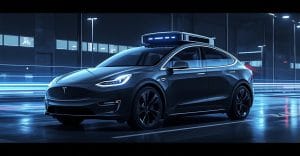
Tesla’s steering-wheel-free Cybercab is now carrying staff around the Giga Texas site, marking a new phase in the company’s autonomous ride-hailing programme but still limited to factory grounds.
Picture a car pulling up to collect you from work. No driver. No steering wheel. No pedals. Just a two-seat pod with butterfly doors that swings open and waits for you to climb in. That’s what Tesla employees at Gigafactory Texas in Austin are now experiencing — and it’s the closest the company has yet come to running a real-world robotaxi service with actual passengers on board.
On 10 July 2026, Tesla’s official X account posted a short video of the Cybercab operating on the Giga Texas campus, accompanied by the announcement: “Cybercab employee rides at Giga Texas starting soon.” Subsequent reporting indicates those rides have since moved from imminent to active, with staff now travelling around the factory site in unsupervised, driverless vehicles as part of an internal programme.
The Cybercab has no manual controls at all. It was built from the ground up on the assumption that software — not a human — will always be doing the driving. That design choice makes it fundamentally different from Tesla’s existing consumer vehicles, which retain conventional controls and are subject to ongoing driver-assistance regulation.
What Tesla Is Actually Doing at Giga Texas
Gigafactory Texas is an enormous manufacturing and logistics campus, covering hundreds of hectares on the outskirts of Austin. Its internal road network, car parks, and defined routes make it a controlled environment — far removed from the unpredictability of a city street, but considerably more complex than a closed test track.
The employee ride programme is, in essence, a shuttle service. Workers can be picked up and dropped off within the site by a Cybercab operating without any human safety driver present. Tesla hasn’t disclosed how many vehicles are running, what the operating hours are, whether staff summon rides through an app, or what speed limits apply on the routes. Those details remain unpublished.
But every trip matters. Each mile driven with a real passenger on board feeds data back into Tesla’s neural networks — the same systems that underpin Autopilot and Full Self-Driving across its wider consumer fleet. In that sense, the Giga Texas programme is as much a data-gathering exercise as it is a transport service.
A Milestone, But Not a Launch
Some observers have greeted the announcement with genuine excitement. The Cybercab’s post attracted around 2.9 million views across Tesla-related X accounts, reflecting the level of public interest in the project.
Yet industry analysts have been quick to draw a line between what this is and what it isn’t. Operating driverless vehicles on private property, carrying employees who’ve presumably consented to the experience, is a very different proposition from running a commercial robotaxi service on public streets with paying members of the public.
It’s a bit like a restaurant cooking meals for its own staff before opening to customers. Useful, necessary even — but not the same thing as being open for business.
Sam Abuelsamid, a principal analyst at Guidehouse Insights who covers the autonomous vehicle sector, has previously noted that the gap between controlled-environment testing and regulated public deployment remains one of the hardest problems in the industry. The engineering is one challenge; the regulatory, insurance, and liability frameworks are another entirely.
Tesla has not announced any confirmed timeline, route details, or regulatory approvals for Cybercab services on public roads — in Austin or anywhere else.
The Broader Race for Driverless Transport
Tesla isn’t alone in chasing the robotaxi dream. Waymo, the Alphabet-owned autonomous vehicle company, has been running fully driverless paid rides in San Francisco, Los Angeles, and Phoenix for some time, operating within geofenced urban areas under specific regulatory licences. China’s Baidu has its own Apollo Go service expanding across several cities.
What makes Tesla’s approach different is its reliance on a vision-based, neural network system trained on data from its consumer fleet — rather than the high-definition mapping and lidar sensors that competitors tend to use. The Giga Texas rides are, among other things, a live test of whether that approach holds up in a real operational setting.
And Tesla has form for ambitious timelines that slip. The company has been promising a commercial robotaxi service for several years. Whether Giga Texas represents the beginning of that becoming real, or another step in a longer road, is unclear.
What This Means for Kent Residents
There are currently no confirmed plans, pilots, or announced timelines for Tesla Cybercab operations anywhere in the United Kingdom, let alone in Kent; the programme is entirely focused on private property in Texas. Any future deployment on British roads would require engagement with the Department for Transport, the Vehicle Certification Agency, and local highways authorities — a process that could take years. For now, Kent residents and UK consumers are watching the same story as everyone else: a genuinely interesting development in autonomous transport that remains, for the time being, firmly on the other side of the Atlantic.
Source: @Tesla
Tesla Cybercab Begins Unsupervised Employee Rides at Gigafactory Texas as Driverless Robotaxi Testing Ramps Up Quiz
5 questions