
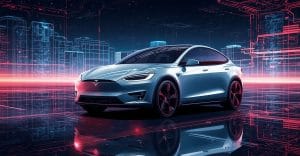
Tesla’s fully autonomous Cybercab is already giving rides in Austin, Texas, yet US federal safety standards still require the very controls the vehicle deliberately omits.
Picture a taxi that has no steering wheel, no pedals, no sideview mirrors — and is already picking up passengers on public roads. That’s the Tesla Cybercab, and it’s now caught the attention of America’s federal vehicle safety watchdog.
The National Highway Traffic Safety Administration, known as NHTSA, has opened a formal inspection into how Tesla self-certified the Cybercab as compliant with US Federal Motor Vehicle Safety Standards — a set of more than 70 individual rules covering everything from braking and tyres to lighting, visibility and occupant protection. The problem, according to multiple reports, is that several of those rules were written with a human driver in mind. And the Cybercab has no human driver.
What Exactly Is the Cybercab?
The Cybercab is a two-seat, fully autonomous vehicle. There’s no steering wheel. No accelerator pedal. No brake pedal. No sideview mirrors. Tesla has replaced those traditional components with an automated driving system — software and sensors doing the job that a driver would normally do.
That’s a bold design choice. And it puts the car in direct conflict with existing federal rules that explicitly assume a human at the controls.
Current Federal Motor Vehicle Safety Standards require items such as an inside rearview mirror, a driver’s outside mirror, a steering column, and driver-operated pedals. Those aren’t vague guidelines — they’re codified requirements. Vehicles that can’t meet them typically need to apply to NHTSA for a formal exemption, with a cap of up to 2,500 non-compliant vehicles per manufacturer per year under specific conditions.
Tesla, according to reporting by Forbes and others, has not applied for such an exemption. The company’s position is that the Cybercab already complies with all applicable standards, arguing that its autonomous systems and sensor suite deliver equivalent — or better — safety than traditional hardware.
NHTSA isn’t taking that at face value.
Regulators Are Playing Catch-Up
To be fair to Tesla, US regulators have known for years that the rulebook needs updating. NHTSA and the US Department of Transportation are actively working through new rulemaking to accommodate vehicles designed to be driven exclusively by automated systems. That includes proposals to remove the requirement for manual brake pedals in fully autonomous vehicles, and a review of rear visibility rules that would shift the focus from specific mirror hardware to functional requirements — camera-based systems, for instance.
But those changes are proposed or in progress. They are not yet law.
That leaves the Cybercab in a grey area. Most Level 4 autonomous vehicle deployments so far — the kind that can handle all driving without any human input — have kept conventional controls in place precisely to avoid this kind of compliance problem. Tesla’s decision to strip them out entirely is more radical than most existing autonomous pilots, and it’s that choice that’s now under scrutiny.
Tesla’s Argument and Its Critics
Tesla’s case rests on the idea that safety standards should focus on outcomes — can the vehicle brake effectively, detect obstacles, maintain stability? — rather than prescribing specific hardware that may simply be irrelevant when there’s no human driver. Industry advocates broadly agree, arguing that clinging to legacy requirements like steering columns and pedals is holding back the full potential of autonomous transport.
Critics see it differently.
Safety advocates and legal analysts point out that if a fully automated vehicle fails mid-journey, there’s no fallback. No passenger can grab a wheel. No emergency service can instruct someone to brake. That raises questions about fail-safe design, liability, and public trust — questions that, in their view, haven’t been adequately answered yet.
There are also broader concerns about self-certification. Under the US system, manufacturers certify their own vehicles as compliant rather than submitting to pre-market approval by regulators. That works reasonably well when the rulebook is clear. But when a vehicle omits components that the rules explicitly require, some analysts argue the system needs a stronger check before rides begin — not after.
The Cybercab is already operating in Austin, Texas. The review is happening in real time, with passengers already on board.
What Comes Next
NHTSA’s inspection will examine Tesla’s data and the process by which the company determined the Cybercab met existing standards. Regulators have the power to demand design changes, limit deployment, or require Tesla to seek a formal exemption. They can also, in principle, accelerate rulemaking to give autonomous vehicles a clearer legal path forward.
The US Department of Transportation has framed its proposed updates — including removing manual brake pedal mandates for fully automated vehicles — as commonsense modernisation. But commonsense updates still take time to move through the federal rulemaking process, and until they’re finalised, the Cybercab sits in uncertain territory.
How NHTSA handles this will set a precedent. Not just for Tesla, but for every autonomous vehicle manufacturer watching from the sidelines.
What This Means for Kent Residents
The Cybercab and its regulatory tangle are a US story for now — there are no verified deployments of control-free autonomous taxis anywhere in the UK, including Kent. But the same questions will land here eventually. UK vehicle type-approval rules, overseen by the Department for Transport and the Driver and Vehicle Standards Agency, still assume steering wheels, pedals and mirrors on road vehicles, meaning any Cybercab-style design would need new legislation or formal exemptions before it could legally operate on Kent’s roads. For residents, the practical issues — who is liable if an autonomous taxi crashes, whether such vehicles would be permitted in town centres or on the county’s major A-roads, and how insurers would price the risk — are questions that UK policymakers will need to answer before this technology arrives on British streets.
Source: @verge
Tesla Cybercab Lacks Mirrors and Pedals as US Safety Regulators Open Compliance Review Quiz
5 questions