
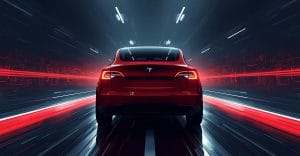
Tesla’s updated Model Y uses anti-pinch sensors in its rear seats and power liftgate to detect obstructions and automatically reverse — but the company warns the system cannot catch everything.
Tesla has been promoting a safety detail built into the updated Model Y: powered rear seats and the power liftgate that can sense an obstruction and automatically reverse direction before causing injury or damage. The company demonstrated the feature in a video using a toy duck as the obstacle, with both the folding seats and the boot lid stopping and springing back when they made contact.
The post drew attention to what Tesla framed as evidence that its safety thinking extends well beyond crash avoidance. Tao Lin, Tesla’s Vice President for Global Affairs, said: “Tesla’s safety lies in every subtle detail.”
What the Feature Actually Does
The anti-pinch behaviour works like this: if the powered liftgate senses something in its path while closing, it stops and emits two chimes. The driver then needs to remove the obstruction before trying again. Tesla’s own owner’s manual for European markets confirms this, though it describes the liftgate stopping and chiming rather than explicitly “popping back up” — the phrasing used in Tesla’s social media post.
For their part, the powered rear seats appear to work on the same principle. When folding or adjusting, they’re designed to stop and reverse if they detect resistance, preventing bags, limbs, or — as the video shows — a rubber duck from being crushed.
But Tesla is also candid about the limits. The owner’s manual states clearly that the liftgate cannot detect all objects at all times, and drivers are told not to rely solely on the sensor when opening or closing the boot. That’s a meaningful caveat. The system is an assist, not a guarantee.
Where the Model Y Fits In
Anti-pinch and obstruction-detection systems aren’t new to the car industry. Powered windows have used similar technology for years, and premium saloons have offered obstruction-aware boot lids for some time. What Tesla is doing here is extending that logic to the rear seat mechanism — a component that can generate considerable force when folding flat.
The Model Y’s wider safety package already includes obstacle-aware acceleration, collision avoidance assist, and a camera-based system that monitors the vehicle’s surroundings. The seat and liftgate sensors sit alongside those features as part of the same general philosophy: use sensors to reduce the chance of something going wrong before the driver notices.
Meanwhile, the variant shown in the video is described as the Model Y Long Wheelbase. That configuration is available in some markets, with cars supplied from Tesla’s Shanghai factory to Asia-Pacific and other regions. Whether a distinct Long Wheelbase version will reach UK buyers with identical specifications hasn’t been confirmed in Tesla’s UK documentation at this stage, so that detail should be treated as unverified for now.
What Tesla Doesn’t Publish
One thing worth flagging: Tesla doesn’t release numerical performance data for the obstruction-detection system in its publicly available manuals. There are no figures for maximum closing force, torque limits, or sensor sampling rates. That makes independent verification of how sensitive the system actually is — and how consistently it performs in real-world conditions — difficult.
Owners on forums have noted that the liftgate can still make contact with low garage ceilings if the maximum open height hasn’t been set correctly for the space, because the sensors are primarily designed to detect objects during closing, not to prevent the lid from striking a fixed structure above. That’s a practical limitation worth understanding before assuming the system covers every scenario.
A Safety Feature, Not a Substitute for Supervision
The broader point from safety advocates is a straightforward one. Anti-pinch systems reduce risk. They don’t eliminate it. Child-safety campaigners generally support the inclusion of such features but call for clear communication about what they can and can’t do — above all given that marketing videos, by their nature, tend to show the feature working perfectly.
Tesla’s demonstration with the toy duck is effective as a visual, but a duck is a uniform, rigid object placed squarely in the path of the seat. A child’s hand, a pushchair handle, or a soft bag might present differently to the sensor. The company’s own manual implicitly acknowledges this by telling drivers to supervise operation rather than rely on the detection alone.
What This Means for Kent Residents
Kent households that use a Model Y for school runs, supermarket trips, or loading pushchairs and luggage will find the obstruction-detection useful in tight car parks and home garages — but it’s worth reading the manual’s caveat that the system won’t catch everything. Parents in particular should treat the feature as a backup rather than a reason to let children near folding seats or a closing boot unsupervised. Any software updates to the liftgate or seat systems would come over-the-air or through Tesla’s authorised service network, accessible from Kent, rather than requiring any local authority involvement.
Source: @Tesla
Tesla Model Y's Powered Seats and Boot Lid Will Stop and Reverse When They Detect an Obstruction Quiz
5 questions