
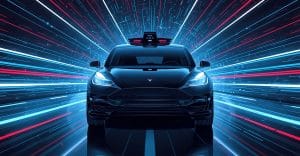
Tesla’s FSD (Supervised) has been authorised in the Netherlands under UN Regulation 171, marking the first European country to formally approve the advanced driver assistance system.
A Tesla dealing with Dutch roadworks — briefly crossing into the opposite lane to pass construction vehicles, yielding to cyclists, then merging back into traffic — has become the centrepiece of Tesla’s latest European push. The clip, posted by Tesla Europe, isn’t just a demonstration video. It’s a statement of intent.
The Netherlands’ vehicle authority, the RDW, has formally approved Tesla’s Full Self-Driving (Supervised) software under UN Regulation 171, classifying it as a Driver Control Assistance System (DCAS). That makes the Netherlands the first European country to give the system the regulatory green light. It’s a moment Tesla has been working towards for some time, and the Dutch roadworks video is very much part of that story.
What FSD (Supervised) Actually Does
It’s worth being clear about what this system is — and what it isn’t. Tesla’s FSD (Supervised) is a Level 2 driver assistance system. That means the car can handle steering, acceleration, and braking across all sorts of conditions, including urban streets, motorways, roundabouts, traffic lights, and junctions. But the driver must remain attentive and in control at all times, ready to intervene immediately.
Tesla describes the system as capable of driving a vehicle “almost anywhere” under supervision. The Dutch video shows it doing exactly that in a genuinely tricky scenario: a narrow road, construction vehicles blocking the lane, cyclists approaching, and oncoming traffic to contend with. The system navigates around the obstruction, yields appropriately, and rejoins the lane.
But Tesla is careful — and regulators are insistent — that this is not autonomous driving. The human driver remains legally responsible for the vehicle throughout.
The Road to Dutch Approval
Getting here wasn’t quick. RDW’s approval reportedly followed around 18 months of testing, more than 1.6 million kilometres of European road data, and compliance checks against over 400 individual technical requirements under UN Regulation 171. That’s a hefty regulatory process, and one that Tesla’s European team will have been closely involved in throughout.
Tesla says FSD (Supervised) draws on camera-based perception, onboard sensors, and neural networks trained on what the company reports as around 8.3 billion miles of real-world driving data globally — though that figure comes from Tesla’s own disclosures and hasn’t been independently verified by European or UK regulators.
On safety, Tesla’s internal Vehicle Safety Report claims that vehicles with FSD (Supervised) engaged experience seven times fewer major and minor collisions than those driven without it, and five times fewer off-highway collisions. Those are striking numbers. They are also entirely company-reported, and no independent UK or EU body has validated them.
Some safety advocates accept the Level 2 classification but raise concerns about Tesla’s marketing language around complex manoeuvres — like the opposite-lane roadworks pass shown in the Dutch video — potentially encouraging drivers to over-trust a system that still demands constant attention.
What the Dutch Approval Means for Europe
UN Regulation 171 provides a shared framework for advanced driver assistance systems across many European markets. That matters because it enables mutual recognition of approvals between participating states. In practical terms, the Netherlands’ decision looks set to create a pathway for Germany, France, Italy, and other European markets to assess FSD (Supervised) without starting entirely from scratch.
That’s the theory, at least. In practice, each country will still apply its own assessment, and local road conditions — narrower streets, different cycling infrastructure, varied signage — mean performance in Amsterdam doesn’t automatically translate to performance in Berlin or Rome.
European Tesla owners have broadly welcomed the Dutch approval, viewing it as confirmation that North American FSD functionality is finally heading their way. Some, though, have flagged concerns about how the system will handle local road norms and cyclist-heavy urban environments where the margin for error is slim.
The UK Picture
Here’s where it gets more complicated for British drivers. The Netherlands’ approval under UN Regulation 171 does not automatically carry over to the United Kingdom. Post-Brexit, the UK operates its own regulatory framework for automated and semi-automated vehicles, guided by the Automated Vehicles Act and overseen by bodies including the Department for Transport and the Vehicle Certification Agency.
Tesla has indicated it is engaged in a parallel testing and regulatory programme with UK authorities, but no confirmed public launch date for FSD (Supervised) on UK roads has been officially announced.
For now, UK Tesla owners have access to Autopilot and related driver assistance features already permitted here, but not to FSD (Supervised). Any future availability depends entirely on UK-specific approvals, on a separate timetable from whatever happens in Europe.
What This Means for Kent Residents
Kent Tesla owners currently have access only to the driver assistance features already approved for UK roads — FSD (Supervised) remains unavailable here until the Department for Transport and the Vehicle Certification Agency complete their own assessment process, which has no confirmed timeline. If and when UK approval does come through, drivers on routes like the M2 and M20, or in busy urban areas such as Maidstone and Canterbury, would be among those who could eventually use the system — though any deployment would be subject to whatever restrictions UK regulators choose to impose. For now, the Dutch breakthrough is a European story, and British drivers are watching from the pavement.
Source: @Tesla
Tesla's Full Self-Driving System Clears Dutch Approval in First European Regulatory Breakthrough Quiz
5 questions