
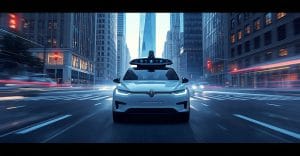
A Waymo robotaxi in Los Angeles has been shown handling a street transformed into a New York City film set, demonstrating how the Waymo Driver uses mapped geometry rather than visual cues to work through.
Waymo’s autonomous vehicles report 94% fewer serious injury crashes than an average human driver over the same distance. That single figure, drawn from Waymo’s own safety performance publications, sits at the centre of the company’s case for driverless taxis — and it got fresh context this week when Waymo posted footage of one of its robotaxis managing a Los Angeles street that had been dressed to look like New York City for a film production.
The post, shared on Waymo’s official social media channels, shows the Alphabet-owned company’s vehicle moving through a stretch of LA road lined with props, altered shopfronts and signage designed to mimic Manhattan. The implication is clear: the Waymo Driver didn’t need the street to look like itself. It already knew where it was.
How the Waymo Driver Actually Works
The system doesn’t deal with the way a human does, glancing at shop signs or landmarks to get its bearings. Before Waymo operates in any new area, the company builds highly detailed custom maps capturing lane markers, kerbs, zebra crossings, traffic signals and the physical geometry of every junction. When the vehicle is on the road, it matches real-time sensor data against those stored maps to pinpoint its location — GPS alone isn’t relied upon, which matters in dense urban areas where satellite signals bounce off buildings and become unreliable.
For their part, the hardware doing the sensing is big. Lidar units on each vehicle can measure objects up to roughly 300 metres away in every direction — about three American football fields — combined with cameras and radar to give 360-degree perception. Waymo describes the system’s overall logic as “Sense, Solve, Go”: perceive the environment, predict what everyone around the vehicle is about to do, then execute a safe path through motion control.
So when a film crew replaces a Los Angeles café with a fake New York deli and puts up unfamiliar street signs, the Waymo Driver’s localisation is anchored to the underlying road geometry, not the décor. The kerbs are still in the same place. The junction geometry hasn’t moved. The vehicle can, in principle, work with that.
That said, Waymo’s own technical documentation acknowledges that large-scale changes can still require map updates or more cautious behaviour from the vehicle. The specific clip posted this week is corporate-controlled marketing content, and the performance figures for that particular scenario are independently unverified.
The Safety Numbers — and the Caveats
Waymo’s published data makes a strong statistical case. Compared with an average human driver covering the same distance in its operating cities — Los Angeles, San Francisco, Phoenix and Austin — the Waymo Driver recorded 82% fewer crashes involving airbag deployment (305 fewer crashes) and 82% fewer injury-causing crashes overall (707 fewer). The serious injury figure, that 94% reduction representing 47 fewer crashes, is the headline claim.
These numbers come from Waymo’s own safety publications, not an independent regulator. Road safety advocates and researchers have consistently called for independent validation of company-reported crash statistics, and for clearer accountability frameworks in mixed-traffic environments where driverless vehicles share roads with cyclists, pedestrians and human-driven cars.
Some community voices in Los Angeles have argued that companies like Waymo are, in effect, using public streets and local residents as large-scale test subjects — deploying technology before thorough regulatory and ethical frameworks are fully in place. It’s a fair challenge to raise, even if Waymo’s safety data trends in a broadly positive direction.
Operating in the Real World
Waymo’s LA service runs within a defined zone covering neighbourhoods including Santa Monica, Marina del Rey, West Hollywood and parts of downtown. Users book rides through the Waymo app; no driver is present. The company says its vehicles can handle construction zones, crossing guards directing traffic and unpredictable behaviour from other road users.
When a vehicle encounters a situation it cannot confidently resolve, remote fleet response staff can be contacted — though Waymo is clear that the vehicle itself retains control and continues making safety decisions. It doesn’t just stop and wait for a human to take over remotely.
The film-set scenario fits Los Angeles above all well. The city is one of the world’s most active production locations, and streets are regularly closed, dressed or altered for shoots. That Waymo has thought through this specific edge case says something about how the company approaches urban complexity — even if the marketing framing around it deserves the usual scepticism.
What This Means for Kent Residents
Waymo does not currently operate anywhere in the UK, so there’s no immediate practical impact for people in Kent. But the technology being demonstrated in Los Angeles — autonomous vehicles managing temporary road changes, construction zones and altered street layouts — is directly relevant to how UK transport policy may eventually develop, and Kent County Council along with National Highways will likely be watching deployments like this as they consider future frameworks for autonomous vehicles on British roads. For consumers, the broader question is when, not if, driverless taxi services arrive in UK cities, and what safety standards and insurance rules will govern them when they do.
Source: @Waymo
Waymo's Self-Driving Car Navigates Los Angeles Street Dressed as New York City Film Set Quiz
5 questions