
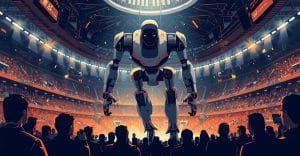
Hyundai’s humanoid robot Atlas performed footballer goal celebrations and delivered the match ball at the World Cup Round of 16, in a global first for live sports.
There’s a moment at any big football match when the crowd holds its breath — and at New York/New Jersey Stadium in East Rutherford, New Jersey, that moment came not from a striker bearing down on goal, but from a humanoid robot walking onto the pitch in front of around 80,000 spectators. Boston Dynamics’ Atlas, the most advanced bipedal robot the company has ever produced, stepped into the interval of a FIFA World Cup 2026 Round of 16 fixture between Brazil and Norway to perform goal celebrations and hand the match ball to the referee for the second half.
It’s the kind of thing that, not long ago, would have seemed firmly in the field of science fiction. But this was live, in a packed stadium, broadcast to a global audience.
What Atlas Actually Did on the Pitch
The activation was organised by Hyundai Motor Company, the Official Robotics Partner of FIFA World Cup 2026, as part of its broader “School of Football” campaign. During the interval, Atlas performed a sequence of goal celebrations modelled on moves associated with some of football’s biggest names — England’s Harry Kane, Norway’s Erling Haaland, Brazil’s Matheus Cunha, and South Korea’s Son Heung-min. After the performance, the robot carried the ceremonial match ball across the pitch and delivered it to the referee, helping kick off the second half.
Boston Dynamics shared footage of the appearance across TikTok, Instagram, YouTube and X, with captions describing how Atlas “stepped into the spotlight” at the World Cup and helped “kick-off the second half.”
The whole sequence depended on a cluster of advanced robotics techniques. Hyundai and Boston Dynamics describe these as including *retargeting technology* — which maps human movement onto the robot’s body so it can replicate gestures — alongside whole-body control, model predictive control, and sophisticated locomotion systems. In plain terms: Atlas watched how a footballer moves and reproduced it, in real time, on grass, in front of a crowd.
A Production Robot, Not a Lab Experiment
This wasn’t a research prototype wheeled out for a photo opportunity. Boston Dynamics introduced the production version of Atlas at CES 2026 earlier this year, designed for real-world commercial and industrial use rather than purely for demonstration purposes. The World Cup appearance is being presented by Hyundai and Boston Dynamics as the first public demonstration of this production-level Atlas in a major live sports setting.
It’s also described — by Hyundai, Boston Dynamics and media covering the event — as the first-ever integration of a humanoid robot into a FIFA World Cup live match environment. FIFA’s own partner communications support that claim, and there’s no record of a humanoid robot delivering a match ball or performing on-pitch at any previous World Cup.
That said, the reported attendance figure of roughly 80,000 at the Brazil vs Norway fixture, and the specific fixture pairing itself, are sourced from Boston Dynamics and Hyundai materials rather than independently confirmed FIFA match records at the time of writing.
Not Everyone Is Celebrating
The reaction online has been largely enthusiastic, with clips of Atlas doing Erling Haaland’s meditation pose spreading widely across social media. But the appearance has also prompted a familiar set of questions about where humanoid robots are heading.
Some commentators have raised concerns about job displacement — asking whether robots performing roles at stadiums, in hospitality, or in logistics could reduce employment opportunities for people. Others have focused on safety, questioning how thoroughly Atlas was tested for operation in a densely crowded live environment, and what the liability position would be if something went wrong. There are also broader debates about the normalisation of humanoid robots in public spaces, including questions around data collection and surveillance.
These are fair questions to ask. And they’re ones that regulators, employers, and the public will need to keep asking as robots like Atlas move from showcase events into everyday settings.
Boston Dynamics and Hyundai, for their part, have not published details of the safety approval process or the specific risk assessments carried out ahead of the appearance. No official reports of safety incidents at the event have been published.
The Bigger Picture for Robotics
Hyundai’s decision to use the World Cup as a platform for Atlas reflects a wider strategy of building public familiarity with humanoid robots through high-profile, visible moments. The company owns Boston Dynamics and has been positioning itself not just as a car manufacturer but as a robotics and mobility group.
Atlas-class robots are being developed for use in logistics, manufacturing, construction, inspection and disaster response. The World Cup appearance is entertainment, yes — but it’s also a very public proof of concept. Demonstrating that a humanoid robot can operate safely, on time, in front of a global broadcast audience and tens of thousands of people is a different kind of test from anything a laboratory can provide.
What This Means for Kent Residents
For anyone in Kent watching the World Cup, the Atlas appearance is a reminder that humanoid robotics is moving quickly from research curiosity to real-world deployment — and that has practical effect on local industries. Businesses across the Thames Estuary corridor in logistics, warehousing and manufacturing will be keeping a close eye on companies like Boston Dynamics as commercial robots edge closer to affordable, scalable use. Closer to home, institutions like the University of Kent are likely to find moments like this useful when making the case for robotics, computer science and engineering courses to prospective students — because it’s one thing to describe what a humanoid robot can do, and quite another to point to one delivering a match ball at the World Cup.
Source: @BostonDynamics
Boston Dynamics' Atlas Robot Makes History at FIFA World Cup 2026 in Front of 80,000 Fans Quiz
5 questions