
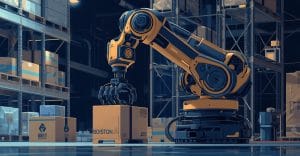
The Stretch warehouse robot uses a smart suction gripper, machine vision and individually controlled suction cups to pick and move cardboard cases of varying sizes and weights.
Picture a floor-loaded shipping container, packed floor to ceiling with cardboard boxes of every shape and size. Some are dented. Some are printed with bold promotional graphics that would confuse a simple camera. A human worker would spend hours in there, lifting case after case — some weighing as much as a full sack of cement. Boston Dynamics thinks its Stretch robot can do the same job, and it’s been showing the world how.
The company posted a look at Stretch’s gripper technology on social media, drawing fresh attention to the mechanics behind one of the more practically focused robots it has built. This isn’t Atlas doing backflips. Stretch is built for the unglamorous, repetitive, physically punishing work of shifting boxes in warehouses and distribution centres.
How the Gripper Actually Works
The heart of Stretch is its vacuum suction gripper — a system that uses pneumatic control and onboard sensing to latch onto cardboard surfaces. What makes it more capable than a basic suction pad is that the cups are individually actuated. So if a box has a slightly bowed surface, a torn corner, or an uneven print, the gripper can still maintain contact across the parts of the surface that are usable.
Boston Dynamics says Stretch can handle boxes with varying sizes, weights, packaging graphics, and some degree of physical damage — all without needing to be pre-programmed for each individual box type. That’s not a trivial claim. Traditional pick-and-place systems often require careful calibration for each SKU, which makes them poorly suited to the chaotic reality of a mixed-goods container.
The robot can manage cases up to 23kg — roughly the weight limit recommended for manual lifting in occupational health guidance — and boxes up to 91cm in any dimension under its stated configuration.
Eyes on the Job
Stretch doesn’t work blind. It uses both 2D and 3D vision systems to identify boxes and make picking and placing decisions in real time. The combination matters: 2D cameras can read labels and surface features, while 3D sensing gives the robot spatial awareness — where a box sits, how it’s angled, what’s around it.
This perception layer is what allows Stretch to work in unstructured environments. A container isn’t a tidy conveyor belt. Boxes shift during transit, stack at odd angles, and vary wildly from one shipment to the next.
Boston Dynamics has demonstrated Stretch unloading cases at between 500 and 600 per hour. The company has also projected that a single case-picking system could reach around 800 cases per hour after planned optimisation. Both figures are Boston Dynamics’ own, and haven’t been independently verified by third parties, so they’re best read as targets and demonstrations rather than guaranteed operating rates.
What Stretch Is Built to Do
The robot combines several components: a mobile base that can face warehouse floors, a telescopic conveyor, a robotic arm, the perception system, and the vacuum gripper. Boston Dynamics describes a range of applications — unloading floor-loaded containers and trailers, palletising and depalletising, order building, and outbound truck loading.
On top of that, the company has also developed Orbit, its warehouse management integration software, designed to tie Stretch into broader warehouse operations and inventory systems.
By the end of August 2023, Boston Dynamics stated that Stretch robots had moved more than one million customer boxes since commercial shipments began in January of that year. That figure comes from Boston Dynamics itself and hasn’t been independently verified.
The wider context here is hard to ignore. Warehousing and logistics have faced persistent labour shortages, high injury rates from repetitive manual handling, and pressure to increase throughput. Robots like Stretch are a direct response to all three.
Not Without Questions
Automation in warehouses is not a simple story of progress.
From a worker’s perspective, reducing heavy lifting is genuinely beneficial — repetitive manual handling is one of the leading causes of musculoskeletal injury in logistics roles. But automation also reshapes what those jobs look like. Roles focused on monitoring equipment, maintaining robotic systems, handling exceptions, and integrating new technology are likely to grow. Roles centred on physical case handling may shrink or change substantially.
The line between what a robot can and cannot do keeps shifting as the technology improves.
Performance in real-world conditions can also vary. Vacuum gripping works well on smooth, dry, intact cardboard. Wet boxes, heavily damaged surfaces, very light or very heavy cases, and unusual packaging can all affect reliability. Boston Dynamics acknowledges that the gripper is designed to handle some damage and variation — but “some” is doing real work in that sentence.
What This Means for Kent Residents
Kent is home to a hefty number of distribution centres, logistics operators and retail warehouses, above all along the M20 corridor and around the port of Dover, making the county part of the supply chain that robots like Stretch are designed to serve. For workers in those facilities, the technology could eventually mean less heavy lifting — but also a shift in the skills employers look for, with more emphasis on equipment monitoring and systems management. For consumers across the county, wider adoption of warehouse automation could influence delivery speeds and costs over time, though any such effects remain speculative at this stage.
Source: @BostonDynamics
Boston Dynamics' Stretch Robot Uses Adaptive Vacuum Gripper to Handle Warehouse Boxes Without Pre-Programming Quiz
5 questions