
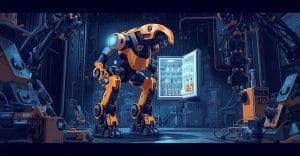
A new video from Boston Dynamics shows its Atlas humanoid robot carrying a 23 kg mini-fridge and handing over a cold drink — a glimpse at what industrial robots might soon be doing for real.
Imagine coming home after a long shift and asking a robot to grab you a drink from the fridge. It sounds like science fiction. But a new demonstration from Boston Dynamics suggests that kind of capability is getting closer — and the technology behind it is more sophisticated than the party trick might suggest.
Boston Dynamics published a video and accompanying social media post showing its Atlas humanoid robot lifting and carrying an unplugged mini-fridge, placing it on a table, and handing over a drink in a laboratory setting. The clip is part of the company’s ongoing “Atlas, can you bring me a drink?” series, designed to show how far humanoid robots have come in handling heavy, awkward objects.
What Atlas Actually Did — and How
The mini-fridge in the demo weighs around 50 lb — that’s about 23 kg, roughly the same as a large bag of dog food or a toddler. For a human, that’s a decent lift. For a robot that also has to walk, balance, and place the object precisely, it’s a genuinely difficult engineering problem.
What makes this more than a flashy video is the method behind it. Atlas uses what Boston Dynamics calls whole-body control — coordinating its arms, legs and torso together, rather than just using its arms in isolation. Think of how you naturally brace your core and shift your weight when you pick up something heavy. Atlas is doing something similar, but driven by AI.
Specifically, the system uses reinforcement learning, where the robot practises the task millions of times in a computer simulation before it ever touches a real object. The simulation trained Atlas at weights of around 23 to 32 kg. But when engineers tested it in the actual lab, the same AI policy successfully lifted loads of up to around 45 kg — well beyond what it had trained on. The new Atlas platform is rated to lift up to around 50 kg in testing.
That kind of generalisation — handling something heavier than you’ve ever practised with — is exactly what makes this demo stand out.
A Robot Ten Years in the Making
Atlas isn’t new. Boston Dynamics has been developing humanoid robots for well over a decade, originally under funding from DARPA, the US defence research agency. Early versions were hydraulically powered and focused on basic locomotion. Over the years, Atlas has learned to do parkour, backflips, and increasingly complex physical tasks.
But the version shown here is different. In early 2024, Boston Dynamics unveiled a new electric Atlas, replacing the old hydraulic system with more compact actuators and a greater range of motion. The new platform has 56 degrees of freedom — meaning 56 independent points at which it can move — and can rotate its upper body a full 360 degrees. That superhuman flexibility turns out to be genuinely useful when manoeuvring a bulky object in a tight space.
Boston Dynamics is clear that Atlas is designed for “real work” in dynamic industrial settings, not just research demonstrations. The company frames these videos as evidence that humanoid robots are approaching readiness for tasks like materials handling, logistics and heavy equipment movement.
Not Everyone Is Convinced
And yet, a lab is not a warehouse. Critics point out that controlled demonstrations don’t always translate well to the unpredictable, cluttered environments where real workers operate. Floors are uneven, objects aren’t always where they’re supposed to be, and things go wrong in ways that simulations don’t always anticipate.
There are also broader questions. What does it cost to buy and run one of these robots? Boston Dynamics hasn’t published a price for Atlas, and the system remains an R&D platform — not commercially available anywhere in the world right now. How does that stack up against paying a human worker the National Living Wage of £11.44 an hour? Nobody outside the company knows yet.
And then there’s the human side. Some workers genuinely welcome robots taking on heavy or dangerous manual handling tasks — back injuries from lifting are a serious and common workplace problem. But others worry about job displacement, reduced wages, or being replaced by machines that can work around the clock without a break.
Robert Playter, Chief Executive of Boston Dynamics, has previously said: “We want Atlas to be able to do any task a human can do in an industrial setting.” Whether that ambition translates into safe, reliable, cost-effective deployment at scale is a question the industry is still working to answer.
The Wider Race in Humanoid Robotics
Boston Dynamics isn’t alone in this space. Companies including Figure AI, Agility Robotics and Tesla — with its Optimus robot — are all pushing to prove that humanoid machines can do useful physical work. The emphasis on “accuracy and reliability” in Boston Dynamics’ messaging reflects a broader industry effort to move beyond impressive-looking clips and demonstrate that these robots can perform consistently, safely, and repeatedly.
That’s a harder bar to clear than it might look.
What This Means for Kent Residents
Atlas isn’t heading to a warehouse in Dartford or a logistics hub near Dover any time soon — this is still a research demonstration, not a commercial product. But Kent’s strong logistics economy, with its major distribution centres along the M20 and M2 corridors and the freight traffic through Dover, makes it exactly the kind of region that could eventually adopt this sort of technology as it matures. For workers in warehousing and manufacturing across the county, it’s worth keeping an eye on how quickly humanoid robotics moves from the lab to the shop floor — and what skills employers will be looking for when it does.
Source: @BostonDynamics
Boston Dynamics Atlas Robot Uses AI to Lift a Mini-Fridge and Deliver Drinks in Lab Demo Quiz
5 questions