
This is a companion piece to KLN’s report on the GB Freedom Party’s “anti-fascist fascists” broadside. GB Freedom Party and Kent Local News share a founder — see the transparency note at the end of this article.
When the GB Freedom Party argued last week that fascism should be judged “by its methods, not its slogans”, it invited a question the Kent party did not itself answer: what does the record show about the “intellectual” society that helped found Britain’s main party of the left — and that claims every Labour prime minister before the current one, and dozens of serving ministers, as members? Kent Local News went back to the documents — the Fabian Society’s own tracts and rules, its founders’ published words, the government’s own register of ministers’ interests, and the Society’s own account of its history.
Who the Fabians are
The Fabian Society was founded in London on 4 January 1884, taking its name from the Roman general Fabius Cunctator, who wore down Hannibal by patient delay rather than pitched battle. Its early members included Sidney and Beatrice Webb, the playwright George Bernard Shaw, the writer H.G. Wells and the political scientist Graham Wallas. The Webbs and Shaw went on to found the London School of Economics in 1895 and the New Statesman in 1913.
Its stated aim was never modest. The Society’s founding “Basis”, adopted in 1887 and reprinted on its publications for decades, reads: “The Fabian Society consists of Socialists. It therefore aims at the reorganisation of Society by the emancipation of Land and Industrial Capital from individual and class ownership, and the vesting of them in the community for the general benefit.” It went on to commit the Society to “the extinction of private property in Land”. Its method was equally explicit. Edward Pease, the Society’s secretary and official historian, described “permeation” — placing Fabians and Fabian ideas inside other parties, the universities and the machinery of government — as something that “has always been an important part of the propaganda of the Society”. The Society at first tried to permeate the Liberal Party; after 1900 it turned to Labour.
Labour, the prime ministers and the cabinet
The link to the Labour Party is structural. The Society took part in founding the Labour Representation Committee in 1900 and describes itself today as “a Labour affiliate and one of the party’s original founders” — the only original founder, it says, that “remains affiliated in unchanged form”. Sidney Webb drafted the original Clause IV of Labour’s 1918 constitution, committing the party to public ownership, and served in both of Ramsay MacDonald’s Labour governments.
By the Society’s own count, 229 Fabians were elected to Parliament in the 1945 landslide and “over 200” sat in the Commons after 1997. After the July 2024 election its then general secretary, Andrew Harrop, hailed “a Fabian prime minister and 141 Labour MPs who are Fabian members” — a record, according to the Society’s annual reports, out of 218 Fabian members who stood as Labour candidates. Membership lists are not public and the Society has published no updated total since, so 141 remains the best available figure — more than a third of the parliamentary Labour Party. Its website states that “every Labour prime minister has been a Fabian” — a claim covering Ramsay MacDonald, Clement Attlee, Harold Wilson, James Callaghan, Tony Blair, Gordon Brown and Sir Keir Starmer, who was a serving member of the Society’s executive when he became Labour leader in 2020. At the time of writing the site still describes Sir Keir as Labour leader and says “more than half his cabinet” are members.
Andy Burnham, who became Labour’s eighth prime minister on 20 July 2026 after Sir Keir’s resignation, has written for the Society and spoken at its events; Kent Local News could find no public record of whether he is a member, and the Society has not updated its claim. What can be checked is the government’s own transparency register. In the List of Ministers’ Interests published as at 9 July 2026 — the last before Mr Burnham took office — 31 ministers declared membership of the Fabian Society, among them Rachel Reeves, David Lammy, Lisa Nandy, Hilary Benn, Peter Kyle, Douglas Alexander, James Murray, Jonathan Reynolds and Nick Thomas-Symonds. The Society reports more than 6,000 members overall and “hundreds” of Labour politicians among them; its general secretary since January 2025 is Joe Dromey.
The wolf in the window
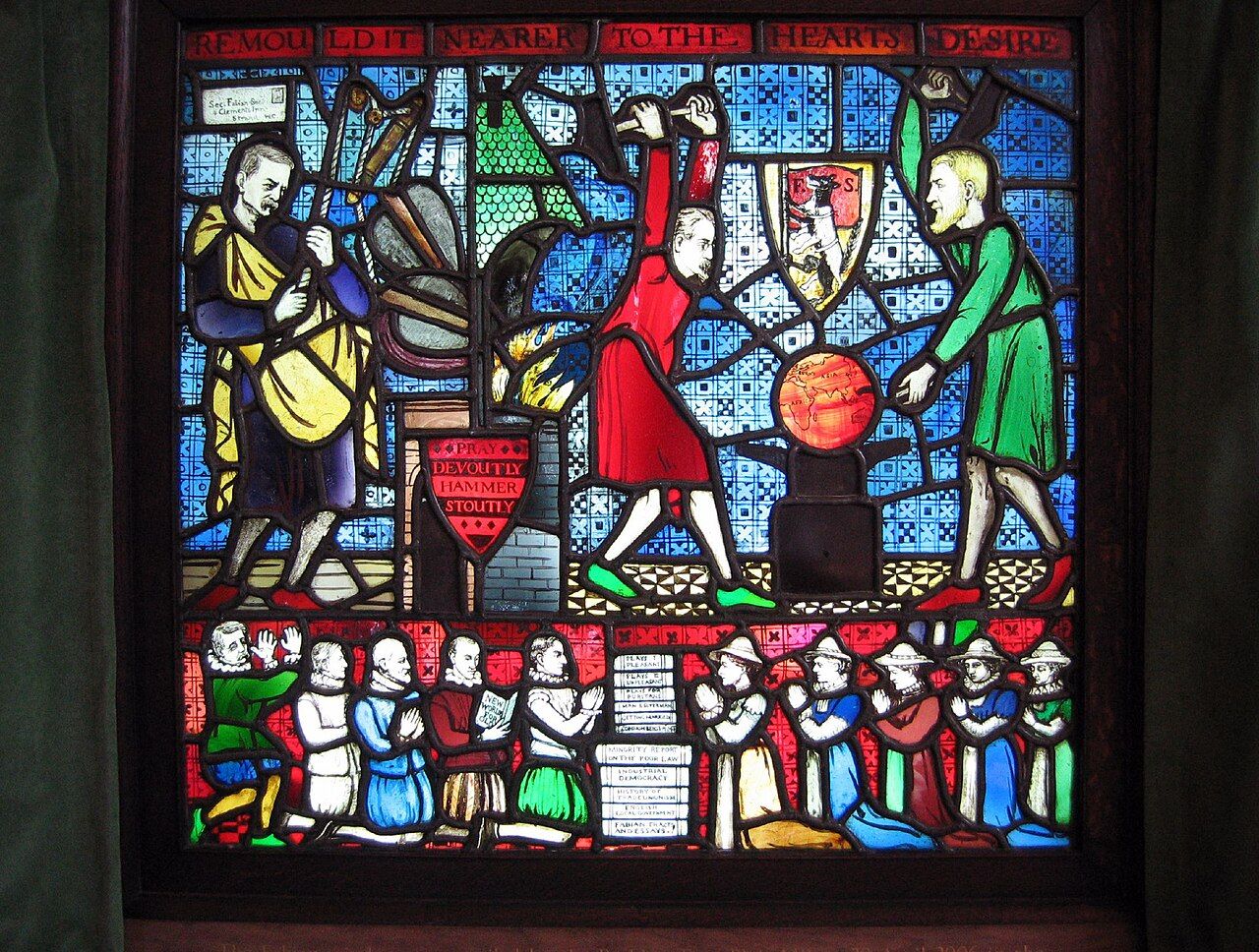
The Society’s most famous artefact is a stained-glass window designed by Shaw in 1910 and made by the artist Caroline Townshend. It shows Shaw and Sidney Webb hammering the globe on an anvil beneath the motto “Remould it nearer to the heart’s desire”, a line borrowed from Omar Khayyam. Above them hangs a heraldic shield bearing the Society’s initials — and, on it, a wolf in sheep’s clothing. Below, a row of Fabians kneel in worship before a stack of the Society’s own tracts; H.G. Wells, who had quit the Society in 1908 after a row with Shaw and the Webbs, is shown at the edge cocking a snook at his former colleagues.
The window’s own history is odd enough. It was never collected from Townshend’s studio, surfaced decades later, was stolen in 1978, reappeared in Arizona, and was bought back at Sotheby’s in 2005 by the Webb Memorial Trust. On 20 April 2006 the then Prime Minister, Tony Blair, unveiled it in the Shaw Library at the LSE, where it remains.
Fabians claim the wolf is a joke at their own expense — Shaw’s wry acknowledgement that a society of gradualists intended to change the world without frightening it. Critics have read it less charitably ever since. What is not in dispute is that Shaw chose the emblem himself, for a window that shows the Society’s members on their knees before their own writings.
Breeding a better Briton
The most uncomfortable part of the record is eugenics — the belief, fashionable across the political spectrum before 1945, that the state should encourage the “fit” to breed and discourage or prevent the “unfit” from doing so. Its leading British advocates were disproportionately found among the Fabian and socialist intelligentsia.
Shaw wrote in 1903 that “the only fundamental and possible Socialism is the socialisation of the selective breeding of Man”. In a 1910 lecture to the Eugenics Education Society, reported by the Daily Express, he told his audience that “a part of eugenic politics would finally land us in an extensive use of the lethal chamber”, and that “we should find ourselves committed to killing a great many people whom we now leave living”. In a preface to a 1922 book edited by the Webbs he wrote: “If they are not fit to live, kill them in a decent human way.”
He said it on camera, too. In a Paramount newsreel filmed in March 1931, Shaw proposed that “everybody come before a properly appointed board, just as he might come before the income tax commissioners, and, say, every five years or every seven years, just put them there, and say: Sir or Madam, now will you be kind enough to justify your existence? If you can’t justify your existence; if you’re not pulling your weight in the social boat, if you are not producing as much as you consume or perhaps a little more, then clearly we cannot use the big organisation of our society for the purpose of keeping you alive.” In the same period he told viewers: “I don’t want to punish anybody, but there are an extraordinary number of people who I want to kill.” In 1934, in the BBC’s Listener, he added: “I appeal to the chemists to discover a humane gas that will kill instantly and painlessly. In short, a gentlemanly gas.”
Just another death cult. Strip away the wit and that is what Shaw was describing: a state board to decide, every five or seven years, who may go on living, and a “gentlemanly gas” for those who fail the test. Shaw’s defenders say he was a provocateur in the tradition of Swift; the words are his, and he repeated them across a quarter of a century.
Sidney Webb’s Fabian Tract No. 131, The Decline in the Birth-Rate, published by the Society in 1907, worried that the “prudent, foreseeing and self-restrained sections of the community” were having fewer children while others were not. “This can hardly result in anything but national deterioration,” Webb wrote, “or, as an alternative, in this country gradually falling to the Irish and the Jews.” He warned of “degeneration of type — that is, race deterioration, if not race suicide”. Wells, in Anticipations (1901), wrote that “the men of the New Republic will not be squeamish, either, in facing or inflicting death”. Harold Laski — LSE professor, later chairman of the Labour Party — cautioned that “the time is surely coming … when society will look upon the production of a weakling as a crime against itself”.
The Fabians were not alone. William Beveridge, the Liberal architect of the welfare state, argued that those with “general defects” should be denied “civil freedom and fatherhood”; John Maynard Keynes was a director of the Eugenics Society; the Manchester Guardian and the New Statesman both endorsed voluntary sterilisation in the 1930s. But as the Guardian columnist Jonathan Freedland, writing from the left, put it in 2012, “The Fabians, Sidney and Beatrice Webb and their ilk were not attracted to eugenics because they briefly forgot their leftwing principles. The harder truth is that they were drawn to eugenics for what were then good, leftwing reasons”: faith in science, planning and the state, and little value placed on individual freedom.
The Society does not deny it. Its official history states: “Leading members of the society held racist prejudices and opinions which were not in keeping with the society’s commitment to equality for all, either then or now. Fabians engaged in debates on eugenics and were racist towards people of Jewish, black and Asian origin.”
Admiring the dictators
The second strand is the founders’ attitude to the strongmen of the inter-war years — the period in which, the GB Freedom Party argues, “methods” rather than labels are the test.
Shaw welcomed Mussolini’s seizure of power in 1922, calling him “the right kind of tyrant” amid parliamentary “indiscipline and muddle”, and in 1927 published a newspaper defence of the Italian dictator that drew protests from fellow socialists. In 1931 he toured the Soviet Union with Nancy Astor and told a Moscow dinner: “I have seen all the ‘terrors’ and I was terribly pleased by them.” In 1933, as Hitler took power, he described the new Chancellor as “a very remarkable man, a very able man” — though Shaw also publicly denounced the Nazi persecution of the Jews, and his biographers record that his flirtation with dictatorship dismayed friends on both left and right.
Sidney and Beatrice Webb visited the USSR in 1932, at the height of the famine in Ukraine, and in 1935 published Soviet Communism: A New Civilisation? — a thousand-page endorsement of Stalin’s system written during the purges. Later editions dropped the question mark. The historian A.J.P. Taylor called it “the most preposterous book ever written about Russia”.
Wells, for his part, coined a phrase. In July 1932 he told a Liberal summer school at Oxford that he wanted “a Liberal Fascisti, for enlightened Nazis” — an authoritarian elite to impose progress on a public he thought too slow to accept it. The historian Philip Coupland, examining the episode in the Journal of Contemporary History in 2000, concluded that “it was fascism rather than communism which came closest to Wells’s ideal”, though Wells rejected Sir Oswald Mosley’s British Union of Fascists when it appeared.
Mosley himself is the most direct link of all. By his biographers’ account he and his wife Cynthia were committed Fabians through the 1920s and into the early 1930s, and he lectured for the Society in 1924 and 1931; he sat as a Labour MP, served in MacDonald’s cabinet as Chancellor of the Duchy of Lancaster in 1929–30, resigned when his state-led economic plan was rejected — and in October 1932 founded the British Union of Fascists.
What the word means — and the counter-argument
Apparently, none of this makes the Fabian Society a fascist organisation, and for some reason no serious historian says it does. The most widely used academic definitions of fascism — the American historian Robert Paxton’s, the British historian Roger Griffin’s — centre on ultranationalism, the cult of the leader and the glorification of violence, not on planning or state ownership. Fabianism was, by its own account, parliamentary and gradualist; the Labour Party opposed Mosley’s blackshirts, and the Attlee government the Fabians helped shape fought Hitler and built the NHS.
The Society’s defenders would also point out that eugenics was the received wisdom of the Edwardian professional classes across party lines; that Shaw was a professional provocateur; that the Webbs’ Soviet infatuation was with communism, not fascism; and that the Society has openly acknowledged its members’ prejudices rather than buried them.
The counter-case — the one implicit in the GB Freedom Party’s broadside — is that fascism and communism grew from the same soil, and it too has serious scholars behind it. Mussolini was a leading Italian socialist and editor of the party newspaper Avanti! before he was anything else; the Israeli historian Zeev Sternhell, in Neither Right nor Left, traced fascist ideology to a revolt within the revolutionary left itself, and A. James Gregor argued that Mussolini’s movement grew directly out of Marxist and syndicalist thought. On that reading, what the Fabian founders shared with both movements was not a flag but a method: the conviction that an enlightened few should “remould” society from above, that the state should decide who was fit to breed, and that a dictator who “got things done” deserved a hearing. Judged by slogans, the Fabians were the opposite of fascists. Judged by some of the methods their founders endorsed, the argument goes, the line is less comfortable — which is exactly the party’s point. Readers can weigh both cases against the documents linked below.
The fingerprints, as critics see them
The GB Freedom Party’s checklist did not mention the Fabians by name. But several of its twenty-four items — “capturing the institutions”, “policing language itself”, “turning fact into fiction”, “the forced public apology”, “outsourcing the censorship” — describe what its authors see as a modern, international project to remake nations from the inside, and critics of the Society have long argued that the template is Fabian: permeate the institutions rather than storm them; put the “aristocracy of talent” in charge, as the political theorist Ernest Barker described the collectivist ideal in the Society’s own history; and remould the country nearer to the heart’s desire without ever asking the country. Wells’s “enlightened” elite, Shaw’s board of examiners and Webb’s Whitehall planners are, on that view, the same instinct in different clothes.
That is an argument, not a proven fact, and the Society would reject it. Its output today is mainstream centre-left policy — pamphlets on pensions, housing and public services — and it says its early members’ prejudices are “not in keeping with the society’s commitment to equality for all, either then or now”. Whether the tactics the party lists are the modern descendants of Fabian permeation, or simply the ordinary rough-and-tumble of democratic politics, is a judgement for readers. What this article can do is set out, from the documents, what the founders of the Society said they wanted, how they proposed to get it, and who carries the card today.
Why it matters now
The Society whose founders wrote those words is not a museum piece. It is an active Labour affiliate that claims every Labour prime minister as a member, counts 141 of the MPs elected in 2024 among its members by its own announcement, and thirty-one serving ministers declared their membership on the government’s own register only weeks ago. Its critics say a movement should be judged by its roots as well as its slogans; its supporters say a 142-year-old society should be judged by what it does today. Freedland’s own conclusion, writing as a friend of the left, was that “a movement is just like a person: it never entirely escapes its roots”.
Sources
- Fabian Society — Our history and About us
- Andrew Harrop, “Hard Fought”, Fabian Society, 5 July 2024 (“141 Labour MPs who are Fabian members”)
- Edward R. Pease, The History of the Fabian Society (1916), incl. Appendix II, “The Basis of the Fabian Society”
- Sidney Webb, The Decline in the Birth-Rate, Fabian Tract No. 131 (1907), LSE Digital Library
- HM Government, List of Ministers’ Interests: July 2026 (as at 9 July 2026)
- LSE History — Hammering out a new world: the Fabian Window at LSE
- George Bernard Shaw, Paramount British newsreel, 5 March 1931; The Listener, February 1934 — via Wikiquote (sourced entries)
- Jonathan Freedland, “Eugenics: the skeleton that rattles loudest in the left’s closet”, The Guardian, 17 February 2012
- Philip Coupland, “H.G. Wells’s ‘Liberal Fascism'”, Journal of Contemporary History, vol. 35 (2000)
- Jesper Rosenløv, “Eugenics among British socialists: Shaw and Wells”, History Reclaimed
- Kent Local News — GB Freedom Party turns the “fascist” label back on its accusers in new broadside
Transparency: GB Freedom Party and Kent Local News share a founder. KLN reports on the party under the same editorial policy it applies to all Kent political parties.