
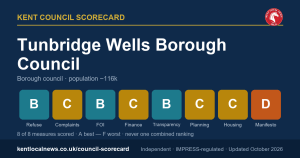
Tunbridge Wells Borough Council tops three of the Kent Council Scorecard’s tables, for bins, complaints and housing, and scores in band B or C on every measure but one in the October 2026 refresh.
Declaration: Kent Local News is edited by Daniel Dabin, who is also the leader of the GB Freedom party. The Scorecard is scored from published data under a published methodology, every council receives its scores for right of reply before publication, and every score links to its source so that readers can check it.
Tunbridge Wells Borough Council, which collects the bins, decides planning applications and handles homelessness for about 116,000 people, is scored on eight measures in the October refresh of the Kent Council Scorecard. It scores in band B on three, band C on four and band D on one, and it won three of the eight Kent Council Scorecard Awards 2026, more than any other council. This is the last of 14 pieces, one for each Kent council.
Scores run from 0 to 100 and are banded A to F. They are never added together, because each measures a different service with different data. The full evidence for every score is on the Tunbridge Wells Borough Council page.
The scores at a glance
| Measure | Score | Band | Position |
|---|---|---|---|
| Refuse collection | 72 | B | 1st of 13 |
| Complaints handling | 67 | C | 1st of 14 |
| Freedom of information | 81 | B | 3rd of 13 scored |
| Financial health | 58 | C | 8th of 14 |
| Transparency | 72 | B | 12th of 14 |
| Planning | 64 | C | 8th of 13 |
| Housing and homelessness | 68 | C | 1st of 13 |
| Manifesto delivery (Trust) | 50 | D | joint 9th of 14 |
Education, children’s services, safeguarding, highways and adult social care are run by Kent County Council, so they do not apply to the borough.
Where it does best
On bins, it wins the award with 72. It recycled 51.4% of household waste in 2024-25, the best rate in Kent and well above the England average of 42.0%, and it produced the least residual waste per household in Kent, 381.6kg against 513.3kg for England.
On complaints, it wins the award with 67. The Local Government and Social Care Ombudsman dealt with nine complaints about the council in 2025-26, the fewest in Kent, completed one investigation and upheld none. At district level the numbers are small, which is why the score stays in band C.
On housing, it wins the award with 68. It had 73 households in temporary accommodation at the end of March 2026, 1.44 per 1,000 households, with 58 children among them, about half the 2.83 rate for England outside London. 69.4% of its homelessness prevention cases in 2024-25 ended with a home secured for at least six months (209 of 301), against 51.9% for England, and the figure for January to March 2026 was 84.0%. It met 93% of its requirement under the Housing Delivery Test, just below the 95% threshold, so it must publish an action plan, and its affordable completions came to 17.0% of the requirement, close to the Kent median of 17.2%.
On freedom of information, it scores 81, third in Kent. It answered 93.1% of requests within the legal limit of 20 working days in 2025-26 (734 of 788, excluding land-charges requests), above the 90% the Information Commissioner expects. The Commissioner issued one decision notice against it in three years, which was not upheld. The council publishes no freedom of information statistics of its own and holds no figure for 2024-25 because it changed its case-management system.
Where it falls short
On finances, it scores 58. Its 2024-25 accounts received the only unqualified audit opinion among the councils compared with it, and its auditor found no significant value-for-money weaknesses. The score is held down by forecasting and delivery: its draft 2025-26 accounts show the cost of services 10.4% (£1.6m) under budget, an underspend the methodology counts against accurate budgeting, and £14.2m of capital spending was deferred to 2026-27. Its usable reserves of £23.4m fell by £4.0m in the year. Its Band D council tax, £217.10, is the fourth-lowest of the 12 Kent districts, and its 2026-27 rise of 2.79% was the only district increase set below the referendum cap.
On transparency, it scores 72, 12th in Kent. It publishes monthly spending files on its main website, current to July 2026 when checked on 1 October, allowances back to 2014-15 and a log of information released under freedom of information. Its contracts register sits on an older procurement site and appeared out of date, the newest pay-policy statement found is for 2024-25, and its separate open-data portal has not been kept up. In September Kent Local News reported that its spending data was about 18 months out of date. That was wrong: our audit had looked only at the open-data portal. The score was corrected from 43 to 72 on 1 October and we apologised to the council.
On planning, it scores 64. It decided 88.6% of major applications on time over the two years to June 2026, just under the England figure of 91.0%, and 95.5% of smaller ones, above England’s 90.7%. Only 2.1% of its major decisions were overturned at appeal, against 3.2% for England.
Promises
Kent Local News tracks three pledges from the Liberal Democrat administration: a balanced 2026-27 budget with no external debt, a village road safety scheme worth £25,000 for each parish council, and keeping the council free of external debt. None has yet been judged, so the Trust score of 50 rests on whether the council’s actions match the issues residents raise.
Who was in charge
The Liberal Democrats, led by Ben Chapelard, have held a majority since May 2024 and kept it at the May 2026 election. Before that he led the Borough Partnership coalition, so all the data falls to administrations he led. Each score on the council’s page names the administration in office during the period it measures.
What the council said
The council was sent its October scores on 2 October, with a deadline of 5pm on 23 October. It did not respond, and it did not respond to the first refresh in July.
What it means for Tunbridge Wells, and what comes next
Residents of Tunbridge Wells are served by the best-scoring council in Kent on bins, complaints and housing, on the measures the Scorecard uses. Local news is on the Tunbridge Wells page.
This completes the series on all 14 Kent councils. The Scorecard hub has a comparison table for each measure and the full list of the 2026 awards. The next refresh is due in January 2027, and each council will again see its new and changed scores before publication.
The right of reply stays open. Any response from the council will be published word for word beside the score it concerns. Corrections are welcome at editor@kentlocalnews.co.uk.