
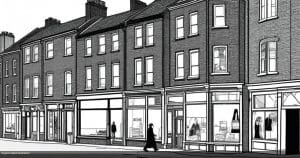
Folkestone & Hythe District Council has purchased a block of eight two-bedroom flats in central Folkestone as part of a £5 million plan to provide better temporary housing for families facing homelessness — and to cut the spiralling cost of private nightly lets.
A Roof Over Their Heads — Right Here in Folkestone
Imagine being told your family has nowhere to live. No home, no plan, and the council’s only option is a B&B miles from your children’s school. That’s the reality for too many families in Folkestone & Hythe right now — and it’s the problem the council says it’s trying to fix.
Folkestone & Hythe District Council announced this week that it has bought a block of brand-new flats in the heart of Folkestone town centre, purpose-built to offer short-term housing to households in crisis. The eight two-bedroom flats are fully self-contained — meaning families get their own front door, their own kitchen, their own space — rather than sharing a B&B corridor with strangers.
The council posted the news on social media, confirming the purchase and describing it as part of its commitment to supporting residents facing the crisis of having nowhere to live.
Why the Council Says It Had to Act
The numbers behind this decision are striking. Council data shows that spending on temporary accommodation — B&Bs, hotels and short-term nightly lets — topped £1,052,870 in a single recent financial year. And the number of households the council has had to house in temporary accommodation has roughly doubled in about a year, rising from around 55 households to around 115.
That’s a lot of families. And nightly-let accommodation doesn’t come cheap.
A Cabinet report identified a projected shortfall of around £1.2 million in the council’s temporary accommodation budget, which pushed the authority to change approach. Rather than keep paying private landlords and hoteliers by the night, the council decided to buy its own properties. Cabinet approved a plan to invest £5 million to acquire or deliver at least 20 properties for this purpose — and this central Folkestone block of eight flats is part of that commitment.
Cllr Rebecca Shoob, Cabinet Member for Housing and Homelessness, has publicly backed the scheme, pointing to safety, security, quality and long-term cost savings as the driving reasons behind the purchase.
The flats are also newly built and energy-efficient, which should keep running costs manageable for the families living in them — a practical detail that matters when you’re already in financial difficulty.
The Case For — and the Questions Being Asked
The argument in favour is fairly straightforward. Council-owned flats give the authority control over quality, cost and management. Families placed here stay in central Folkestone — close to schools, GP surgeries, bus and rail links, and support services. That matters enormously when you’re trying to keep children’s lives as stable as possible during an already stressful time. Out-of-area placements, where families are sent to accommodation outside the district, can be deeply disruptive.
But not everyone is entirely satisfied with the approach.
Some critics have questioned whether buying eight flats makes a meaningful dent in a problem this size. With the social housing waiting list reportedly running into the thousands — local Freedom of Information data, which the council has not directly confirmed, suggests around 1,157 households were on that list at one point — eight new temporary units can feel like a small answer to a very large question.
There are also broader arguments about whether investment in temporary housing, however well-intentioned, addresses the root of the problem. Housing experts generally agree that expanding council-owned temporary accommodation can be financially sensible and improve standards for residents. Yet they also tend to say the same thing: it needs to go hand-in-hand with building more permanent, affordable homes. Temporary solutions, by definition, don’t end homelessness — they manage it.
Some residents and commentators may also raise questions about concentrating temporary accommodation in particular parts of central Folkestone, and what that means for pressure on local services. So far, no specific objections to this particular block have emerged publicly.
Part of a Bigger Picture for Housing in the District
This purchase doesn’t sit in isolation. The council has also been working on 26 new affordable homes in Hythe — 20 for the housing waiting list and six available through shared ownership — including plans for fossil-fuel-free properties with air source heat pumps and solar panels. That’s a broader signal that the council is trying to think about housing supply more strategically, not just crisis management.
And the pressure councils face here in Kent and across England is real. Private rents have risen sharply, the supply of social housing has shrunk over decades, and central government support has tightened. Many local authorities are making similar moves — buying or building their own temporary accommodation stock to reduce dependence on expensive nightly lets. Folkestone & Hythe is not alone in facing this challenge, but it does need local solutions that work for this district.
The decision to purchase these flats is final, not a consultation. The properties are already bought.
What Happens Next
Families will be placed into the new flats through the council’s housing and homelessness service, following the standard legal assessment process under homelessness legislation. Stays are intended to be short-term, with residents working towards either a place on the social housing waiting list or a private rented home. The central location means most families placed there won’t face long journeys to schools or workplaces — which is, at least, one less thing to worry about.
—
Key Takeaways
- Folkestone & Hythe District Council has bought eight new two-bedroom flats in central Folkestone to provide self-contained temporary housing for families facing homelessness
- The purchase is part of a £5 million council investment plan to reduce reliance on expensive private nightly-let accommodation, after temporary housing costs exceeded £1 million in a single year
- While the council says the flats will improve quality and cut costs, some critics argue eight units are a limited response to wider housing demand, and that more permanent affordable homes are ultimately needed
What This Means for Folkestone & Hythe Residents
If your household is facing homelessness — whether through eviction, relationship breakdown or financial hardship — you should contact Folkestone & Hythe District Council’s housing and homelessness service as early as possible, rather than waiting until you have no home at all. Early contact gives the council more options and gives you more time. Families placed in temporary accommodation through the council will go through a formal assessment, and stays in units like these central Folkestone flats are intended to be short-term while longer-term housing is arranged. If you’re already on the social housing waiting list and have concerns about your situation, it’s worth getting in touch with the council directly to make sure your circumstances are properly recorded — particularly if your situation has recently changed or worsened.
Folkestone & Hythe Council Buys Eight New Flats in Central Folkestone to House Homeless Families Quiz
5 questions