
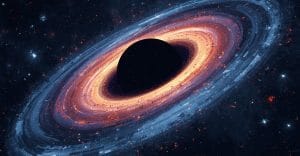
New JWST observations reveal a black hole in a compact galaxy just 570 million years after the Big Bang, challenging long-held theories about how galaxies and black holes grow together.
A black hole that is too big for its galaxy. That’s what NASA’s James Webb Space Telescope has found — and it’s forcing astronomers to rethink how the universe’s most massive objects came to be.
The James Webb Space Telescope, operated jointly by NASA, ESA, and the Canadian Space Agency, has detected an actively growing supermassive black hole at the centre of a compact early galaxy designated CANUCS-LRD-z8.6. The galaxy is observed as it existed around 570 million years after the Big Bang — a blink in cosmic time — and according to ESA’s Webb mission update, the black hole at its heart is “overmassive” relative to the galaxy’s stellar mass. That means it breaks the well-established relationship between how heavy a galaxy is and how heavy its central black hole tends to be.
At the same time, the findings are published in the peer-reviewed journal Nature Communications, cited in ESA’s official mission communications.
A Black Hole That Shouldn’t Exist — Yet
In the nearby universe, astronomers have long observed a tight correlation between a galaxy’s mass and the mass of its central black hole. The two appear to grow together, regulated by feedback processes that slow or accelerate star formation and gas accretion in tandem. It’s one of the bedrock principles of extragalactic astronomy.
CANUCS-LRD-z8.6 breaks that rule. The host galaxy is still assembling its stellar mass — it’s small, young, and described in ESA’s release as the most massive host galaxy known at such an early cosmic time, yet even so, its central black hole is still more massive than the standard scaling relation would predict. In other words, the black hole has raced ahead.
Webb’s Near-Infrared Spectrograph, known as NIRSpec, detected spectral features consistent with an accreting black hole — one actively pulling in gas and growing — confirming the presence of an active galactic nucleus deep inside this early-universe system.
Why This Is So Hard to Explain
The puzzle of early supermassive black holes isn’t new. Astronomers have known for some time that billion-solar-mass black holes existed less than a billion years after the Big Bang, spotted as bright, distant quasars. Getting a black hole that large, that fast, has long strained the physics of gas accretion.
Several theories have been proposed. One involves the direct collapse of large primordial gas clouds into massive “seed” black holes, bypassing the ordinary stellar route entirely. Another proposes sustained periods of super-Eddington accretion — growth above the classical luminosity limit that physics normally imposes. Repeated mergers of smaller black holes offer a third pathway. High-resolution simulations of these scenarios suggest that strong gas inflows and radiative effects in early, gas-rich galaxies could allow black holes to grow disproportionately fast relative to their hosts.
CANUCS-LRD-z8.6 now provides direct observational evidence — not just a simulation — that this can actually happen.
What the Scientific Community Makes of It
The result has drawn broad interest, though with measured caution. Many researchers view it as an important data point connecting faint early galaxies to the luminous quasars observed at later stages of cosmic history. According to ESA’s mission update, the observation helps bridge that gap — showing how overmassive black holes in small, early galaxies could be the precursors of the bright quasars seen billions of years later.
But not everyone is ready to tear up the textbooks just yet. Some scientists caution that this is a single system, or at best a small sample, and that more Webb observations are needed before drawing sweeping conclusions. There’s also ongoing debate about measurement uncertainties at such extreme distances; calculating both black hole mass and stellar mass at redshift z ≈ 8.6 involves significant technical challenges, and critics stress that selection biases and measurement systematics need careful assessment.
The CANUCS collaboration — the CAnadian NIRISS Unbiased Cluster Survey — uses Webb to study distant galaxies magnified by gravitational lensing, and CANUCS-LRD-z8.6 belongs to a class of small, extremely red, very distant galaxies that have puzzled astronomers since Webb first spotted them. Their unexpected brightness hinted that something unusual was going on inside. Now, at least for some of them, it appears the answer is a rapidly growing black hole.
The Unanswered Questions
How common are these overmassive early black holes? Are they the exception or the rule in the first billion years of the universe? And which growth mechanism — direct collapse, super-Eddington accretion, mergers — actually dominates? Webb is still collecting data, and the CANUCS programme continues. Each new observation either tightens or loosens the theoretical constraints.
What’s clear is that the standard co-evolution model, in which galaxy growth and black hole growth proceed in careful lockstep regulated by feedback, doesn’t fully account for what happened in the universe’s earliest chapters. The feedback mechanisms that govern nearby galaxies may have been weaker, or simply different, in those primitive, gas-rich environments 570 million years after the Big Bang.
What This Means for Kent Residents
There’s no direct day-to-day impact on life in Kent from this discovery — it concerns cosmology at distances and timescales almost impossible to picture. But UK taxpayers, including those in Kent, indirectly fund and benefit from ESA missions through the UK Space Agency and UK Research and Innovation, meaning British scientists have access to Webb data and play a role in the science it produces. For students and educators at schools, colleges, and the University of Kent, the CANUCS-LRD-z8.6 finding offers a vivid, current example of how new instruments overturn established theory — exactly the kind of real-world case study that brings physics and astronomy to life in the classroom.
Source: @NASA
James Webb Space Telescope Finds Supermassive Black Hole That Has Outgrown Its Early Universe Galaxy Quiz
5 questions