
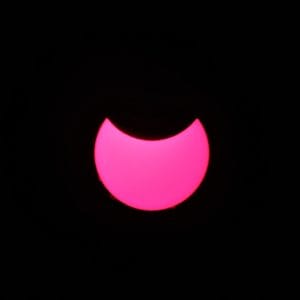
Safety first: never look at the Sun without ISO 12312-2 certified eclipse glasses. Ordinary sunglasses are not safe at any darkness, and binoculars or a telescope must never be used unless a proper solar filter is fitted to the front of the instrument. At 90 per cent coverage there is no moment when it is safe to look unfiltered. Serious and permanent eye damage can happen in seconds.
Kent has a rare evening of astronomy ahead of it tonight, with a deep partial solar eclipse, a peak meteor shower and a gathering of six planets all falling within a single 24 hours.
The Royal Observatory Greenwich says the UK and Ireland will see between 90 and 96 per cent of the Sun covered this evening — “the most coverage seen from the UK and Ireland since the 1999 solar eclipse”. Full totality is confined to parts of Greenland, Iceland and northern Spain.
Times for Kent
In Canterbury, according to eclipse-tracking site Eclipseando, first contact comes at 18:17 BST, maximum eclipse at 19:13 with 90.9 per cent of the Sun’s area covered, and the eclipse ends at 20:06. The whole event lasts about an hour and 48 minutes.
Maidstone’s timings are near-identical: Time.now gives first contact at 18:16:59, maximum at 19:14:59 and last contact at 20:06:59. Sources differ slightly on how deep it gets there — Time.now puts maximum obscuration at 90.7 per cent, while TheSkyLive gives 91.19 per cent.
For comparison, BBC Sky at Night Magazine lists London at 18:17–20:06, with 91.4 per cent coverage at 19:13. Cardiff, at 93.2 per cent, sees the deepest partial of the major UK cities, and Bishop Rock in the Isles of Scilly tops the country at 96.5 per cent.
The real obstacle is height, not timing
The difficulty in Kent is how low the Sun will be. At maximum, Eclipseando puts the Sun just 9.5 degrees above the horizon at Canterbury — roughly the width of a clenched fist held at arm’s length. Time.now gives 9.6 degrees for Maidstone, in the direction of 282 degrees, or west-north-west. BBC Sky at Night notes that from Dover the Sun will be only about 9 degrees up at maximum.
That makes an open western skyline far more important than any equipment. As Eclipseando puts it: “a hill, a terrace of houses or a line of trees to the west-north-west can hide the whole thing.”
Nor should anyone expect darkness. Eclipseando is blunt on the point: at 90.9 per cent “the human eye adapts so smoothly that 90.9% of the Sun hidden still leaves what feels like a slightly dull evening… the sky looks a little wrong rather than dark.” The visible drama is in the filtered crescent, and in the crescent-shaped speckles cast by leaf shadows on a pale wall. The nearest place reaching true totality is Santoña in Cantabria, Spain — about 934km from Canterbury in a straight line.
Where to watch in Kent
English Heritage and the South East Kent Astronomical Society are running a free viewing event at Reculver Towers and Roman Fort, Herne Bay, from 18:00 to 20:30 — a site with exactly the open north-and-west coastal horizon this eclipse demands.
Society astronomers will be there with specialist solar telescopes, and English Heritage says 100 pairs of eclipse glasses will be available. Reculver’s North Tower is due to be open during the event for panoramic views across the north Kent coast. Places are free but are being reserved through Eventbrite, and anyone planning to go should check availability before travelling.
Elsewhere in the county the same rule applies: what matters is a clear line of sight low to the west-north-west. A coastal promenade, an open field or high ground will beat a garden hemmed in by trees or rooftops.
Perseids and a planet parade
BBC Sky at Night Magazine notes that the Perseid meteor shower peaks a few hours after the eclipse, in moonless skies — leaving a dark window for anyone willing to stay up.
Before dawn, six planets — Jupiter, Mercury, Mars, Uranus, Saturn and Neptune — are gathered in the same broad stretch of sky. The term “planetary parade” is a loose one. Andrew Fazekas of Astronomers Without Borders told USA Today it is “a colloquial term… It just simply means that the planets are visible in, generally, the same area of the sky.” The planets are not lined up in any literal sense.
According to Star Walk, Mars and Saturn are the straightforward naked-eye targets, Mercury is catchable low down given a clear horizon, and Jupiter sits very low in the brightening dawn. Uranus requires binoculars and Neptune a telescope. Venus is not part of the group. The best window is 45 to 90 minutes before sunrise, looking from the eastern horizon round towards the south-west. The mornings either side of today offer a similar view.
Weather
Conditions across the county look favourable. Kent Local News’s weather page has today as sunny with no rain forecast in any Kent town, with Maidstone at 30°C, Canterbury 29°C, Folkestone 29°C and Dover 28°C. Tomorrow is expected to be sunnier still. An amber extreme heat warning covering London and parts of the South East runs from 08:00 to 22:59 on Thursday; Kent is not among the areas named by the Met Office in that warning.
If you cannot get a clear horizon
The Royal Observatory Greenwich is streaming the eclipse live through one of its telescopes from 18:10, on YouTube and Facebook — which is also the only way to watch it with no eye-safety risk at all.
Sources
- Royal Observatory Greenwich — how to see the 12 August 2026 partial solar eclipse, and its UK live stream.
- English Heritage — solar eclipse viewing at Reculver Towers & Roman Fort, with the South East Kent Astronomical Society.
- BBC Sky at Night Magazine — UK guide, city timings and coverage.
- Eclipseando; Time.now; TheSkyLive — local circumstances for Canterbury, Maidstone and Dover.
- Star Walk — planet visibility; Andrew Fazekas, Astronomers Without Borders, quoted in USA Today.