
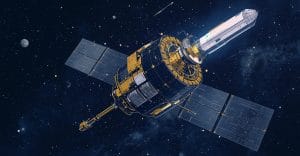
The observatory will survey around one billion galaxies and detect more than 1,000 exoplanets during its five-year primary mission.
NASA’s newest flagship space telescope left Earth on 30 August 2026, carrying with it one of the most ambitious survey programmes in the history of astronomy. The Nancy Grace Roman Space Telescope — Roman, to those who’ve followed its decade-long development — is now travelling to an orbit around the Sun–Earth L2 point, roughly 1.5 million kilometres from Earth in the direction away from the Sun. The same vantage point used by the James Webb Space Telescope.
NASA marked the moment on social media with characteristic optimism.
“Roman is on her way, and the Golden Age of Discovery is just the beginning,” the agency posted, a line that reflects genuine expectations within the astronomy community rather than mere promotional language. Roman’s combination of survey speed, sensitivity and field of view is unlike anything currently in orbit.
What Roman Actually Does — and Why the Numbers Matter
The telescope carries a primary mirror 2.4 metres in diameter, identical in size to Hubble’s. But the comparison ends there. Roman’s Wide Field Instrument packs a 300-megapixel camera with a field of view at least 100 times larger than Hubble’s, allowing it to survey the sky at around 1,000 times Hubble’s speed while maintaining comparable sensitivity and infrared resolution.
That’s not a modest upgrade. That’s a fundamentally different machine.
Operating in near-infrared wavelengths — roughly 0.6 to 2 microns — Roman sits between Hubble’s optical and ultraviolet strengths and the James Webb Space Telescope’s deeper infrared capabilities. Where Webb stares long and hard at specific targets, Roman sweeps wide. Over its five-year primary mission, the Wide Field Instrument looks set to measure light from around one billion galaxies, covering more than 2,000 square degrees of sky. That scale of data will enable statistical studies of galaxy evolution and the structure of the Universe that simply weren’t possible before.
The mission was the top-ranked large space mission in the US Astro2010 Decadal Survey, the exercise through which the American astrophysics community sets its priorities for the decade ahead. That ranking reflects a broad scientific consensus about Roman’s potential.
Dark Energy, Dark Matter, and the Big Questions
Roman’s primary science goals sit at the frontier of cosmology. Dark energy — the mysterious force thought to be accelerating the expansion of the Universe — and dark matter, which appears to hold galaxies together without being directly visible, are both targets. Roman will use several independent methods to study them: weak gravitational lensing, baryon acoustic oscillations, and observations of Type Ia supernovae. Using multiple approaches to cross-check results is standard practice in cosmology, and it gives Roman’s findings more weight than any single method could.
Testing general relativity on cosmic scales is also on the agenda. These aren’t small ambitions.
Exoplanets: A Census of Distant Worlds
Beyond cosmology, Roman will conduct a microlensing survey of the inner Milky Way expected to detect more than 1,000 exoplanets. Microlensing works by detecting the way a planet’s gravity bends and briefly brightens the light of a background star — it’s above all good at finding planets that other detection methods miss, including smaller, more distant worlds.
Roman also carries a Coronagraph Instrument, which functions as a technology demonstration for high-contrast imaging. The goal is to directly photograph planets orbiting nearby stars — blocking out the blinding glare of the star itself to reveal the faint reflected light of a planet alongside it. If it works as designed, it could open a path towards eventually imaging Earth-like worlds around other stars.
The mission’s baseline is five years, with the design allowing for an additional five-year extended mission subject to performance and funding.
A Decade in the Making, With International Partners
Roman’s development has taken around ten years, from early design work through hardware build, integration and testing. The mission was previously known as WFIRST — the Wide-Field Infrared Survey Telescope — before being renamed in 2020 to honour Nancy Grace Roman, a pioneering astronomer who played a central role in establishing the case for space-based observatories and is often called the “Mother of Hubble.”
The European Space Agency is involved as a Mission of Opportunity, contributing hardware and scientific participation. That international collaboration means data and observing opportunities will be shared globally. NASA intends to make Roman’s data publicly available, following the model established by Hubble and other major observatories.
Not everyone is enthusiastic about the price tag, though. Critics of large flagship missions argue that they can consume budgets that might otherwise support smaller, more targeted projects — and that fundamental cosmology research competes for funding against more immediate scientific or societal priorities. Those debates are ongoing within the scientific community.
Mark Clampin, director of the astrophysics division at NASA Goddard Space Flight Center, which leads the Roman project, said: “Roman will give us a much more complete picture of the cosmos than we’ve ever had before.”
What This Means for Kent Residents
UK researchers, including astronomers at the University of Kent, can compete for access to Roman’s open data sets through UK Space Agency and ESA-linked programmes, with the potential for research placements, PhD projects and high-skill employment across the south-east. For anyone in Kent with an interest in space science or data analysis, Roman’s findings are likely to feed into planetarium shows, school curriculum materials and public outreach events accessible across the region. More broadly, UK participation in Roman via ESA helps ensure British scientists and institutions remain at the table for one of the most ambitious survey missions ever launched.
Source: @NASA
NASA's Nancy Grace Roman Space Telescope Launches to Begin a New Golden Age of Discovery Quiz
5 questions