
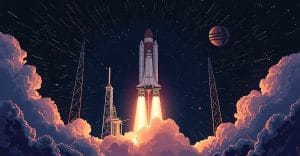
NASA’s newest flagship observatory lifts off from Kennedy Space Center, bound for a distant orbit one million miles from Earth to survey dark energy, dark matter, and thousands of exoplanets.
At 07:26 EDT on the morning of 30 August 2026, a SpaceX Falcon Heavy rocket lit up the Florida sky from Launch Complex 39A at Kennedy Space Center. Perched atop it was NASA’s Nancy Grace Roman Space Telescope — a machine built to see the universe not in pinpoints, but in sweeping panoramas. Three side boosters peeled away and returned to Earth in the kind of choreographed landing that still looks improbable even after years of SpaceX doing it. Roman, meanwhile, kept going.
It’s heading to a place called L2.
The Sun–Earth Lagrange Point 2 sits roughly 1.5 million kilometres from our planet — a gravitational sweet spot where the combined pull of the Sun and Earth allows a spacecraft to hold a stable position while consuming very little fuel. The James Webb Space Telescope is already there. Roman will join it, settling into a halo orbit and beginning what NASA describes as at least a five-year science mission. The journey alone takes more than three months.
A Telescope Named After a Pioneer
Nancy Grace Roman was NASA’s first Chief of Astronomy. She championed the idea of putting telescopes in space at a time when many in the scientific establishment weren’t convinced it was worth the trouble. Without her, there might not have been a Hubble. That’s why she’s often called the “Mother of Hubble” — and why this telescope carries her name.
The observatory was previously known by the rather less memorable title of the Wide Field Infrared Survey Telescope, or WFIRST, before being renamed in her honour in 2020. It’s a fitting tribute. Roman the person pushed for big, ambitious science. Roman the telescope is exactly that.
What Roman Will Actually Do
Think of Hubble as a telephoto lens — extraordinary at zooming in on a single object with breathtaking clarity. Roman is more like a wide-angle camera bolted to the same quality optics. Its Wide Field Instrument covers a patch of sky roughly 100 times larger than Hubble’s at comparable resolution. That matters enormously for the kind of science Roman is designed to do: mapping the large-scale structure of the universe across billions of light-years.
Its three headline science goals are ambitious even by space telescope standards. Roman will measure the history of cosmic expansion to probe the nature of dark energy — the mysterious force thought to be driving the universe apart at an accelerating rate. It will map the distribution of dark matter across the cosmos using a technique called gravitational lensing, where the mass of galaxy clusters bends and distorts light from objects behind them. And it will survey thousands of exoplanets using microlensing, a method that can detect planets too distant or too faint for other techniques to find.
Roman also carries a Coronagraph Instrument, a technology demonstrator designed to directly image exoplanets and the dusty discs around young stars by blocking out the blinding glare of their host suns. That’s harder than it sounds — it’s a bit like trying to spot a firefly hovering next to a lighthouse from several kilometres away.
Complementing Webb, Not Replacing It
NASA has been careful to position Roman as a companion to the James Webb Space Telescope rather than its successor. Webb excels at deep, targeted infrared observations of specific objects. Roman will cover the sky at scale. The two observatories are expected to work in tandem — Roman identifying targets of interest across wide swathes of sky, Webb then zooming in with its extraordinary sensitivity.
Bill Nelson, NASA Administrator, said during pre-launch briefings: “Roman will be a powerful complement to Webb and Hubble, giving us a wide-field view of the universe that we’ve never had before.”
The mission launched ahead of its original schedule and within a revised budget, after the programme underwent restructuring earlier in its development to bring costs under control. Critics of large flagship missions have long pointed to their vulnerability to cost growth and delays — Roman’s earlier difficulties weren’t unusual for projects of this scale. But the telescope is now in space, and the debate about its development has given way to anticipation about its science.
After arriving at L2, Roman will go through several commissioning phases: instrument check-out, calibration, and test observations before routine science operations begin. That process typically takes months. But once it’s running, astronomers expect a flood of data unlike anything available from current facilities.
A Debate That Doesn’t Go Away
Not everyone in the scientific community is entirely comfortable with how much money and attention flows towards flagship missions. Some researchers argue that the same investment spread across smaller, more frequent missions — or directed towards ground-based facilities — might produce more science per pound. It’s a genuine tension in how space agencies allocate limited budgets, and Roman’s earlier cost struggles gave those critics some ammunition.
Yet the scientific community broadly views Roman’s wide-field infrared survey capability as something that simply cannot be replicated from the ground. Earth’s atmosphere absorbs infrared light in ways that make large-scale infrared surveys from the surface impractical. Roman can do things no ground-based telescope can.
What This Means for Kent Residents
UK researchers will have open access to Roman’s data through NASA’s public archives, meaning astronomers at universities across Britain — including those accessible to Kent students — can use its observations in their work. For anyone in Kent with a passion for astronomy or a child interested in space science, NASA’s educational resources tied to the Roman mission offer freely available material that schools and colleges can bring into STEM teaching. More broadly, Roman is a reminder that the biggest questions humanity is trying to answer — what is dark energy, are there other Earths out there — are being pursued right now, and the results will be public.
Source: @SpaceX
SpaceX Falcon Heavy Launches NASA's Nancy Grace Roman Space Telescope on Three-Month Journey to Deep-Space Orbit Quiz
5 questions