
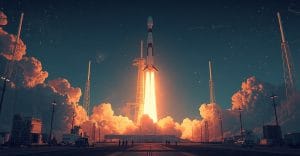
A single Falcon 9 first stage has reportedly flown and landed 36 times, setting a new reuse record as SpaceX lands on its Atlantic droneship A Shortfall of Gravitas.
Picture a barge the size of a football pitch, sitting somewhere in the Atlantic Ocean off the Florida coast. No crew on deck. Just thrusters holding it steady against the swell, a painted bullseye on the landing pad, and then — out of the sky — a rocket the height of a fifteen-storey building drops back down to Earth, legs deploying, engines firing, touching down with a crack of displaced air. It’s routine now, almost. That’s what makes it extraordinary.
SpaceX posted a social media update claiming that a Falcon 9 first stage had completed what the company described as the first booster to achieve a 36th launch and landing, touching down on the autonomous spaceport droneship A Shortfall of Gravitas. The post, which was reposted and widely circulated online, marks another step forward in SpaceX’s long-running effort to make orbital rockets as reusable as commercial aircraft.
It’s worth pausing on that number. Thirty-six flights. The same rocket, flying and returning, again and again.
A Droneship Named After a Novel
A Shortfall of Gravitas is the third vessel in SpaceX’s fleet of autonomous spaceport drone ships, joining Of Course I Still Love You and Just Read the Instructions. All three names are borrowed from the late Scottish science fiction author Iain M. Banks, whose Culture novel series features vast, sentient spacecraft with a fondness for absurdist names. It’s a nice touch — rockets landing on barges named after fictional spaceships.
The vessel entered service in 2021 and operates out of Port Canaveral, Florida. It measures around 90 metres in length and 40 metres across, equipped with thrusters and landing hardware that allow it to hold position at sea while a booster descends at speed from altitude. The ship handles missions where the rocket’s trajectory or payload mass makes a return flight back to the launch site impractical — which, on many commercial satellite missions, is most of them.
SpaceX uses drone ships rather than land pads for a straightforward reason: heavier payloads burn more fuel on ascent, leaving less propellant for the booster to fly all the way back. Landing at sea, closer to the trajectory’s endpoint, solves the equation.
The Record and Its Caveats
The “36th” figure comes directly from SpaceX’s social media messaging. Earlier versions of similar wording circulating online referenced a “35th” launch and landing, suggesting the count was updated or corrected around the time of the announcement. Independent cross-checks against aggregated launch logs and official mission manifests have not yet fully reconciled the precise figure, so the 36-flight claim is best treated as unverified pending further confirmation.
That caveat aside, the broader trajectory is clear. SpaceX has been systematically pushing its boosters further with each passing year. Early milestones — a booster’s 10th flight, then its 20th, then 30th — were each treated as headline news. The goalposts keep moving. What was once considered ambitious engineering is now, for SpaceX, considered normal operations.
Gwynne Shotwell, SpaceX’s president and chief operating officer, has previously spoken about the company’s reusability ambitions. She said: “We want to be able to reuse the rocket like you reuse an aeroplane. That’s the goal.”
What Reusability Actually Changes
The economics are the point. A brand-new Falcon 9 first stage costs tens of millions of dollars to manufacture. Flying the same booster 36 times spreads that cost across dozens of missions. For satellite operators, communications companies and government agencies buying launch services, that translates into lower prices per kilogram to orbit — and more frequent access to space.
But not everyone views the rapid pace of launches as straightforwardly positive. Some environmental researchers and commentators have raised concerns about the cumulative effects of high-frequency rocket launches: exhaust emissions in the upper atmosphere, the growing density of satellite constellations, and questions about long-term debris management. These are live debates in the space industry, and regulators in both the United States and Europe are paying attention.
And yet the appetite for launches keeps growing. Satellite internet, Earth observation, weather monitoring, defence communications — the demand for orbital access is accelerating, not slowing.
What This Means for Kent Residents
There’s no direct impact on Kent from a rocket landing on a barge off the Florida coast — that much is straightforward. But the broader shift toward cheaper, more frequent access to space does matter to anyone in the county working in satellite services, Earth observation, or downstream data industries, all of which depend on affordable launch costs. For students in Kent studying engineering, physics, or aerospace, milestones like this one are a reminder that the commercial space sector is expanding fast and will need skilled workers to grow with it. UK universities and colleges offering STEM courses may increasingly find that space-sector careers are a realistic destination for their graduates, not a distant ambition.
Source: @SpaceX
SpaceX Falcon 9 Booster Completes Record 36th Launch and Landing on A Shortfall of Gravitas Quiz
5 questions