
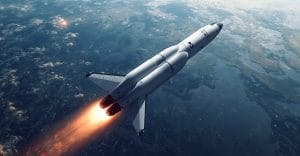
SpaceX posted video of Starship’s final flip manoeuvre and landing burn from its twelfth flight test, with the footage captured above the Indian Ocean.
SpaceX’s twelfth Starship flight test ended not with a dramatic catch back at the launch tower, but with a controlled splashdown over the Indian Ocean — and the company has now posted footage of the final moments. The clip shows the vehicle executing its characteristic flip manoeuvre before firing two Raptor 3 engines in a landing burn to bleed off speed ahead of splashdown. It’s a long way from Texas.
Flight 12 lifted off from Pad 2 at Starbase, Texas, on 22 May 2026 at 5:30 p.m. Local time, according to Friends of NASA, which covered the launch. The footage SpaceX afterwards shared on social media shows the vehicle’s Ship upper stage in the closing seconds of its mission, oriented and decelerating over open ocean.
The post frames the sequence as a demonstration of Starship’s controlled recovery capability. SpaceX has not, at the time of writing, published a full mission summary through official channels, so broader details about altitude reached, payload carried, or splashdown precision remain unconfirmed from primary sources.
What the Footage Actually Shows
The flip manoeuvre is a controlled attitude change — the vehicle rotates to point its engines towards the ground, positioning itself for the deceleration burn. It’s a technique SpaceX also used on earlier Starship flights and, in a different form, on Falcon 9’s first-stage landings. But Starship’s scale makes it something else entirely. The vehicle stands around 120 metres tall when fully stacked with its Super Heavy booster, making the sight of the upper stage flipping itself belly-to-sky over the Indian Ocean a genuinely unusual piece of footage.
For their part, the landing burn itself, according to Tesla Oracle’s coverage of the flight, used two Raptor 3 engines. Raptor 3 is the latest iteration of SpaceX’s methane-fuelled engine, designed for higher thrust and improved reliability compared with earlier versions. The choice of two engines for the burn — rather than a larger cluster — suggests a relatively controlled, low-thrust deceleration sequence for splashdown rather than a precision land-back.
Whether the splashdown met SpaceX’s internal targets for accuracy or vehicle condition isn’t clear from the material posted. The company has not confirmed those figures publicly.
Twelfth Time Around
Starship’s test programme has moved quickly by historical standards for a rocket of this complexity. Each flight has built on the last, with SpaceX iterating on hardware and flight software between tests. Earlier flights ended in explosions — sometimes spectacular ones — and the programme has drawn scrutiny from the US Federal Aviation Administration over its environmental and safety licensing process at Starbase.
Flight 9, earlier in 2026, saw SpaceX attempt to catch the Ship upper stage with the mechanical arms on the launch tower — the same system used successfully on Super Heavy booster catches. The trajectory for Flight 12, ending in an Indian Ocean splashdown, suggests the company chose a different recovery profile for this particular test, though the reasons for that choice haven’t been officially explained.
SpaceX describes Starship as a fully reusable launch system intended for deep-space missions, including NASA’s Artemis programme lunar lander contract and, eventually, missions to Mars. NASA awarded SpaceX a contract to develop a Starship-based Human Landing System for Artemis, making the vehicle’s continued development a matter of interest well beyond SpaceX’s own commercial ambitions.
The Raptor 3 Engine
The Raptor 3 deserves a mention on its own terms. SpaceX has been iterating through Raptor versions since the engine first flew, with each generation bringing changes to thrust output, manufacturing complexity, and reliability. Raptor 3 was designed to be simpler to produce than its predecessors — fewer external pipes and components — while delivering more power.
Elon Musk, SpaceX’s chief executive, said earlier this year: “Raptor 3 is a profound engineering achievement.” That claim is, of course, from the company’s own chief executive, so independent verification of its performance improvements against earlier Raptor variants remains limited in publicly available data. But the engine has now flown on multiple Starship tests, accumulating operational history.
Two Raptor 3 engines firing in a coordinated landing burn over a remote ocean location, captured on camera and shared within hours of the flight, does at least demonstrate that the system functioned as intended at that stage of the mission.
Footage as Evidence
It’s worth being clear about what a social media clip does and doesn’t prove. The footage shows the flip and the burn. It doesn’t, by itself, confirm the vehicle’s condition on impact, whether telemetry targets were met, or what SpaceX learned from the flight. Post-flight analysis takes time, and SpaceX tends to share detailed findings selectively and on its own schedule.
That said, the fact that the footage exists — shot from what appears to be a chase aircraft or onboard camera system over the Indian Ocean — is itself a logistical achievement. Getting cameras to that location, transmitting or recovering the footage, and posting it within the news cycle requires infrastructure that earlier rocket programmes simply didn’t have.
What This Means for Kent Residents
Starship has no direct operational role in the UK at present, but the vehicle’s development is tied to NASA’s Artemis lunar programme and to SpaceX’s Starlink satellite network, which is already used by UK consumers and businesses, including some in Kent, for broadband access. As Starship matures into a launch vehicle capable of deploying large satellite batches more cheaply, that could affect the cost and availability of satellite internet services across rural parts of the county where fixed-line broadband remains limited.
Source: @SpaceX
SpaceX Shares Starship Flight 12 Flip and Landing Burn Footage Over the Indian Ocean Quiz
5 questions