
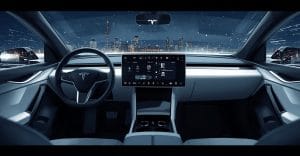
Tesla says its Cybercab robotaxi will offer theatre, music and gaming apps on a giant touchscreen, with satellite internet from Starlink V5 hardware to follow shortly.
Picture sitting in the back of a taxi with no driver, no steering wheel, and a screen the size of a small television filling the dashboard. That’s the vision Tesla posted to X, describing the Cybercab as a space where passengers can watch films, listen to music, or play games during their journey — all on a 22-inch touchscreen.
It’s a bold pitch. And it tells you a lot about how Tesla is thinking about the Cybercab: not just as a way to get from A to B, but as a moving living room.
What Tesla Actually Said
The post, shared on Tesla’s official X account, describes the Cybercab as a place to “be productive or unwind,” with theatre, music and gaming apps available on that vast 22-inch display. The same post states that the vehicle will “soon be equipped” with V5 Starlink hardware, pointing to satellite internet connectivity rather than a reliance on standard mobile data networks.
A matching post from Starlink’s own account echoed the claim, suggesting the partnership is deliberate — the idea being that Starlink V5 could keep passengers connected even where 4G or 5G coverage is patchy or congested.
But there’s an important caveat here. The phrase “soon to be equipped” leaves the timeline genuinely unclear. Earlier posts from July 2026 had suggested Starlink V5 integration was already planned directly into the Cybercab, yet the September post frames it as a forthcoming addition. Whether the hardware is fitted to production vehicles, limited to prototypes, or still in a future rollout phase isn’t confirmed by any independent source in the available material.
A Vehicle Without a Wheel in Sight
The Cybercab is Tesla’s autonomous robotaxi concept. It has no steering wheel and no pedals. Passengers simply get in, select a destination, and the car does the rest — at least in theory. The entertainment pitch makes sense in that context: if no one’s driving, everyone in the cabin is a passenger, and passenger time becomes something to fill.
At the same time, the 22-inch touchscreen is a serious piece of hardware. For context, many home televisions sold in the UK measure around 24 inches diagonally. Fitting something close to that into a vehicle dashboard is a statement of intent about what Tesla wants the in-cabin experience to feel like.
Starlink V5, meanwhile, is SpaceX’s latest generation of satellite internet hardware. The idea of routing it into a moving vehicle rather than a fixed dish on a roof represents a shift in how satellite broadband might eventually be used day-to-day.
The Connectivity Angle
Relying on cellular networks in a vehicle has always had its limits. Anyone who’s watched a film buffer on a train through the North Downs will know the problem. Satellite connectivity, if it works as described, could offer a more consistent signal — especially in rural areas or on routes where mobile coverage drops out.
That said, the performance of Starlink V5 in a fast-moving vehicle, at scale, across different weather conditions, hasn’t been independently verified from the material available here. Tesla and Starlink’s posts are promotional by nature. The operational reality may differ.
Hype, Hardware, or Both?
Some observers will look at the feature list — giant screen, satellite internet, gaming apps — and see a genuinely appealing product. Others will point out that the Cybercab still faces major regulatory hurdles before it can operate commercially, above all outside the United States. No UK launch date has been announced. No regulatory approval for autonomous taxi operation on UK roads has been confirmed.
Tesla has form for announcing features ahead of their availability. Full Self-Driving, for instance, has been described as imminent for several years. That history doesn’t make the Cybercab’s features impossible, but it does give room for scepticism about timelines.
Elon Musk, who leads both Tesla and SpaceX, has consistently described the Cybercab as central to Tesla’s future business model — a vehicle that can earn money for its owner by operating as a robotaxi when not in personal use. The entertainment and connectivity features fit that commercial logic: a more enjoyable ride might command a higher fare, or attract more repeat passengers.
What This Means for Kent Residents
There’s no confirmed plan to bring the Cybercab to UK roads in the near term, and no regulatory framework currently exists in Britain for fully driverless commercial taxis of this kind. For Kent residents, the story is one to watch rather than act on — but as autonomous vehicle regulation develops across the UK, the entertainment and connectivity standards Tesla is setting now may well shape what future taxis, whether from Tesla or its rivals, look and feel like on British streets.
Source: @Tesla
Tesla Previews Cybercab's 22-Inch Touchscreen and Planned Starlink V5 Connectivity Quiz
5 questions