
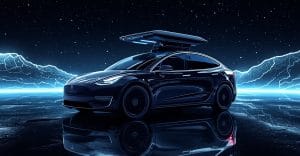
Tesla has announced that its Cybercab robotaxi will carry built-in Starlink V5 satellite connectivity — making it the first vehicle in the company’s line-up to have the technology integrated from the factory.
Tesla posted that “Starlink V5 [is] directly integrated in Cybercab”, setting out a connectivity package that goes well beyond what any current Tesla model offers. The post, which forms part of Tesla’s ongoing Cybercab communications, shows the Starlink V5 terminal embedded in the vehicle’s roof structure alongside GPS and 5G LTE hardware.
Multiple reports say the graphic makes clear this is a factory-built feature — not an aftermarket add-on bolted on later.
What Starlink V5 Actually Means
Starlink V5 is SpaceX’s latest generation of satellite terminal hardware. Compared with the standard dish — which reportedly weighs around 6.5 pounds — the V5 unit is said to weigh around 2.4 pounds, making it far better suited to fitting inside a vehicle roof. One report claims the hardware can deliver speeds above 375Mbps, though neither figure has been independently verified from an official source, so treat them as indicative rather than guaranteed.
The key point is the integration itself. Slotting a Starlink terminal into the roof of a production vehicle — rather than strapping a dish to the outside — is a different engineering challenge entirely. And doing it alongside 5G LTE and GPS suggests Tesla is building a layered connectivity system, not relying on any single network.
What It’s Actually For
Don’t expect the satellite link to be steering the car. Ashok Elluswamy, Tesla’s VP of AI Software, was direct on this point. He said the Starlink connection is not required for safe operation of the vehicle. The car can drive itself without it.
Elluswamy said connectivity is mainly for navigation, customer service, and fleet management. That puts the Starlink link in a supporting role — keeping the robotaxi in contact with Tesla’s operations team, pulling in map updates, and letting passengers do what passengers do while they’re being driven somewhere.
That last point matters for the robotaxi pitch. If you’re sitting in a Cybercab with no steering wheel and nothing to do, a fast, reliable internet connection becomes part of the product. Commentary around the announcement has flagged potential passenger uses — high-speed browsing, video calls, 4K streaming, gaming — though Tesla itself has not made specific claims about passenger features.
The Fleet Management Angle
The bigger story here may be less about individual passengers and more about how Tesla plans to run a robotaxi fleet at scale.
Over-the-air software updates, remote diagnostics, and live support for vehicles operating in areas with patchy mobile coverage all need reliable connectivity. A 5G LTE connection works well in a city centre. It works less well on a rural road at 2am. Starlink fills that gap — which is exactly the kind of coverage problem a 24-hour autonomous taxi service would run into.
Tesla is positioning the Starlink integration as part of the operational backbone of Cybercab, not just a passenger perk. That’s a different framing from simply offering Wi-Fi in the back seat.
What We Don’t Yet Know
There’s an important caveat sitting underneath all of this. Current reporting does not confirm whether the Starlink V5 integration is active in production vehicles or whether it’s been shown only in concept material and presentations.
Tesla has not publicly confirmed a production timeline for the Cybercab in the UK. The company has previously set and revised launch targets for autonomous products, so the gap between a graphic showing hardware and that hardware arriving in a finished vehicle on a public road can be considerable.
The post is real. The ambition is clear. But the production reality is still unverified.
What This Means for Kent Residents
For most people in Kent right now, this is one to watch rather than one to act on. If Tesla does eventually bring Cybercab to UK roads — which would require regulatory approval from the Driver and Vehicle Licensing Agency and the Department for Transport — residents in areas with weak mobile coverage could find the Starlink-backed connectivity especially relevant. For UK consumers more broadly, the announcement raises the bar on what connectivity inside a vehicle might look like as autonomous services edge closer to reality.
Source: @Tesla
Tesla Confirms Starlink V5 Satellite Connectivity Will Be Built Into the Cybercab Robotaxi Quiz
5 questions