
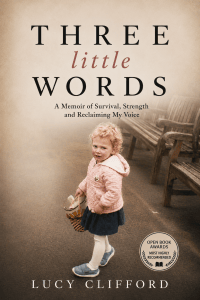
Lucy Clifford spent more than eight years in a Medway children’s home and five as a deputy head of care. Her memoir, published on 18 September, argues that what happens after a child speaks matters as much as the moment they do.
Lucy Clifford was ten years old when she wrote three words on a piece of paper and slipped it under her mother’s bedroom door. She had been abused, and she could not say it out loud.
More than three decades later, those three words are the title of her first book — and the foundation of a career spent inside the system that exists to protect children like her.
The note
Clifford, now 43 and living in Kent, says a lesson at school had begun to make her understand that what was happening to her was not right. She could not speak the words, so she wrote them.
“I remember Mum acknowledging it on the way to school the next morning and hugging me before I got out of the car,” she says. “That hug has always stayed with me. For the first time, somebody else knew what I had been carrying.”
What she remembers feeling was hope. “I’d told somebody. Maybe now it would stop happening.”
Police and social services became involved. The professionals who interviewed her were, she says, kind and careful, but the process was frightening for a child sitting with adults she did not know, “trying to explain things I didn’t really have the language to explain”.
She also carried something she could not have articulated at the time. “When the adults around me were upset and everything started changing, my child’s brain didn’t necessarily understand that this was happening because an adult had done something wrong. Part of me thought everything was happening because I had told.”
Then the story appeared in a local newspaper. It did not publish her name. It did publish her date of birth — enough, in a small community, for people to work out who it was about.
At school, someone decided the way to protect her was to give her a large sticker reading: “Please don’t ask me any questions.”
“I can look at that now and understand that it was probably well-intentioned,” she says. “But as a child, it didn’t feel protective. It made me stand out at the exact moment I desperately wanted to feel normal.”
It is a distinction she returns to often. “I didn’t need everyone to have the perfect words. I needed them to say, ‘If you ever want to talk, I’m here,’ leave that door open and then carry on treating me normally. Because I was still Lucy. I was still a child.”
An exam paper, and 28 years
At 16, sitting a GCSE English exam and casting about for something to write, she wrote about what had happened to her.
“It was something I knew. It was my experience. So I wrote about it,” she says. “Looking back, I think it was probably my first experience of journaling without realising that’s what I was doing. I could put it all down on paper, send it away and never have to look at it again.”
She remembers a fleeting thought: this could be a book one day. “But I was 16. That thought disappeared pretty quickly, and I went back to much more important teenage things, like what I was going to wear that weekend.”
Three Little Words is published on 18 September, almost 28 years later.
Inside children’s care
Clifford did not set out to work in children’s social care. She came across an advert for a job in a children’s home, did not have the experience being asked for, and applied anyway.
She worked at a residential children’s home in Medway from September 2008 to March 2017, and went on to spend five years as a deputy head of care at a specialist school in Kent.
Once she started working with the children, she says, she began recognising things. “Their experiences were all different and their reasons for behaving in certain ways were their own, but I could see some of my own behaviours reflected back at me.”
One moment has never left her. A young person looked at her and said: “I know you know.”
“I remember feeling uneasy and confused because I genuinely had no idea what she meant. I had never shared my childhood experiences with the children I worked with.” Only later, when the girl disclosed something about her own life, did Clifford understand.
It is the idea underneath the consultancy work she does now. She has lost count, she says, of the times she has told someone she works with children in residential care and been told: “Oh, you work with naughty kids.”
“My response has always been, ‘No. I work with children who have experienced trauma at the hands of adults.'”
Words like naughty and attention-seeking come quickly, she says, and they close down the more useful question. “Where somebody else might see attention seeking, I often see, ‘Help me.'”
“That doesn’t mean we ignore behaviour or that there shouldn’t be boundaries. Children need safe boundaries too. But if all we ever do is try to stop the behaviour without understanding its purpose, we risk silencing the very thing that is trying to tell us something.”
What happens after a child speaks
Clifford is careful to say the system has improved over her eighteen years in it — more awareness of the signs, better understanding of safeguarding, a clearer duty to listen and report.
Where it still fails children, she argues, is consistency. A child builds trust with a social worker or carer, and then the worker changes, or the placement does.
“We have to remember that a child doesn’t necessarily want to keep telling their story. Finding the words once can be difficult enough.”
“I think we sometimes put so much focus on getting the disclosure, recording it correctly and making the appropriate referrals that we can forget what happens to that child afterwards.”
“A child doesn’t only need somebody to listen when they disclose. They need somebody to hold their hand long after the disclosure. By that I don’t necessarily mean physically. I mean consistency. Somebody who keeps showing up. Somebody who remembers their story so they don’t have to continually start again.”
Her message to professionals is blunt. “Don’t wait for certainty. It’s better to raise a concern and be wrong than stay silent, be right, and a child continues to suffer.”
And to a child in Kent sitting on something they have never told anyone: “You don’t need to be brave. You just need to find a way to let somebody know. Say it. Write it. Text it. Draw it. However you can get it out is enough.”
“If the first person doesn’t hear you properly, tell somebody else. Keep going until somebody listens.”
Leaving care
Clifford now works as an independent Regulation 44 visitor — the independent person who, under the Children’s Homes (England) Regulations 2015, must visit a children’s home at least once a month to monitor how it is run and how children in it are faring. She takes that work on a freelance basis for L.W. Socialcare Consultancy and separately through Reconstruct.
Most homes, she says, are doing an excellent job in difficult circumstances. Her concern is what happens when young people age out of the system.
An independent review commissioned by the Department for Education and published in August found that 112 deaths of care leavers aged 18 to 24 were notified in 2025, and that care leavers are three to four times as likely to die in young adulthood as their peers.
“Those figures should make all of us working around children and young people stop and think,” she says.
“I understand there are budgets, limited resources and professional boundaries. But I think we have to be brave enough to ask: are some of our decisions genuinely child-focused, or are they budget-focused? And if we save money by withdrawing support at one point, what is the longer-term cost — not only financially to society, but to that young person’s life?”
“Turning 18 doesn’t undo trauma. The need for consistency, connection, love, safety and security doesn’t disappear because somebody legally becomes an adult.”
The launch
Three Little Words is launched at the Rochester Corn Exchange on Friday 18 September, at a private, guest-list event bringing together people from children’s social care, advocacy and the wider sector.
The book is dedicated to Clifford’s uncle Richard, who contributed his own perspective to it — she had always wanted it to show that abuse ripples through families, not only through the person it happens to. Richard died before publication. There will be a chair for him on the night, and a relative attending in his place.
What she wants people to leave with is not sympathy.
“I don’t want people leaving feeling sorry for me. That’s not what the evening or the book is about,” she says. “Most importantly, I’d like them talking about sexual abuse rather than whispering about it. Because every time we make these conversations a little less uncomfortable for adults, we make it a little easier for a child to find their voice.”
“Predators live in silence.”
She is not interested, she says, in spending the rest of her life simply surviving.
“Surviving was something ten-year-old Lucy had to do. At 43, I’m not interested in spending the rest of my life just surviving. I’m interested in living. The abuse took enough from that little girl. It doesn’t get the rest of her life as well.”
The book
- Three Little Words: A Memoir of Survival, Strength and Reclaiming My Voice by Lucy Clifford
- Independently published, 18 September 2026 — paperback ISBN 9781919014753, EPUB 9781919014760
- A finalist in the 2026 Page Turner Awards True Story Award
- Launch: Rochester Corn Exchange, Friday 18 September 2026, guests from 7pm — private, guest-list only
- Lucy Clifford works as an Independent Regulation 44 Visitor and Behaviour Change Consultant
If you have been affected by anything in this article, the NSPCC helpline is 0808 800 5000 and Childline is 0800 1111. Adult survivors of childhood abuse can contact the National Association for People Abused in Childhood (NAPAC) on 0808 801 0331.