
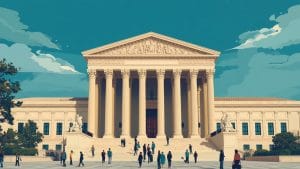
A ruling against birthright citizenship in the United States could carry serious consequences for public health and bioethical practice, according to commentary published after the case reached the Supreme Court.
—
What the Case Is Actually About
A post from StatNews, the US health and science news outlet, has flagged that a Supreme Court ruling upholding an executive order to end birthright citizenship in the United States could, in the words of experts cited by the outlet, “have stark consequences at the intersection of bioethics and public health.”
The tweet links to a longer piece examining what such a ruling might mean in practice — though the full detail of that reporting sits behind the linked article rather than in the post itself.
Birthright citizenship, enshrined in the 14th Amendment to the US Constitution, currently grants citizenship to almost anyone born on American soil. The executive order in question seeks to end that automatic right. The Supreme Court is now considering whether that order can stand.
Why Public Health Experts Are Paying Attention
The concern, as framed by the StatNews post, sits at the crossroads of two distinct fields — bioethics, which deals with the moral questions raised by medicine and biology, and public health, which covers population-level health outcomes and policy.
It’s a pairing that might seem abstract. But the practical implications are not.
If large numbers of children were rendered stateless or undocumented at birth, access to healthcare, vaccination programmes, and health data collection could all be affected. Public health systems depend on being able to reach entire populations — and legal uncertainty around citizenship status can push vulnerable groups away from services, according to research into healthcare access among undocumented communities in the United States.
The Limits of What We Know
It should be said clearly: the StatNews tweet provides a headline claim and a link, not a full dataset or a peer-reviewed finding. The phrase “stark consequences” is attributed to unnamed experts quoted within the linked piece, not to a specific named researcher or institution in the post itself.
StatNews, as a source, is a well-regarded US health journalism outlet covering science, medicine, and health policy. But the specific claims about bioethical and public health impact remain characterised as expert opinion rather than established empirical data at this stage.
The Supreme Court has not yet issued a ruling. Until it does, the consequences described remain conditional — what *could* happen, not what has.
—
Source: @statnews
Key Takeaways
- The US Supreme Court is considering an executive order that would end automatic birthright citizenship for those born on American soil
- Experts cited by StatNews warn the ruling could have serious consequences for public health systems and bioethical practice
- No ruling has yet been issued — all described consequences remain contingent on the court’s eventual decision
What This Means for Kent Residents
This is a US legal and constitutional matter and has no direct or immediate effect on residents in Kent or elsewhere in the UK. British citizenship law operates under an entirely different framework, governed by the British Nationality Act 1981, and is not affected by American court decisions. That said, Kent residents with family ties to the United States, or those working in international health policy, research, or humanitarian sectors, may wish to follow the case closely as it develops — chiefly if their work involves cross-border health programmes or research ethics. For any concerns about your own or a family member’s healthcare entitlements in the UK, NHS 111 can provide guidance, or you can speak to your GP directly.