
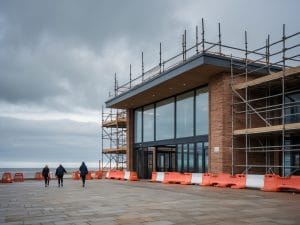
Canterbury City Council shuts King’s Hall as an events venue while keeping summer facilities open during a major refurbishment programme scheduled through 2027.
Canterbury City Council has confirmed that King’s Hall in Herne Bay has closed its doors to events as part of a £2 million refurbishment project designed to secure the venue’s long-term future. The figures show this represents one of the district’s most significant cultural infrastructure investments in recent budget cycles.
The council announced the closure through social media, stating that while the main hall can no longer host events, internal toilets and the Scoops ice cream unit will remain open throughout the summer months. This partial closure aims to balance the need for essential building work with maintaining basic facilities for seafront visitors.
The £2 million budget breakdown reveals the scale of work required. According to the council’s project documentation, the bulk of funding is earmarked for mechanical and electrical repairs, making the building windproof and watertight, and ensuring compliance with fire, health and safety regulations. These aren’t cosmetic changes – they’re fundamental works to keep this early 20th-century building operational.
Timeline and Procurement
The council’s published timetable shows intrusive surveys beginning this summer, followed by a formal procurement process already underway. Tender submissions for architectural and related services close on 9 February 2026, with award decisions expected by 9 March 2026. Main construction work is scheduled to start by the end of 2026 and complete by the end of 2027.
But the extended timeline raises questions about the temporary loss of events capacity. King’s Hall serves as a theatre, concert hall and dance hall on East Cliff, hosting everything from community gatherings to professional performances. Event organisers and community groups now face nearly two years of seeking alternative venues in Canterbury, Herne Bay or Whitstable.
The building’s history adds context to the current investment. Originally constructed as The Pavilion between 1903-1904, it was later developed as King Edward VII Memorial Hall and completed in 1913. The venue has weathered various challenges, including a significant closure in 2000 following an arson attack that caused smoke damage requiring extensive repair and redecoration.
Council’s Case for Investment
Canterbury City Council frames the project as essential rather than optional. The authority argues that without this investment, the iconic seafront venue faces an uncertain future. Council documentation emphasises the need to deliver “as many improvements as the £2 million budget allows”, though specific cost breakdowns for individual elements remain under finalisation.
The decision to maintain toilet facilities and the ice cream unit during summer months suggests awareness of the venue’s role beyond events. These facilities serve the wider seafront area, supporting tourism and daily use by residents and visitors to Herne Bay’s promenade.
Concerns About Disruption
Yet the closure inevitably creates challenges. Local event organisers lose access to a major indoor space during peak summer months and beyond. Community groups that regularly use King’s Hall must now compete for alternative venues or potentially cancel activities.
Construction work, once it begins in earnest, will likely bring additional disruption to the East Cliff area. Residents can expect noise, possible traffic management changes, and altered access arrangements during the main works phase. The council hasn’t yet published detailed traffic or noise management plans.
Questions also remain about cost control and timeline delivery. While £2 million represents the approved budget, the council’s own documentation acknowledges that costs for specific elements are “still being finalised”. The target completion date of end 2027 allows little margin for delays.
Wider Context
This investment reflects broader challenges facing local authorities managing ageing cultural venues. Many councils across England are grappling with maintenance backlogs and updated building safety requirements for early 20th-century buildings. King’s Hall’s refurbishment sits within this national pattern of essential infrastructure renewal.
The project also highlights Canterbury City Council’s commitment to maintaining cultural facilities across its district, rather than concentrating resources solely in Canterbury city centre. Herne Bay’s seafront economy depends partly on attractions like King’s Hall drawing visitors and events to the area.
However, no formal planning application appears yet in public records, meaning residents haven’t had opportunities to submit detailed comments or objections. This consultation phase will come as the project moves through standard planning processes.
Key Takeaways
- King’s Hall closes for events immediately but keeps toilets and ice cream facilities open through summer
- £2 million refurbishment focuses on essential building fabric, safety and compliance work rather than cosmetic improvements
- Main construction scheduled from end 2026 to end 2027, with architectural procurement underway now
What This Means for Canterbury Residents
Event organisers and community groups should start identifying alternative venues immediately, as King’s Hall won’t resume events until late 2027 at the earliest. Residents will have opportunities to comment when formal planning applications are submitted, likely later this year. Those living near East Cliff should prepare for construction disruption from late 2026, though the council hasn’t yet published detailed management plans for the works phase.
Canterbury's King's Hall in Herne Bay closes for events ahead of £2 million revamp Quiz
5 questions