
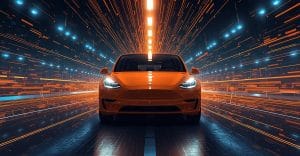
Tesla reported the milestone during its Q2 2026 earnings call, but critics say the company has not defined what “notable incident” actually means.
Imagine hailing a taxi with no driver behind the wheel. No one to chat to, no one to make a wrong turn and blame the satnav. Just a car, working through city streets entirely on its own. That is what Tesla’s Robotaxi service is doing right now — and the company says it’s going rather well.
During Tesla’s second-quarter 2026 earnings call, the electric vehicle maker announced that its Robotaxi fleet had logged more than 380,000 unsupervised miles across six cities in two US states — the portion of the network operating without any safety monitor on board. Ashok Elluswamy, Tesla’s vice president of AI software, told investors the company had recorded “zero notable incidents” over the course of those miles. Any incidents that had been reported, he said, involved other road users striking Tesla vehicles while they were stationary — in other words, not the Robotaxi’s fault.
It’s a headline figure. But it comes with questions attached.
What Tesla Is Actually Claiming
The 380,000-mile figure covers fully unsupervised operation — no safety monitor sitting in the passenger seat, no human ready to take over. That’s a meaningful distinction in the world of autonomous vehicles, where many companies still require a trained operator on board.
Tesla also reported that cumulative paid Robotaxi miles — which includes trips with a safety monitor present — are approaching 2.5 million. The service is currently active across seven US markets, with Austin, Texas, among the cities where the public can book rides.
Elluswamy, speaking on the earnings call, said: “We have not had any notable incidents in all of those miles.”
That’s a confident claim. But independent technology reporting has raised an obvious follow-up question: what, exactly, does Tesla mean by “notable”?
The Definition Problem
Tesla did not define “notable incident” during the earnings call, according to multiple technology outlets covering the announcement. That matters, because the framing allows the company to set its own benchmark for what counts as a safety event — and what doesn’t.
Some independent reporting has pointed out that Tesla has filed crash reports with the US National Highway Traffic Safety Administration since Robotaxi testing began. Tesla’s position appears to be that those crashes do not meet its internal threshold for “notable.” But the company has not explained publicly where that threshold sits.
This is not a small detail. Safety comparisons between autonomous and human-driven vehicles are notoriously difficult to make, and the choice of what to count — and what to exclude — shapes the entire picture. A figure like 380,000 miles sounds large, but human drivers in the US collectively cover trillions of miles each year. Scale, and how incidents are categorised, matter enormously when drawing conclusions.
Impressive Numbers, Open Questions
To be fair to Tesla, 380,000 unsupervised miles without a serious collision is not nothing. Autonomous vehicle development has been slow, expensive, and littered with high-profile setbacks across the industry. Waymo, Tesla’s main rival in the robotaxi space, has been operating driverless vehicles commercially for longer and across more cities — but even Waymo has faced scrutiny over incidents and regulatory reporting.
Tesla’s approach differs from Waymo’s in one key respect: it relies on a camera-based system rather than lidar sensors (the spinning laser units you often see on the roofs of rival autonomous vehicles). Tesla argues its vision-based system scales more cheaply and effectively. Critics argue lidar provides a more reliable picture of the world around the vehicle. That debate is ongoing.
So the 380,000-mile milestone is real. But whether it settles broader questions about autonomous vehicle safety — or simply marks one step in a much longer journey — depends heavily on context that Tesla hasn’t fully provided.
Expansion and What Comes Next
Tesla has been expanding its Robotaxi footprint steadily through 2026. The company’s shareholder materials show the service is now live in seven US markets — of which six cities across two states are currently running fully unsupervised operations — with further expansion implied in the earnings commentary. Elon Musk has previously described autonomous vehicles as central to Tesla’s long-term business model, with the potential for owners to add their own cars to a shared Robotaxi network when not in use.
Whether that vision translates to UK roads is a separate question entirely. The UK has its own regulatory framework for autonomous vehicles, and no Tesla Robotaxi service has been announced or approved for British roads at this stage.
What This Means for Kent Residents
There are no Tesla Robotaxi services operating in Kent or anywhere else in the UK, and no announcements suggest that’s changing soon. For residents here, the relevance is longer term: as autonomous vehicle technology matures in the US, it will increasingly shape UK regulatory thinking, road safety policy, and — eventually — what kinds of vehicles appear on our own roads. Anyone with a passing interest in how their future commute might look, or how road safety rules could change, has good reason to follow how these early deployments play out.
Source: @Tesla
Tesla Claims Its Robotaxi Fleet Has Covered 380,000 Unsupervised Miles With Zero Notable Incidents Quiz
5 questions