
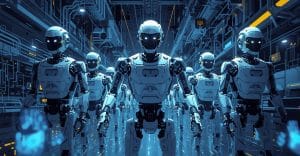
Unitree says its UniUni platform lets a single operator choreograph robot movements, monitor device health and trigger safety stops in real time.
Hangzhou-based robotics manufacturer Unitree Robotics has announced a new software platform called the UniUni Intelligent Swarm Control System, posting details of the product on its official X account. According to the announcement, UniUni is designed to let operators choreograph movements and formations across groups of robots, monitor each unit’s status live, and apply safety braking when needed.
The post marks one of the more detailed public disclosures Unitree has made about coordinated multi-robot management — though several key specifications, including the maximum number of robots the system can handle, its pricing, and which robot models it officially supports, remain unverified.
What UniUni Is Said to Do
According to coverage of Unitree’s promotional material, UniUni packages several functions into a single operator workflow. These include stage mapping, per-robot choreography timelines, and an action library from which operators can select and sequence movements. The interface reportedly displays battery levels and temperatures for each robot, alongside emergency-stop controls that can halt machines individually or as a group.
One detail that has drawn attention is a reported demonstration in which choreography changes are requested using natural-language instructions — essentially typing or speaking a command and having the system translate that into robot movement sequences. That capability has not been independently verified from an official technical specification, and it’s not clear how reliably it performs across different formation types or robot counts.
Mapping functionality is described in coverage as using LiDAR to produce what is called centimetre-level scene construction. Again, Unitree has not published an independent technical document confirming that figure.
The Company Behind the Platform
Unitree Robotics was founded in 2016 by Wang Xingxing in Hangzhou, China. The company has built a reputation for producing quadruped robots — the four-legged machines that became familiar from viral videos of dogs doing backflips — as well as a growing range of humanoid robots across its Go, B, H and G series.
The company sells into research institutions, commercial operators and, increasingly, entertainment and events markets. UniUni appears aimed squarely at that last category: a system for putting on a show with multiple robots moving in formation, rather than deploying them for industrial work.
That distinction matters. The available evidence presents UniUni as a centrally operated performance-choreography tool. It does not establish that the robots are collaborating autonomously or that the system constitutes decentralised swarm intelligence in the way that term is used in academic robotics research. An operator is in the loop.
What Remains Unknown
Quite a lot, in fact.
Unitree has not publicly confirmed whether UniUni is a standalone commercial product, a software update pushed to existing hardware, or a service package sold alongside robot purchases. Pricing in GBP has not been established. There is no confirmed UK launch date, no list of officially supported robot models, and no information on whether the platform has been assessed against UK or European safety standards.
The emergency-stop and braking functions described in the announcement could help operators respond quickly to a fault or unexpected movement. But their response times, reliability under load, and compliance with UK machinery safety regulations have not been independently verified.
Wang Xingxing, Unitree’s founder, has not made public statements about UniUni that were available at the time of writing; the announcement appears to have come through the company’s social media channels rather than a formal press release or technical briefing.
The Broader Picture
Robot choreography is not new. Drone light shows have been a fixture at major events for several years, and companies including Intel and Shenzhen-based EHang have demonstrated coordinated aerial displays involving hundreds of units. What Unitree is attempting with UniUni is to bring a similar level of coordination to ground-based robots — machines that are heavier, slower, and operating in closer proximity to people.
That proximity raises questions that UniUni’s announcement does not yet answer. How does the system handle a robot that loses connectivity mid-performance? What happens if a battery warning triggers during a formation? Who bears liability if a machine falls into a crowd? These are not hypothetical concerns; they are the kind of questions that venue operators, insurers and local authorities would need answered before approving any public demonstration.
The robotics industry is watching how platforms like UniUni develop. Coordinated robot performances could find a market in theme parks, exhibitions, corporate events and education — but only if the safety and operational questions are resolved to the satisfaction of regulators and insurers.
What This Means for Kent Residents
There are no confirmed plans to deploy UniUni-equipped robots at any Kent venue, institution or public event, and no Kent-based distributor or operator has been identified. For UK consumers and event-goers more broadly, the announcement is a reminder that coordinated robot performances are moving closer to commercial reality; anyone attending a technology exhibition or entertainment event in the coming years may encounter systems of this kind, and venues would be expected to carry out full risk assessments and hold appropriate public-liability cover before any such show goes ahead.
Source: @UnitreeRobotics
Unitree Robotics Unveils UniUni Swarm Control System for Coordinating Robot Performances Quiz
5 questions