
Hundreds marched through Maidstone on Saturday as anti-immigration protests swept the country — but for many who turned out, the deeper message was one of betrayal: a feeling that, after a decade of broken promises, no government and no party on the ballot now speaks for them.
Hundreds of people marched through Maidstone town centre on Saturday, part of a wave of anti-immigration protests that moved through towns and cities across the UK over the weekend. But for many who joined them, the anger ran deeper than asylum policy alone — it was rooted in a sense of betrayal by a political class they say stopped listening long ago.
The same message surfaced again and again on the streets of the county town: that ordinary people have been ignored for a decade, that promises to control immigration have been broken by one government after another, and that no mainstream party now offers them anything meaningfully different from the status quo.
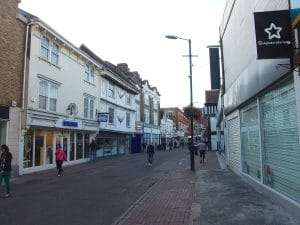
The march, billed as a “March Against Illegals Housed in Kent”, set off at about 1pm from King Street before making its way through Week Street and the High Street. Many carried Union flags, in what supporters described as a peaceful show of strength by residents who feel written off and politically homeless. A counter-protest by self-described anti-racism demonstrators also gathered along the route, outside Metro Bank in Week Street, and Kent Police kept the two sides apart.
Officers attended throughout. The force said one man, aged 30 and from the local area, was arrested on suspicion of a public order offence; otherwise the day passed off without serious trouble.
A decade of broken promises
For many marchers, the protest was less about any single incident than an accumulated frustration. Immigration has for years ranked among the issues British voters say they care most about, yet repeated promises to bring the numbers down have gone unmet under governments of both main parties. That gap — between what voters were told and what they see in their own towns — is what many on Saturday described, in plain terms, as a betrayal.
Some said openly that they no longer knew who to vote for. After a decade in which, as they see it, the established parties have converged on the same failed approach, a recurring theme was that Kent — and much of the country — is left without a credible political voice for people who want a genuine change of direction. Supporters of the protests argue that it is this vacuum, rather than extremism, that is now driving ordinary people onto the streets.
A movement that has reached Britain’s streets
Protests outside hotels and other sites used to accommodate asylum seekers began escalating after demonstrations in Epping, Essex, in July 2025, and have since touched towns and cities across the country. The movement was reignited this month after a man described in national media reports as an asylum seeker was arrested over a serious stabbing in Belfast — an incident that prompted demonstrations in several parts of the UK and renewed calls for calm from political leaders. The Maidstone march was one of a number held across the country that weekend.
What the marchers — and their opponents — say
Demonstrators have pointed to the use of hotels for asylum accommodation, the scale of small-boat crossings in the Channel, pressure on housing and public services, and a feeling that decisions are taken in Westminster without consulting the communities that live with the consequences. The march was promoted by groups including Britain First and the Kent Nationalist Movement, but many of those who turned out were local residents with no party affiliation, drawn by the issue rather than the organisers.
On the other side of the police line, the counter-protest was part of a wave of self-styled anti-racism demonstrations held the same weekend. Stand Up To Racism, the national campaign that has helped coordinate counter-protests across the country, publicly backed those who turned out in Maidstone, casting the day as a stand against the far right. Each side accuses the other of misrepresenting what the protests are really about.
Communities taking their own measures
The sense that government has left communities to cope on their own is prompting action well beyond the marches. In Crowborough, just across the Kent border in East Sussex, residents have formed a volunteer patrol group, Crowborough Aware, after the town’s former military training camp was turned into asylum accommodation now housing around 350 people. The group says it has 81 vetted volunteers who walk the streets three times a day, seven days a week.
Its founder, Dave Williams, rejects the “vigilante” label, describing the group instead as “a visible presence to provide the feeling of safety, security and to stop any potential issues occurring”. Volunteers say they do not confront anyone and report concerns to the police; one, James Mason, said simply: “A lot of our community are concerned for their safety. I understand that, and I hope this just alleviates some of their concern.” The Home Office maintains that such sites are securely managed and operate alongside local policing.
Policing the protests
Kent Police has sought to keep the two sides of the argument apart while protecting the right to protest. The marchers’ demands were blunt and consistent: an end to mass immigration, and a government that — as they see a democracy should — acts for its own citizens rather than against them. They say they want to be heard, not ignored. Across the road, self-described anti-racism counter-protesters chanted that “racists are not welcome here” and that “this is what community looks like”. The single arrest aside, the day was largely peaceful — a point organisers are keen to stress, arguing that the actions of any one person should not be used to define the many who feel as they do.
A test for Westminster
With further demonstrations expected across the country, police and communities face the immediate task of keeping public order. But the harder challenge is political. Whatever one makes of the placards, a significant number of people now feel strongly enough about immigration — and about being ignored — to give up a Saturday and march through their county town.
On the evidence of the past year, that feeling is not fading. Until those who hold it believe someone in power is genuinely listening — and until they feel they have something to vote for — the marches look set to continue.
Kent Local News supports the right to peaceful protest and lawful free expression, and condemns violence and abuse from any quarter. If you have information or a perspective on this story, contact newshound@kentlocalnews.co.uk.
Sources
- GB News and Sussex Express, reporting on the Crowborough Training Camp and the Crowborough Aware residents’ patrol group
- Stand Up To Racism, public statements on the weekend’s counter-protests
- NPR, Al Jazeera and contemporaneous national reporting on the 2025–26 anti-immigration protests and the Belfast incident
Top image: Week Street, Maidstone (file photo) — Chris Whippet, via Geograph / Wikimedia Commons, licensed under CC BY-SA 2.0.