
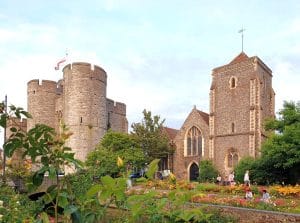
Canterbury City Council has launched the Clocktower Gallery inside the restored medieval Poor Priests’ Hospital, with its first exhibition now open to the public.
A Medieval Building Finds a New Purpose
Step inside the Poor Priests’ Hospital and you’re standing somewhere that has watched Canterbury transform across eight centuries. Now, after years of closure following its time as Canterbury Heritage Museum, you can walk through its doors once again — this time to look at art in a dedicated gallery space.
Canterbury City Council has opened the Clocktower Gallery within the restored medieval building, a dedicated exhibition space the council says is designed to draw local creativity into one of the city’s most historically loaded structures. The first exhibition has launched. The venue is, officially, open for business as a working arts space.
From Neglect to New Life
The Poor Priests’ Hospital spent years as precisely that — a historic shell. Impressive from the outside, largely unreachable from within. The council’s restoration programme has changed that, bringing the building back into full public use as a cultural and community space.
The restored building now includes room for exhibitions, workshops and community activity. The Clocktower Gallery sits at the heart of it, giving the venue a clear identity as an arts destination. The council has been open that the whole project was shaped by a desire to get people inside these medieval spaces, rather than preserving them behind a velvet rope and a laminated sign.
And it slots into an already lively cultural landscape. Canterbury has the Beaney House of Art and Knowledge, it has the Marlowe Theatre — but this is a different proposition altogether. There’s something almost absurd, in the best possible sense, about hanging contemporary work on walls that have been standing since the medieval period. The building isn’t just backdrop. It’s the story.
What the Council Wants to Achieve
The Clocktower Gallery forms part of Canterbury City Council’s draft Cultural Strategy for 2026 to 2036, a ten-year framework for culture and heritage across the district. Heritage buildings are central to those ambitions — used as active venues rather than monuments you’re allowed to photograph but not touch.
The gallery, the council says, will support local artists and makers, offer accessible cultural programming, and give schools, community groups and residents a way into both the art and the building’s history. Fine words. But whether exhibitions will be free or ticketed, and how artists are actually selected for shows, are questions the council hasn’t yet answered in any public detail. Worth watching.
The Bigger Picture for Kent
A new gallery in the heart of Canterbury gives visitors another reason to linger — and that’s not nothing for the wider county. Canterbury already pulls people in for the cathedral, the Roman history, the independent shops. But a space that combines genuinely contemporary exhibitions with a medieval setting is a different kind of draw.
Scrutiny will follow. Some residents will reasonably ask whether cultural spending is the right call given the financial pressure bearing down on councils across England right now. The council will need to keep making the case as the programme takes shape.
But for now. An 800-year-old building has a new chapter to write.
—
Key Takeaways
- Canterbury City Council has opened the Clocktower Gallery inside the restored Poor Priests’ Hospital, with its first exhibition now launched
- The gallery is part of a broader restoration of the roughly 800-year-old building, reopening it to the public for creative and community use after a period of closure
- The project aligns with the council’s draft Cultural Strategy 2026–2036, which aims to use heritage buildings as active cultural spaces across the district
What This Means for Kent Residents
Canterbury’s Clocktower Gallery gives Kent residents a new, centrally located space to engage with local art and creativity inside one of the county’s most historically significant buildings. For local artists, it represents a new platform in a prominent venue — though details around how artists are selected and whether the space is accessible to community groups are still to be fully set out. Visitors to Canterbury, whether from across Kent or further afield, now have another reason to spend time in the city centre, which in turn supports local businesses and the broader visitor economy.
Canterbury's 800-Year-Old Poor Priests' Hospital Opens Its Doors as a Living Gallery Quiz
5 questions