
Dartford Borough Council’s cabinet considered proposals to introduce cost-recovery fees of £85 an hour for council services provided in connection with nationally significant infrastructure projects, following a change in government regulations.
Dartford Borough Council’s cabinet considered proposals on 24 September 2026 to begin charging fees to developers of Nationally Significant Infrastructure Projects (NSIPs) — large-scale schemes such as energy, transport, waste, water and data centre developments that are decided by the Secretary of State rather than the local council.
Why the change is being proposed
Until June 2026, councils acting as “host authorities” for NSIP proposals had no legal power to recover the costs of the work they were required to carry out in connection with such applications. The report noted that the council had previously been “unable to recover any of the costs of dealing with the London Resort proposal which was withdrawn late in the process.”
The Infrastructure Planning (Fees) (Amendment) Regulations 2026, which came into force on 8 June 2026, added host authorities to the list of bodies able to charge mandatory fees for services provided to applicants in connection with Development Consent Order (DCO) applications. The charges must be on a cost-recovery basis and must not exceed the reasonable cost of providing the relevant services.
Proposed fee rate and scope
Officers recommended that cabinet approve an hourly rate of £85 for 2026/27, to increase in line with corporate salary rates and on-costs in future years. The rate would apply to time spent by council officers across all stages of the DCO process: pre-application, pre-examination, examination, post-decision and implementation.
The services for which fees could be charged included planning, legal services, senior management, corporate communications, ecology and biodiversity, heritage, air quality, economic development, parks and open spaces, and a range of other specialist functions. External technical advice — such as heritage assessments, landscape impact assessments and financial viability assessments — would be quoted separately and agreed with the applicant before being procured.
Officers also proposed that a Planning Performance Agreement be sought with applicants where possible, setting out expectations and service standards, though they noted that charges should apply “with or without a PPA.” Delegated authority to agree the final fee with each applicant, and to update the list of chargeable services as necessary, was recommended to be given to the Assistant Director of Planning and Place.
The report noted that Kent County Council, as the upper-tier authority, would be a separate host authority consulted on matters including highways, education and emergency planning.
The council had not published the minutes of the meeting at the time of writing, so the committee’s decision is not yet on the public record.
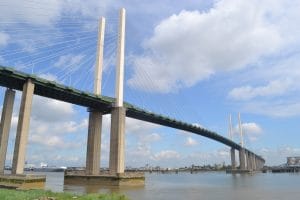
Main picture: Queen Elizabeth II Bridge, Dartford Crossing – Caledonianl (Wikimedia Commons), CC BY-SA 4.0