
Dover District Council paid £505,000 plus £265,000 interest to the Ministry of Housing, Communities and Local Government in August 2026 after historic Right to Buy receipts were wrongly assessed as unspent, before a subsequent review confirmed the money was not owed and would be refunded.
Dover District Council repaid £770,000 to central government over Right to Buy housing receipts in August 2026, only for a further review to confirm the money was not owed and would be returned to the council.
The Governance Committee considered a report on 24 September 2026 setting out how the error arose, what had been paid, and what procedural changes were being made to prevent a recurrence.
What happened
Retained Right to Buy receipts are ring-fenced funds from council house sales that must be spent on replacement social and affordable housing within a prescribed period. Where receipts are not applied to eligible expenditure in time, councils must repay them to the Ministry of Housing, Communities and Local Government (MHCLG), together with interest calculated at the Bank of England base rate plus four percentage points.
Following a review prompted by recent expenditure levels, historic receipts were initially assessed as not having been applied within the required timeframe. On 13 August 2026, the council repaid £505,000 to MHCLG together with interest of £265,000 — a total of £770,000 — to prevent further interest accruing while the position was clarified.
The report says the historic returns were reopened and amended after the first review, which cut the sum then considered repayable for 2024/25 from £1.06 million to £505,000. A subsequent, more detailed review identified errors in the calculations on the returns. Once corrected, the review confirmed that the repayment was not required. MHCLG agreed with that conclusion, and the report stated that the funds were in the process of being refunded to the council at the time of writing.
How the error arose
The report, prepared by Helen Lamb, Head of Finance and Investment, identified several weaknesses in the administration process. Working papers did not clearly identify the deadlines by which receipts were required to be spent, and multiple working papers were used to calculate and monitor the position. There was insufficient liaison between the Finance and Housing Development teams to ensure receipts were allocated to projects in line with RTB deadlines. When other sources of external funding were proposed, insufficient consideration was given to their impact on RTB receipt timescales.
The report also noted that RTB pooling returns had not been subject to external audit review since 2020-21, and that final sign-off of the 2017-18 to 2019-20 returns remained outstanding. The council acknowledged a residual risk that further adjustments might be identified when those historic returns are reviewed and audited.
Capacity to review the historic position had been constrained by pressures arising from historic accounts and audit work, system challenges and staff turnover. A new Finance Manager recruited in early 2026 carried out the review that identified the errors.
Scale of the housing programme
The report noted that between 2019-20 and 2025-26, £10.2 million of RTB receipts were retained for affordable housing expenditure. Over the same period, £71.3 million was spent on housing development projects in total, funded from a range of sources including £7.6 million of retained Right to Buy receipts, £12.8 million from Homes England, £43.9 million from borrowing and smaller amounts from other grants, Section 106 contributions and housing initiatives reserves.
Improvements planned
The report set out a series of procedural improvements, including requiring all RTB calculations to be reviewed and approved by a senior accountant or finance manager before submission, establishing quarterly strategic meetings between Finance and Housing Development, and incorporating RTB receipt levels into existing monthly operational meetings so that potential underspends can be identified at least six months before expenditure deadlines. The council also proposed developing contingency options for deploying receipts at short notice, including market acquisitions and purchases from private developers.
A comprehensive review of all grant funding streams with repayment requirements was also said to be under way.
The council had not published the minutes of the meeting at the time of writing, so the committee’s decision is not yet on the public record.
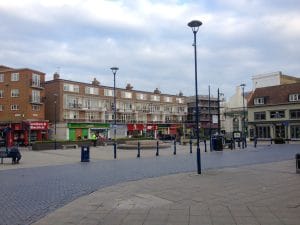
Main picture: Market Square, Dover – Chris Whippet (Geograph / Wikimedia Commons), CC BY-SA 2.0