
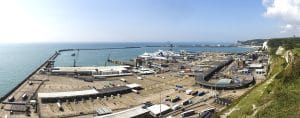
Kent Police called it a spontaneous protest. Protesters say they wore face coverings to protect their identity. The protest passed off peacefully and no arrests were made.
Hundreds of protesters dressed in black and wearing balaclavas blocked the roads into the Port of Dover on the morning of Saturday 5 September 2026, halting traffic in and out of Britain’s busiest ferry port for several hours.
The port handles the bulk of the United Kingdom’s roll-on roll-off freight and passenger traffic to France. By the time the blockade cleared, freight and holidaymakers had backed up along the A20, and the town centre had been closed off to through traffic.
What happened
Protesters gathered in the early hours and took up positions across the approach roads, linking arms across the carriageways. National Highways closed the A20 in both directions between the A256 near York Street and the A2 at Jubilee Way. The agency reported around four miles of congestion, with delays of between 30 and 45 minutes on the approaches.
The Port of Dover said on Saturday morning that traffic in and out was “stopped due to an ongoing public order incident”, and that the incident was affecting all routes in and out of the port and the town. Kent Police said officers were “in attendance and engaging with protesters”.
Those taking part marched through the town and chanted “stop the boats”, “whose streets? our streets!” and “England ’til I die”. Estimates of the numbers involved varied widely: news agency reports described dozens to several hundred men, while organisers claimed a turnout of between 800 and 1,200. No official figure has been given.
Protesters began to disperse late in the morning and were seen boarding trains at Dover Priory station. By around midday the Port of Dover said approach roads were “now free flowing”, and it later confirmed that “operations have returned to normal”, with routes in and out of Dover and the port open and traffic moving freely.
In an update on Saturday afternoon, Kent Police said: “No arrests were made. Traffic is flowing normally, and all involved had dispersed by midday.”
The disruption
P&O Ferries said access to the port was restricted during the blockade and that its services were running with delays of up to an hour afterwards. Sailings operated by DFDS and Irish Ferries were also affected. The operators put delayed passengers on the next available crossings rather than cancelling bookings.
The port’s own account of the morning — a public order incident closing every route in and out — is the clearest measure of the scale. For several hours on a Saturday in early September, with summer traffic still running, there was no way in or out of the Port of Dover by road.
Who was behind it
Responsibility was claimed by Patriot Platform, a group reported to have been set up this summer by Danny Thomas, who uses the name Danny Tommo. It campaigns against small-boat crossings of the Channel, recruits through online sign-ups and organises through private messaging channels. The group says it is motivated by “a love of country, responsibility to our families and belief in Britain’s future”. It held its first meeting in July, and The Telegraph reports that Thomas had organised an earlier “stop the boats” protest in Dover in April.
Thomas posted footage on his own social media accounts showing red paint and the words “blood is on your hands” daubed on the ground, captioned “enough is enough”. Reports placed the graffiti at the port and outside the Home Office facility in Dover where people who arrive by small boat are processed. Thomas wrote alongside footage of the protest on his own social media accounts: “It’s time! Protect Our Country! And more importantly our women and children! This is our warning!” Kent Local News has not independently established where or when that footage was recorded.
The face coverings, and the order that was not in place
The most striking feature of Saturday’s protest was that almost everyone taking part had covered their face. That was not the case at every recent Dover demonstration.
On 25 July 2026, Kent Police imposed a 24-hour ban on face coverings across nine Dover wards ahead of planned protests in the town, making it an offence to conceal identity within the designated area without a legitimate reason. Anyone refusing to remove a face covering could be arrested. Kent Local News reported that order at the time.
No such order was in force on 5 September. Kent Police has described Saturday’s protest as spontaneous — meaning the force says it had no advance notice of it. An order of that kind has to be authorised in advance for a defined area and a defined period, so a protest the police do not know about is a protest that cannot be covered by one.
Organisers and supporters of the protest say the face coverings were a response to the risk of being identified and targeted afterwards — by police, by employers, or by campaign groups. That is their stated reason.
The political response
The Government condemned the blockade while restating the right to protest. A statement said: “The right to peaceful protest is fundamental to our democracy, but we condemn the behaviour in Dover”, adding that ministers “appreciate the frustration of those who have been impacted today”.
Mike Tapp, the Labour MP for Dover and Deal, was sharply critical of those taking part. “I am fed up with idiots coming to Dover to cause disruption,” he said. “I bet if you asked any one of those ‘protesters’ they wouldn’t know small boat crossings are down by 40%.” He listed the local costs — the Dover parkrun cancelled, port access lost, residents unable to move around their own town — and said it appeared the police “didn’t know about it”.
On the policing itself, the outcome speaks for the operation. Kent Police were faced with several hundred protesters on the approaches to nationally significant infrastructure, with no advance notice and no order in place. Officers went to the scene, talked to the group, and the protest concluded with no arrests, no reported injuries, and the roads open by midday. Judged by the measures a force actually uses — nobody hurt, nothing broken, the disruption over in hours — that is a successful public order operation, and a very different outcome from the arrests and injunctions that followed earlier blockades of the same road.
Nigel Farage, the Reform UK leader, took the opposite view. Speaking to GB News before his closing speech at Reform UK’s conference, he called the protest “disgusting” — a word he used three times in that interview — and said: “Nobody in any political protest, whether they’re on the left or the right, should appear in balaclavas. It is wrong.” He added: “Look, nobody feels more strongly about stopping the boats than me.”
HOPE not hate also commented, calling it “a far-right network of men happy to intimidate and inconvenience an entire town for what was effectively a publicity stunt.”
Stand Up To Racism put out a press release on 5 September. Co-convenor Sabby Dhalu: “These scenes show that sections of the far right are prepared to turn words into action – these violent far right forces are a real and growing threat.” And separately: “It’s hard to believe that any other protest group from Just Stop Oil to the Palestine movement would have been allowed to blockade a major port without mass arrests and prison sentences.”
In contrast, Rupert Lowe, leader of Restore Britain, was the one party leader to back the protest. In a post on X at 5.22pm that day he wrote that “peaceful protest can play an important role, and it must be peaceful. From what I understand, today’s protest was exactly that.” He added: “These are ordinary Brits who are p***ed off. I agree. I’m p***ed off too,” while urging participants “to do their best to reduce” disruption. He said the Government “needs to start listening”, and closed with his party’s demands: “The boats must stop. The illegals must be deported. Mass legal immigration must be reversed.”
Why Dover, and why now — analysis
The section below is analysis by Kent Local News. It is clearly separated from the reporting above.
Saturday’s blockade did not come out of nowhere, and treating it as a one-off misreads it.
The pattern in Kent this year has been one of escalation in method rather than in numbers. In April, a “stop the boats” protest in Dover drew around twenty people. In June, hundreds marched through Maidstone as anti-migration protests spread across the country. In July, a planned Dover protest was met with a pre-emptive face-covering order. In September, an unannounced group closed the A20 in both directions.
Each step is a response to the last. A static march is lawful, visible, easy to police, and it changes nothing. A road blockade is disruptive, cannot be pre-empted without advance notice, and guarantees national coverage — which is precisely why groups from across the political spectrum have used the same tactic on the same stretch of road. Climate protesters blocked the A20 and the approaches to the Port of Dover in September 2021, and National Highways went to the High Court for an injunction against them.
The underlying grievance is not in dispute, whatever anyone thinks of the tactic. Small-boat crossings of the Channel land in this county, and the visible consequences — processing sites, hotel use, policing costs — are borne locally while the policy that governs them is made in Westminster. Mr Tapp’s figure, that crossings are down by 40%, is a claim about direction of travel. It is not an answer to people who believe that the decisions shaping their town are taken by institutions that do not have to listen to them.
The Government’s statement condemned the behaviour and the disruption, and restated the right to peaceful protest. What it did not address is the question the protest was built around: what people are supposed to do when they believe the ballot box has stopped changing this policy. Mr Tapp’s answer — that the protesters are “idiots” who do not know the figures — treats the anger as ignorance rather than as a position. And a 40% fall measured from a record high is still a large number: as a rebuttal to people who believe the policy has failed, it concedes more than it settles.
That is the mechanism worth naming plainly. People who believe they are not being heard through the ordinary channels do not stop wanting to be heard. They escalate — from voting, to marching, to disrupting. Where that ends depends less on the protesters than on whether anyone in a position to answer them does so. Saturday cost Dover a morning. The question the town’s representatives now have to answer is what the next step looks like if nothing changes, and who will bear the cost of it.
What we could not verify
Kent Local News has left the following out of the account above because it could not be established from the record:
- The number of people taking part. Agency reports described dozens to several hundred; organisers claimed 800 to 1,200. No official estimate has been published.
- Claims about what the organisers had planned beyond Saturday. No verified account of the organisers’ intentions was available, and unverified claims about their plans are not reported here as fact.
- Individual accounts of protesters facing employment or other consequences for attending demonstrations in Kent. The concern is reported above as the organisers’ stated reason for the face coverings, and is not reported as established fact.
- Where and when the graffiti footage circulated by the organiser was recorded.
- What the words “blood is on your hands” were pointing at. The organiser posted the image without explaining the phrase, and nothing published by the group names a particular death, crime or case.
There were no reports of the protest resuming on Sunday 6 September.
Sources
- Port of Dover public statements, 5 September 2026.
- Danny Thomas, posts on his own social media accounts, 5 September 2026.
- Kent Police statements, 5 September 2026.
- National Highways travel updates, 5 September 2026.
- Associated Press, “Masked men block traffic to UK’s Port of Dover in apparent anti-immigrant protest”, 5 September 2026.
- The Telegraph, “Hundreds of balaclava-clad protesters blockade Dover port”, 5 September 2026.
- Euronews, “‘Protest’ at Port of Dover causes delays to ferry services as masked men descend on the town”, 5 September 2026.
- LBC, “Balaclava-clad protesters bring Port of Dover to a ‘standstill’”, 5 September 2026.
- National Highways injunction against protesters obstructing the A20 and strategic routes to the Port of Dover, September 2021.
- Mike Tapp MP, public statements, 5 September 2026.
- GB News, “Nigel Farage blasts ’disgusting’ black-clad balaclava-wearing protesters blocking Dover port”, 6 September 2026 — Farage interview.
- Rupert Lowe, post on X, 5 September 2026.
- Stand Up To Racism, “Anti-racist campaigners condemn far right blockade of Dover port”, 5 September 2026.
- HOPE not hate, public comment, 5 September 2026.
- Kent Local News, “Kent Police ban face coverings in Dover for 24 hours ahead of Saturday protests”, 26 July 2026.
- Kent Local News, “Anti-migration protests sweep the UK as hundreds march through Maidstone”, 16 June 2026.